Battle at Bristol: When NASCAR’s Stadium Became a College Football Field
The Battle at Bristol put Tennessee and Virginia Tech inside a NASCAR landmark. Here is how the speedway changed, what the crowd numbers mean and why the night still interests racing fans.
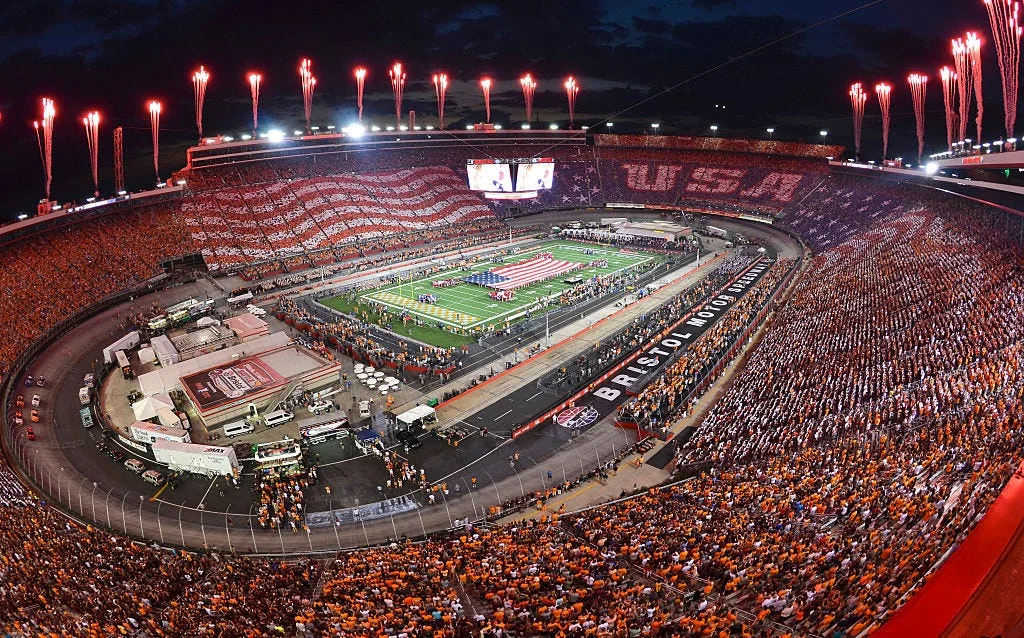
The Battle at Bristol brought Tennessee and Virginia Tech to Bristol Motor Speedway on September 10, 2016, turning its infield into a college football venue for a night that remains part of the track’s identity. Tennessee won 45–24, but the score explains only part of the interest for NASCAR fans. The temporary field, the view from the grandstands and the drivers who wore college colors all tell a more specific story than the crowd photographs alone. Here is what happened, how the conversion worked and where that connection can lead if you want to follow the teams today.
What happened at the Battle at Bristol?
Tennessee beat Virginia Tech 45–24 at Bristol Motor Speedway on September 10, 2016. The Pilot Flying J Battle at Bristol was a regular-season college football game played inside the speedway, with an announced crowd of 156,990. Those three facts explain the photographs that still circulate: this was a real game with a result that counted, staged in the middle of a functioning NASCAR venue.
The football itself was less straightforward than the final margin suggests. Virginia Tech led 14–0 after the first quarter. Tennessee answered with 24 unanswered points in the second quarter and reached halftime ahead 24–14. The Volunteers’ contemporary game report identifies an early second-quarter fumble recovery as the turning point: Micah Abernathy recovered near the Hokies’ goal line, and Joshua Dobbs immediately found Jauan Jennings for a touchdown.
Virginia Tech’s own account makes the cost of mistakes particularly clear. The Hokies gained 400 yards to Tennessee’s 330 but lost five fumbles. That is a useful detail for a racing audience: a final result does not explain itself simply through who appeared faster or gained more ground. Here, possession and field position mattered more than the larger yardage total. It would be misleading, though, to turn the game into an extended racing analogy. Football turnovers were the actual mechanism; there were no stages, pit strategies or championship points involved.
Why two attendance numbers appear
The 156,990 figure is the announced attendance carried in the university accounts and Tennessee’s official box score. Virginia Tech’s report compared it with the previous college football benchmark of 115,109 for Michigan–Notre Dame in 2013. If you are describing the event as it appears in college football records, identify that figure as the announced crowd.
Guinness World Records lists 130,045 for the same Bristol game. Its record page gives the same date, teams and final score, so this is not a second event or a smaller crowd from another weekend. The two institutions publish different attendance totals. Keep each number attached to its source instead of presenting them interchangeably, and do not subtract them to invent a count of empty seats or people turned away.
For NASCAR fans, the enduring significance is the setting as much as the record. The field occupied the space usually associated with the race operation, while the surrounding grandstands remained unmistakably Bristol. The transformation put a familiar sporting landmark to an unfamiliar test: could the scale that makes the speedway such an imposing arena also work for a game concentrated inside a much smaller rectangle?
Building a football field inside a working speedway
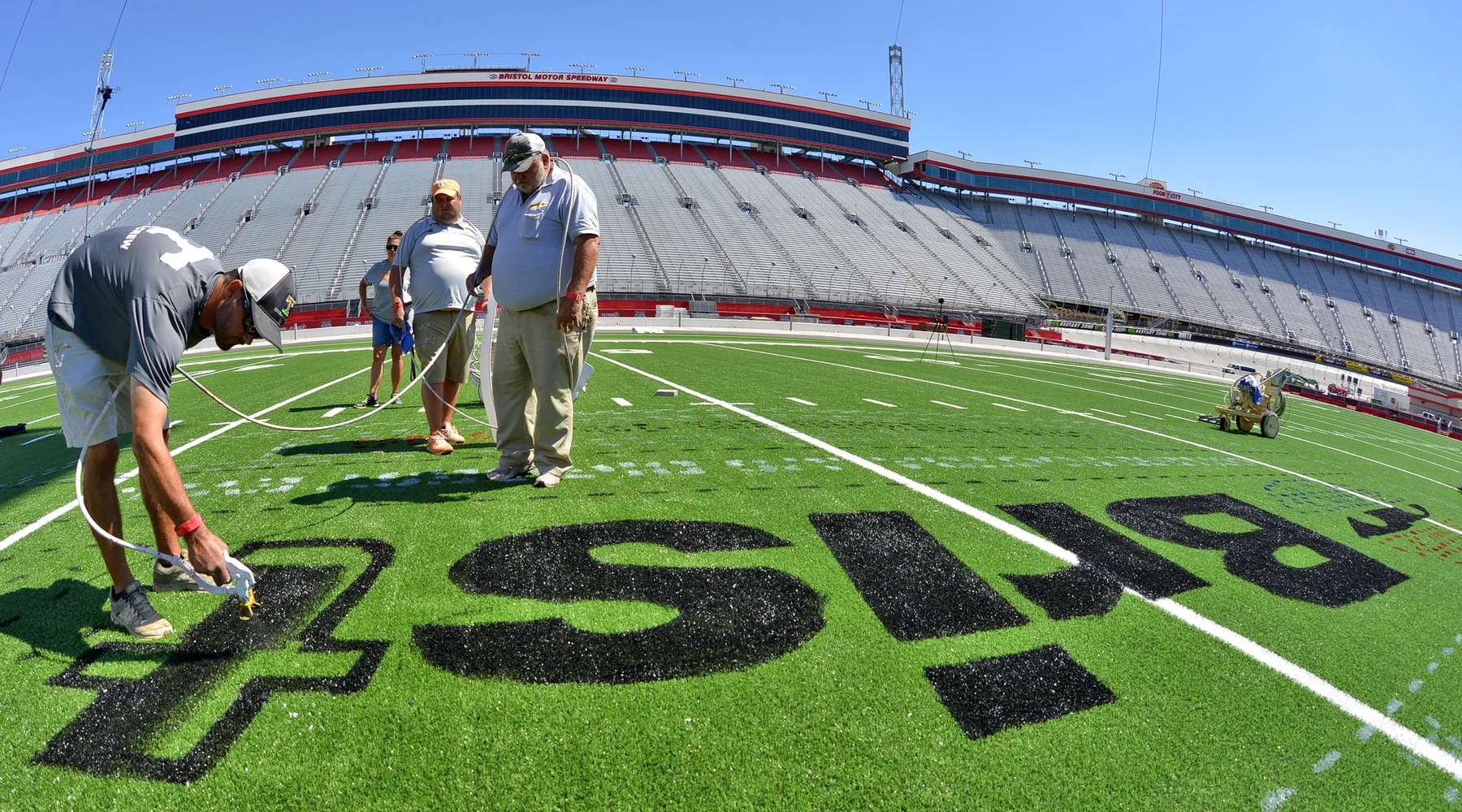
The memorable part of the conversion was green turf appearing inside a concrete oval. The more demanding part was underneath it. Bristol’s infield was not already a football-ready surface awaiting painted lines. In a construction account republished by AstroTurf, track officials explained that the infield normally drained toward its center. The football surface needed a crown that sent water toward the edges. Crews therefore had to build up and shape a suitable base before installing the playing surface.
The plan called for a protective fabric barrier and roughly 450 truckloads of rock and manufactured sand. That is a different operation from rolling a carpet across an empty parking lot. The supporting material had to establish the correct elevation and drainage across the area that players would use. The turf was the visible final layer of a temporary field, not a substitute for the construction below it.
A new surface, not a new stadium
The schedule left little room for an open-ended construction project. Contemporary NPR reporting placed the preceding Cup race on August 21 and described a 19-day conversion effort. NCAA.com published a time-lapse showing four days of field installation during the following week. Those sources are useful together: one explains the compressed turnaround, while the other lets you see physical work happening rather than simply reading an organizer’s advance timetable.
There was also a football operation to fit around the field. Plans included converting existing infield spaces into locker rooms and meeting areas. A race team arriving with its own hauler and a university team needing a game-day changing room do not use a venue in the same way. The grandstands were the obvious reusable asset; the spaces underneath and inside the stadium required a different purpose for the weekend.
Bristol later offered an illuminating comparison when preparing for its 2025 Major League Baseball game. In the speedway’s June 2025 construction update, operations executive Steve Swift distinguished the football project, which was primarily a field build, from the greater facility modifications required for baseball. That distinction matters when looking at conversion photos online. A photograph of demolished walls or a baseball diamond from 2025 does not document what workers did for Tennessee–Virginia Tech in 2016.
For a race fan, the achievement is easier to appreciate by looking away from the finished logo for a moment. The venue needed to support a different playing surface, team movement and event operation within its existing structure. The transformation succeeded because those practical tasks were coordinated, not because Bristol ceased to be a speedway.
The same grandstands produced a different view
Bristol’s familiar shape helps explain both the attraction and the compromise. The official venue guide describes a 0.533-mile concrete oval. During a race, cars use that outer circuit and repeatedly come around to the part nearest your grandstand. At the Battle at Bristol, the meaningful action stayed inside the football rectangle in the infield. The building was the same; the location of the contest within it had changed.
Look at the space between the permanent stands and the football sidelines in an actual event photograph. The racing surface did not disappear. It remained part of the distance across which spectators looked toward the game. That does not establish a universal verdict on seat quality, but it explains why an impressive stadium-wide photograph and a close view of a receiver’s feet are different things. One captures the scale of the occasion; the other depends on the angle and distance of a particular seat.
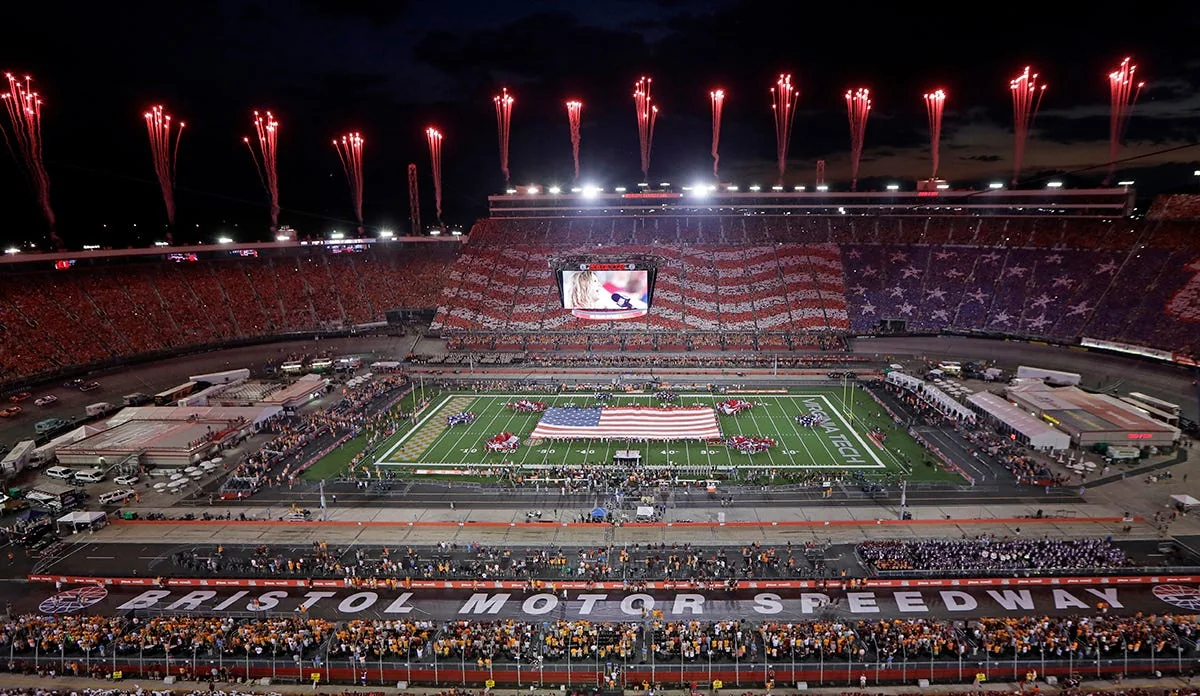
The suspended Colossus video board was an important part of that arrangement. Contemporary reporting confirms it was already in place before the football conversion. A center-hung screen offered a shared place to look for enlarged pictures, while keeping the playing area below free of a central scoreboard support. Its usefulness should not be confused with a promise that every spectator saw every play clearly. Screens supplement a live view; they do not move the football sideline closer to the upper rows.
This is also why it is worth being precise about what you want from an unusual-venue event. If your priority is seeing the full formation develop, elevation may help you read the shape of the play. If you want individual contact and footwork in detail, distance becomes more significant. That is a practical way to evaluate the photograph, rather than assuming the biggest crowd automatically produces the best football view for every person in it.
For a present-day NASCAR visit, use Bristol’s official section-and-row viewing gallery alongside the NASCAR race schedule. The gallery shows race configurations, so it is useful for choosing a race seat, not reconstructing the temporary football layout. The Battle at Bristol remains a striking example of how a venue can retain its identity while asking spectators to watch it in a completely different way.
NASCAR drivers picked sides, too
The connection between the two sports was visible months before workers began installing the field. In March 2016, Bubba Wallace joined Tennessee coach Butch Jones and Bristol general manager Jerry Caldwell for an event promoting the game. Wallace also took part in a Tennessee practice, trying running-back repetitions and receiver routes. The university’s account makes clear that this was a visit from a racing driver, not a football career change.
For Wallace, the Tennessee connection had family roots. His mother, Desiree, ran track at the university, and he had grown up attending games at Neyland Stadium. That background gives his college colors a meaning beyond a one-weekend promotional appearance. NASCAR’s April 2016 Bristol photo gallery subsequently documented his Tennessee-themed racing helmet while he was driving the No. 6 Roush Fenway Racing Ford.
Virginia Tech had its own very visible NASCAR representation. In August, Wood Brothers Racing unveiled a Virginia Tech paint scheme for Ryan Blaney’s No. 21 car ahead of Bristol’s race weekend. The unveiling took place at the university, and Leonard Wood explained the team’s longstanding ties to the Hokies. A football program’s colors on a stock car made the forthcoming game part of a race fan’s normal visual world before the turf arrived.
There is a revealing scheduling detail in that announcement. Wood noted that the team would be racing at Richmond on the night of the September 10 football game. Supporting the Hokies did not mean everyone involved could sit in the Bristol grandstands. The promotions connected the audiences, while the racing and football calendars continued to operate independently. It is a good reason not to assume a driver photographed in college colors was also photographed attending the game itself.
These details are more useful than calling the event a vague meeting of two passionate fan bases. Wallace’s family connection, a documented helmet and the Wood Brothers’ Virginia Tech car show exactly how the link appeared in the paddock. They also explain why a NASCAR reader might come away interested in following one of the teams after the spectacle ended. For the wider story of the sport and its long-running teams, our NASCAR history timeline provides the racing context around that crossover.
Following the teams after the one-off spectacle
If the Wallace connection makes you curious about Tennessee, or the Wood Brothers car draws you toward Virginia Tech, the next step is to follow the team rather than wait for another game in the speedway. The 2016 result is a historical event, not a standing fixture on Bristol’s annual calendar. A college team’s normal season moves between home games, away trips and, sometimes, separately announced neutral-site events.
CollegeFootballSchedule.net, a related site operated within the same project as NASCAR Schedule, is a useful starting point for that search. Its homepage brings together game listings and filters for teams, weeks, conferences and TV networks. We are recommending our own related schedule tool here, rather than presenting it as an independent comparison of competing services. For this particular story, the value is straightforward: find the next listed game involving the college program whose connection to racing caught your attention.
The Tennessee team schedule is a more focused route for Volunteers followers. Read the opponent and venue together. Seeing Tennessee in a matchup does not necessarily mean the game is in Knoxville, and a historical Bristol photograph does not identify the location of a future meeting. Use the university’s official schedule and event information to confirm the venue before making a trip.
The time label matters when matching football with a race broadcast. CollegeFootballSchedule.net labels its listed kickoff times as Eastern; TBA means a detail remains unconfirmed. Keep both events in the same time zone when comparing them, and distinguish a scheduled start from a guaranteed finish. Neither a football game nor a race has to end neatly before the other begins. A driver supporting a team while working elsewhere, as Wood described in 2016, is a better model than assuming the two calendars always fit together.
For the Bristol side of the story, our 2027 Bristol Night Race date guide covers the actual forthcoming race weekend. Use that event’s current information for a speedway visit. The appeal of revisiting the Battle at Bristol is that it opens two distinct paths: understanding the race venue more deeply, and finding a college team to watch when the cars are running somewhere else.
About the author
NASCAR Schedule Editorial Team
The NASCAR Schedule editorial team turns verified schedules, timing and scoring, official announcements and race-weekend context into direct answers for fans.
View all articles by this author →Join the discussion
Comments
Sign in with Google to comment. Keep it race-focused; new comments are reviewed before publication.
Loading comments…