How Kansas Changed the 2026 NASCAR Truck Series Chase: Honeycutt vs. Riggs
Kansas was more than a dramatic finish. Honeycutt's 75-point sweep and Riggs' 19th-place finish changed a three-point gap into a 37-point lead in the 2026 Truck Series Chase, with five races remaining.
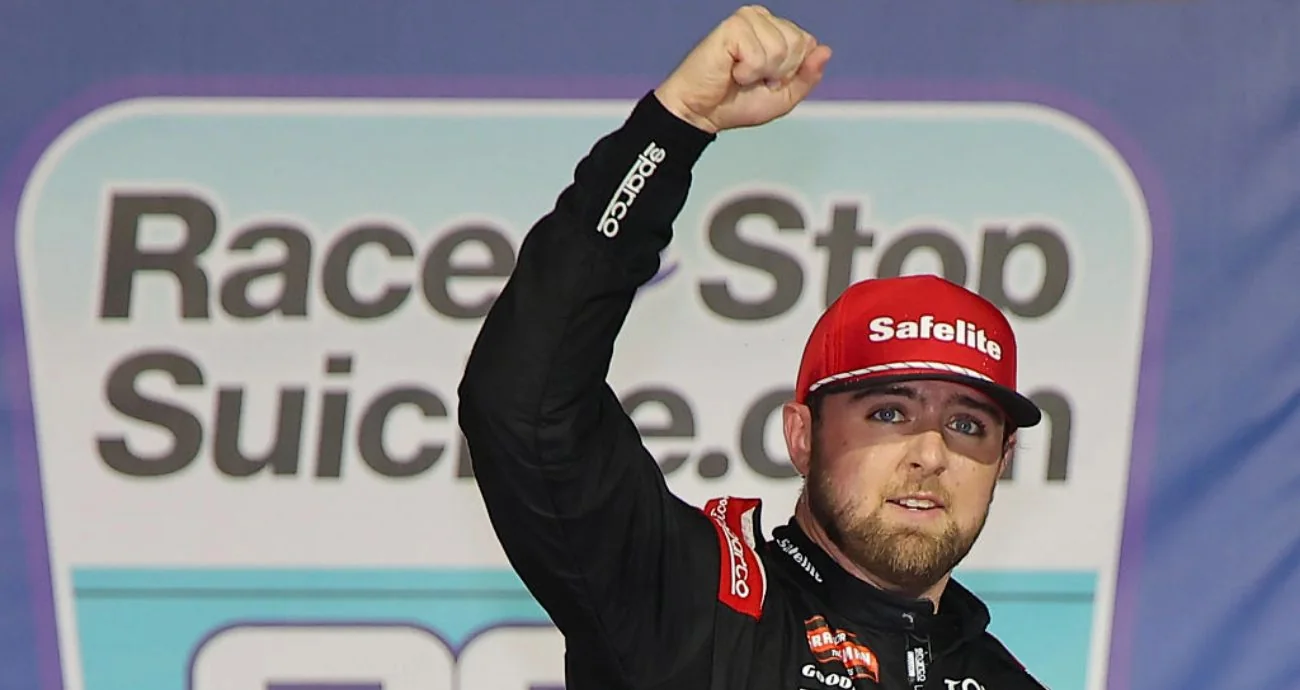
As of the Final at Kansas Speedway on September 26, 2026, Kaden Honeycutt leads Layne Riggs by 37 points in the NASCAR Craftsman Truck Series Chase. Honeycutt swept both stages and won after leading 111 of 134 laps; Riggs finished 19th when a late wall touch cost him a likely second place. The two were separated by only three points in Riggs? favor before the race. Kansas therefore produced a 40-point reversal with five Truck Chase races left. Here is how the rain delay, pit stops, tire choices and scoring combined to change the championship?and what the 2026 no-elimination format means for the remaining schedule.
What changed in the Truck Chase at Kansas?
Kaden Honeycutt left Kansas Speedway leading the 2026 NASCAR Craftsman Truck Series Chase by 37 points over Layne Riggs. Before the September 26 race, Riggs led him by three. That is a 40-point change in the championship contest after only one event, driven by Honeycutt's near-perfect afternoon and Riggs' collapse from a likely runner-up finish to 19th on the final two laps. Kansas was the second of seven Chase races, so the swing matters without settling the title.
The Final result in context
Honeycutt started fourth in the No. 11 Tricon Garage Toyota, led 111 of 134 laps, won both stages and took the Race to Stop Suicide.com 200 by 1.358 seconds over Christian Eckes. Brent Crews, Daniel Hemric and Ben Rhodes completed the top five. NASCAR said postrace inspection was completed without issue, confirming Honeycutt as the winner. Its official recap credits him with 75 race points, every available point but the fastest-lap bonus, which went to Tyler Ankrum.
Riggs' No. 34 Front Row Motorsports Ford was classified 19th, although the finishing order alone hides how competitive he was. He led three laps and was second late before brushing the wall. The full Truck Series results are the right place to see the complete 36-truck order; this particular recap is about why the top two Chase drivers ended so far apart. Eckes' second place was a strong Kansas result, but he was not the driver who entered the night defending the series points lead.
From three points to 37
At the Bristol Chase opener, Riggs held a three-point advantage over Honeycutt despite finishing 32nd. Kansas reversed that position: Honeycutt emerged 37 ahead. Subtracting the old Riggs lead from the new Honeycutt lead gives a 40-point head-to-head swing. A NASCAR Statistics postrace points report, explicitly labeled unofficial, lists Honeycutt on 2,197 and Riggs on 2,160; NASCAR's published race story independently confirms the 37-point difference. The report also places Chandler Smith third on 2,126, 71 behind Honeycutt, consistent with NASCAR's recap.
Those are post-Kansas figures, not a promise about the next race. A driver can finish outside the top ten yet salvage stage points, and a dominant winner can build a large single-race gain. Riggs did both at different moments: he collected 35 points in a 19th-place finish because he had scored in the stages, while Honeycutt's stage sweep turned a race win into a 75-point haul. We will unpack the timing and scoring below. For the standings after subsequent events, use the site's current NASCAR standings rather than this dated snapshot.
How did Honeycutt control the 134-lap race?
Honeycutt's 111 laps led were the product of winning back position after interruptions, not simply staying at the front from green to checkered. He took the lead from Nick Sanchez on the opening lap despite starting fourth, swept the two stages, reclaimed the top spot after Riggs briefly got ahead, and then handled both a long rain delay and a late tire-strategy challenge. At Kansas, that sequence says more about the No. 11's speed and execution than the lap-led number by itself.
Stage points before the long rain stoppage
Honeycutt won Stage 1 without giving up its lead. Riggs reached the stripe ahead on a Lap 48 restart, but Honeycutt moved back past him on Lap 50. Connor Hall's second spin came on Lap 54 and ended the green-flag fight for Stage 2; the stage was scored through Lap 60 under caution with Honeycutt still first. The two stage wins banked 20 points before the winner's 55 finish points were available. In a cumulative Chase, those points survive whatever happens in the final run; they are the reason a race-long command can deliver more than an impressive laps-led statistic.
He then pitted for tires and fuel under the stage caution, yielding position to eight trucks that stayed on the track. By the time a Lap 66 restart wreck slowed the field, he was already back to third. Rain finally forced NASCAR to halt the trucks after 70 laps. The red flag lasted four hours and 47 minutes, a large break in an event whose lead chart otherwise looks like a single sustained Honeycutt drive. Grant Enfinger and Ben Rhodes held the first two places during that stoppage because they had remained out on older tires.
Winning the restart and the last tire exchange
When the race resumed on Lap 78, Honeycutt passed Enfinger and Rhodes to restore his earlier control. That distinction matters: the stay-out call bought those teams track position, but it did not give them the same tire state as a truck that had taken service. The race report documents the pass; without published lap-by-lap tire-wear figures, the sound conclusion is simply that Honeycutt turned his fresh-tire opportunity into the lead. Fans could see the strategic trade rather than assume a driver disappearing from first at a pit stop had lost raw speed.
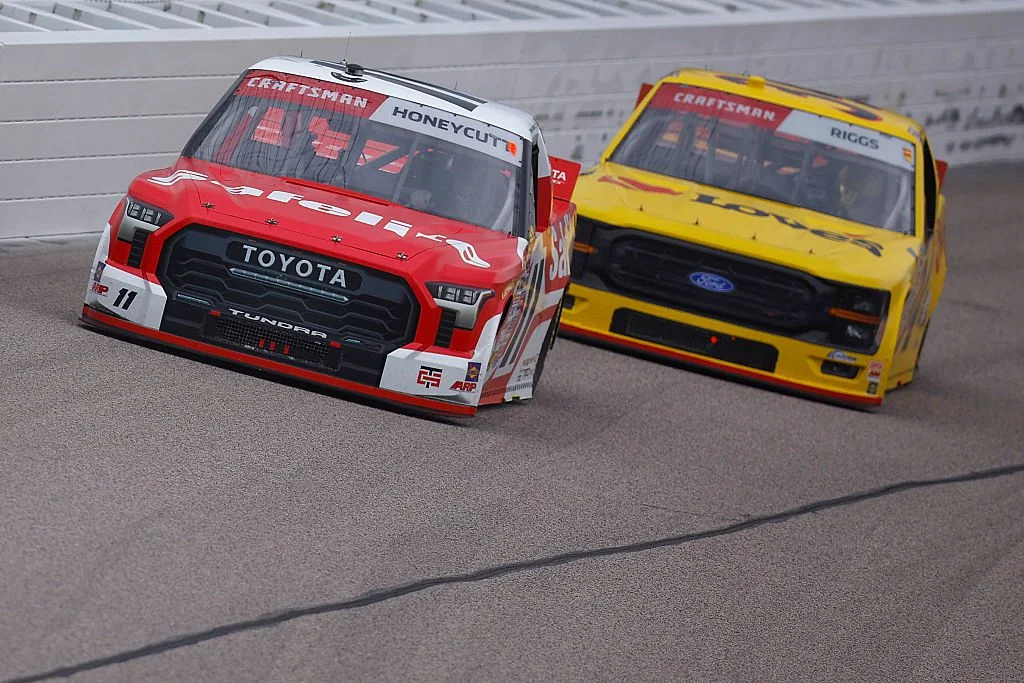
The final caution stop on Lap 117 set up a second version of that contest. Honeycutt took four tires while Riggs took two to gain track position. Riggs restarted third, grabbed the lead on Lap 122, and Honeycutt passed him one lap later. From there the No. 11 led to the finish, including the restart after Enfinger's late caution. NASCAR's race account makes the sequence clear: the last pit call did not hand Honeycutt an uncontested win, but the four-tire car had enough pace to overcome the two-tire challenger before the closing laps.
The score is straightforward once separated into parts: 55 points for winning, ten for Stage 1 and ten for Stage 2, for 75 in all. NASCAR also credited the fastest-lap bonus to Tyler Ankrum, which is why it described Honeycutt as collecting all available points except one. There were seven cautions spanning 47 laps in the official cumulative report, so restarts repeatedly tested whether the No. 11 could protect or recover its position. It did so often enough to change both the race result and the Chase table.
How did Riggs get back into the fight?
Riggs was a plausible late challenger because he recovered from a serious pit-road delay, not because 19th place was his usual position during the race. On the Lap 61 stage-break stop, the jack dropped before all five lug nuts on the left-front wheel were secured. The No. 34 had to back into its stall so the crew could finish the job. A driver who later got close enough to lead against Honeycutt had first spent the middle of the event working out of traffic.
The loose-lug stop and recovery drive
NASCAR's race account says Riggs restarted 25th after the stop. That number describes the restart immediately after the problem. A separate NASCAR interview places him 16th when the race resumed following the long rain delay. These are different points in the timeline, not conflicting versions of one restart. From 16th, Riggs advanced to ninth on the first green-flag lap and reached second six laps later, according to the interview. That was a significant recovery against a field that had just waited nearly five hours to return to race conditions.
The pit problem also had a Chase echo. At Bristol a week earlier, the top seed won the first two stages but an issue around the final-stage stop and wheel sent him to 32nd. He still arrived at Kansas with a three-point lead, yet a second compromised pit sequence put his crew's execution under scrutiny. The Kansas recovery showed the No. 34 had speed; it did not erase how much harder the team had made its night. NASCAR reported that Riggs acknowledged the pit mistakes but took personal responsibility for the eventual Kansas loss.
Two tires versus four for the last restart
At the final caution stop on Lap 117, Riggs' side of the contest changed from recovery to attack. He took two tires; Honeycutt took four. A two-tire stop can gain positions during service because less work is done in the stall, while the four-tire truck gives its driver a better chance to make speed over the next green-flag run. That is the strategic logic visible from the choices and restart positions; the public race record does not give us a full crew-radio explanation or a numeric tire-wear curve.
Riggs restarted third, put the No. 34 ahead at the stripe on Lap 122, and was passed by Honeycutt on Lap 123. The brief lead proves the call gave him an immediate opportunity. It also shows its limit: track position alone did not keep a faster No. 11 behind once the trucks were running. With another late caution and restart still to come, Riggs nevertheless remained close enough to challenge. His 19th-place classification should be read alongside those phases, rather than treated as proof that the two-tire call never worked at all.
Why did the final wall contact cost Riggs 17 points?
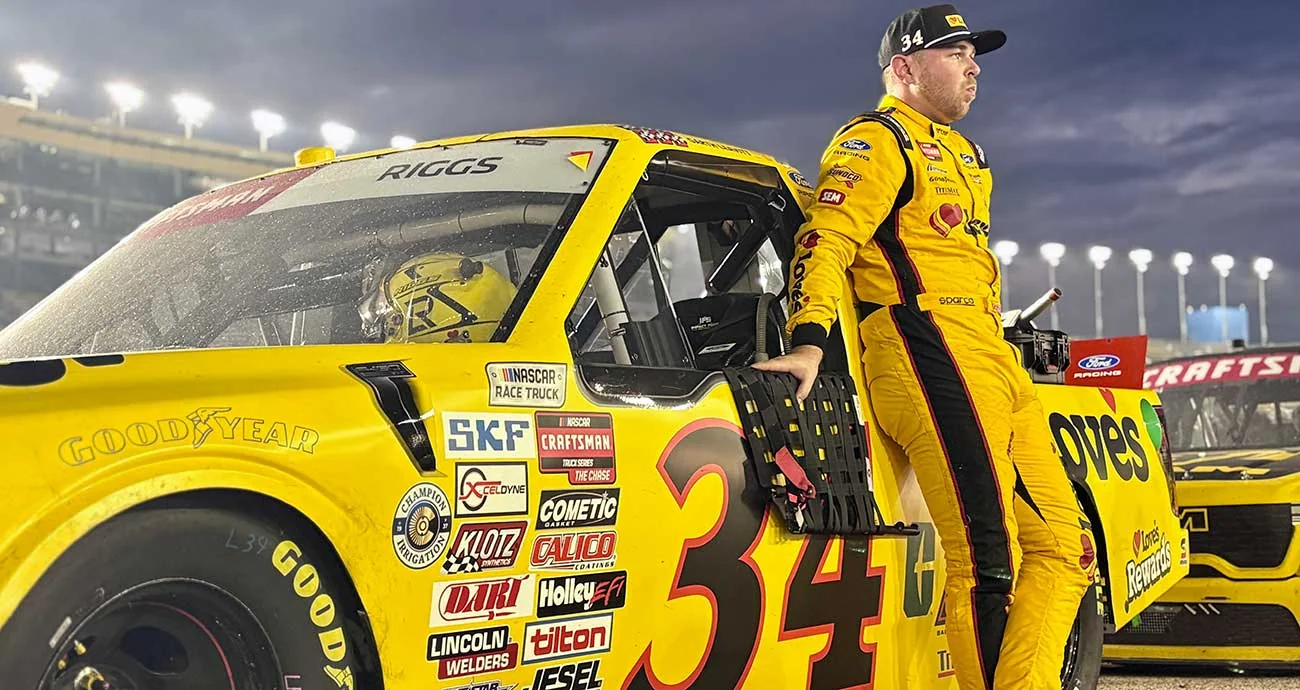
Riggs was running second when he brushed the outside wall with two laps remaining. NASCAR's account says the contact in Turns 3 and 4 cut his right-front tire, and he slid to 19th by the checkered flag. That was a loss of 17 finishing places and, under the 2026 finish-points scale, 17 points. The scoring detail matters because Riggs still earned 35 race points overall: his strong first two stages had already added 17 to the 18 points paid for finishing 19th.
A brief lead, then a slide to 19th
The last battle had more than one turn. Riggs had led for two laps early in the race, on Laps 48 and 49, and again for Lap 122 after the two-tire stop. Honeycutt passed him on Lap 123 and led the final 12 laps. Riggs then stayed close enough to think he had a run coming with two laps left. His postrace explanation to NASCAR was that he tried too hard on the high line, reached Honeycutt's air wake and touched the wall. He accepted responsibility for pressing when second place was available. There is no need to invent a dispute about who caused it.
Be careful when watching Kansas clips: the No. 34 also grazed the wall in a separate Lap 50 battle after contact with Honeycutt. That earlier moment did not create the final 19th-place result. The decisive damage described in the driver interview came much later, with two laps left. NASCAR's complete result still lists Riggs as running at the finish with all 134 laps completed. His slow final laps cost positions, but this was not a retirement or a disqualification.
The scoring arithmetic behind the loss
NASCAR's 2026 Chase scoring explanation pays 35 finish points for second and one fewer for each following place, so 19th pays 18. Riggs placed third in Stage 1 for eight points and second in Stage 2 for nine. The official Final shows 35 points for him, matching 18 plus eight plus nine. Nothing about a 19th-place finish erased the stage points he had banked.
| Riggs' Kansas score | Finish points | Stage points | Total |
|---|---|---|---|
| Actual: 19th | 18 | 8 + 9 | 35 |
| Illustration: held second | 35 | 8 + 9 | 52 |
The second row is a counterfactual calculation, not an alternate result. Holding second with identical stage scores would have been worth 52, which is 17 more than Riggs actually took home. Honeycutt collected 75, so the real Kansas head-to-head scoring difference was 40; that is precisely why a three-point Riggs lead before the race became a 37-point Honeycutt lead afterward. Finishing second would still have left Riggs behind in the standings after Kansas, but only by 20 on that simplified assumption. The late decision therefore changed the scale of the deficit, not whether Kansas was one of Honeycutt's best days.
Was going for the win a mistake in this Chase?
Riggs judged his own final move too aggressive, but that does not mean every attempt to beat Honeycutt was a poor decision. The two-tire stop gave him a lead opportunity and the No. 34 proved quick enough to run near the winner. The later decision to keep pressing against the outside wall with second place in hand had a different risk profile. This is an editorial assessment of the public race sequence, not a NASCAR finding about what Riggs was supposed to do.
The 2026 points system offers a real reason to pursue a win. NASCAR increased the winner's finish award to 55 points while second remains worth 35, a 20-point premium before stage and fastest-lap points. A team trailing in a short seven-race title contest can justify trading some track position for a shot at that premium, especially if the alternative is allowing its nearest rival to take the victory. That logic helps explain why Front Row Motorsports could support an attacking approach. Competition director Drew Blickensderfer told NASCAR that the team wants trophies and urged Riggs to focus on winning the coming races rather than dwell on Kansas.
Yet the format also makes every lost finish point durable. There are no elimination rounds and no reset after Kansas. A result banked now remains part of the championship total through the final race. Had Riggs held second, his Kansas total would have been 52 on the same stage scores. The actual 35 gave Honeycutt a 40-point race advantage. Put differently, going from second to first would have gained Riggs 20 finish points; going from second to 19th cost him 17. Those quantities are close enough that the risk deserves more thought than either “always send it” or “never race for the win.”
Riggs' own interview supports that narrower distinction. He described trying too hard near the wall and said he should have considered the five remaining races. He did not suggest that his truck was incapable of contending, and his recovery from the slow stop shows why the team was reluctant to settle early. His regret concerns the moment when the truck was already second, the leader had passed back, and the high line left little room for error. The resulting tire cut turned a manageable post-Kansas deficit into 37 points.
There is also a limit to what the scoring arithmetic can tell us. We can calculate the points difference between second and 19th, but we cannot know whether a more cautious Riggs would certainly have held second through the checkered flag or whether a different move could have won. Those are alternative race histories. The useful conclusion is practical: in this cumulative Chase, aggressive strategy can be valuable, but the final move must be judged against a finish that already pays well. Riggs and his team now have to earn back the lost ground on track rather than wait for an elimination-round reset that does not exist.
What matters in the five remaining Truck Chase races?
The championship remains open after Kansas. Honeycutt's 37-point lead over Riggs is substantial in a seven-race Chase, but five races still award finish, stage and fastest-lap points. NASCAR's 2026 format does not eliminate drivers between rounds: all ten qualifiers continue to score toward the same championship total, and the highest points scorer after the final Truck race is champion. The useful question each Friday is how much the contenders gain or lose relative to one another, not who has crossed an imaginary cutoff.
A five-race calendar, not a series of cutoffs
As listed on NASCAR's published 2026 national-series schedule, the Truck Chase moves from Kansas to these five venues:
- October 9 — Charlotte Motor Speedway
- October 16 — Phoenix Raceway
- October 23 — Talladega Superspeedway
- October 30 — Martinsville Speedway
- November 6 — Homestead-Miami Speedway, the finale
NASCAR's Kansas race story separately confirms Charlotte on October 9 as the next event. The dates above were checked on September 28; use the site's current NASCAR schedule for any later revisions or broadcast details. The important championship fact is the sequence: Kansas was race two, and Charlotte, Phoenix, Talladega and Martinsville all contribute to the same points account that determines the champion after Homestead. A driver can have a bad Friday without being formally eliminated, but the points lost do not disappear.
Which standings signals are worth watching
Start with the Honeycutt–Riggs gap, then look below the leading pair. NASCAR reported Chandler Smith in third, 71 points behind Honeycutt after Kansas. That is a wider deficit, but it is a dated position rather than a mathematical verdict with five races to run. The NASCAR Statistics points sheet lists other Chase contenders close behind Smith; it is marked unofficial, so a fan looking for the latest exact order should check the updated standings after each race.
For Riggs, the immediate test is whether his team can turn speed into complete weekends. Bristol and Kansas each showed strong stage pace alongside costly pit or finish trouble. A win now pays 55 finish points, but repeatedly banking stage scores and keeping the truck in the top five can also close a gap when Honeycutt has an imperfect day. For Honeycutt, the Kansas model is obvious: qualifying near the front, avoiding pit trouble, scoring in the stages and finishing ahead of the direct rival. Neither driver can control the other's result, so their point differential is more revealing than either finishing position alone.
Kansas also warns against assuming the fastest truck will always collect the full reward. Weather interrupted this event for nearly five hours, stay-out calls changed restart order, and a two-tire gamble made the points leader defend a late lead. Future tracks will pose different questions, especially Talladega's pack racing and Martinsville's tight short-track traffic. Those are reasons to watch each race's stage scores and final classification together; they are not predictions that one particular contender will stumble. Honeycutt earned the advantage at Kansas. The remaining five events determine whether it lasts.
About the author
NASCAR Schedule Editorial Team
The NASCAR Schedule editorial team turns verified schedules, timing and scoring, official announcements and race-weekend context into direct answers for fans.
View all articles by this author →Join the discussion
Comments
Sign in with Google to comment. Keep it race-focused; new comments are reviewed before publication.
Loading comments…