Can Kyle Larson Clinch the 2026 NASCAR Title at Martinsville?
Kyle Larson can clinch the 2026 Cup championship at Martinsville. Here is why 59 points guarantees it, how lower scores can work and what fans should track.

Yes. Kyle Larson can clinch the 2026 NASCAR Cup Series championship at Martinsville Speedway on November 1, one week before the Homestead-Miami finale. As of October 29, NASCAR lists 59 points as his guaranteed clinching total, regardless of the other contenders. That requires the race win, worth 55 points, plus at least four more points through the stages and eligible fastest-lap bonus.
He can also seal the title with fewer points if his rivals score poorly enough. Those are conditional scenarios, so a finishing-position graphic alone will not tell the whole story. Larson arrives 73 points ahead of Denny Hamlin; the Cup Series standings, stage scores and final race classification will determine whether that advantage becomes uncatchable. The arithmetic below explains the distinction before a wheel turns at Martinsville.
What Larson carries into Martinsville
Larson leads a seven-driver mathematical championship race with two Cup events remaining. NASCAR’s post-Talladega Chase report gives the following gaps. They describe the position entering Martinsville, rather than a projection of how the remaining races will finish.
| Driver | Points behind Larson |
|---|---|
| Denny Hamlin | 73 |
| Christopher Bell | 74 |
| Chase Briscoe | 79 |
| Joey Logano | 100 |
| Ryan Blaney | 107 |
| Tyler Reddick | 126 |
A dated points lead, not an awarded championship
The most useful distinction is between race points and the change in the lead. Larson scored 71 points at Talladega. His advantage over the next driver grew from five points before that race to 73 afterward, an increase of 68. Those two numbers answer different questions. Using 68 as his Talladega score would start a Martinsville calculation with the wrong information.
A large advantage can make a driver an overwhelming favorite while still leaving a mathematical route for somebody else. The championship remains open on October 29. That matters when reading headlines about a likely third title: likelihood describes an assessment of the remaining racing, while clinching describes a position from which the permitted points outcomes cannot change the champion.
Why there is no Championship 4 reset waiting
The 2026 Chase format carries points through the final ten Cup races after its initial reseeding. There are no scheduled elimination rounds and no fresh, level championship score for four drivers at Homestead. A driver can become mathematically unable to catch the leader, but that does not trigger another reset for everybody still in contention.
That changes what a late-season win means. A rival winning Martinsville will collect a valuable points haul, but the victory does not automatically create a new title berth or erase Larson’s advantage. Similarly, finishing ahead of Larson at Homestead would not necessarily be enough to beat him in the championship. The amount of ground gained across the available scoring opportunities is what matters.
The race itself also remains open to drivers outside the title contest. Their finishing positions and stage scores can reduce the points available to a contender. A noncontender winning can therefore help the leader’s arithmetic without becoming a championship candidate. Watch the whole front of the field, rather than treating the seven names in the table as a separate race with an independent scoring scale.
Why 59 points guarantees the title
The 59-point target works because reaching it requires Larson to win Martinsville, which simultaneously denies every rival the winner’s 55-point payout. His score and their possible scores are connected. Treating each driver as independently able to collect a maximum would miss the reason NASCAR’s guaranteed number is achievable.
The win and four more points route
A win supplies 55 points. Four additional points take Larson to 59, and they can come from more than one combination. The following are hypothetical scoring examples, rather than predictions about which stages the No. 5 will prioritize.
| Race finish | Stage points combined | Fastest-lap point | Total |
|---|---|---|---|
| Win: 55 | 4 | 0 | 59 |
| Win: 55 | 2 + 2 = 4 | 0 | 59 |
| Win: 55 | 3 | 1 | 59 |
In the first example, four stage points could be earned through a seventh-place result in one stage. The second example splits the work across two ninth-place stage finishes. Neither route requires a stage victory. A win without sufficient additional points does not meet the independent 59-point guarantee, although the actual rival results can still make it a clinching afternoon.
The maximum is 76, not 75
The full ordinary-race maximum is 55 for winning, ten for each of the first two stages and one for the eligible Xfinity Fastest Lap. That adds to 76. NASCAR’s Kansas Chase report confirms that Larson achieved that total in September. Leaving the fastest-lap point out of an elimination calculation can produce an incorrect answer near the boundary.
Once Larson wins Martinsville, the strongest possible rival finishing score is 35 for second. Add twenty stage points and the fastest-lap point, and that rival can score at most 56. The conservative comparison against Hamlin becomes 73 + 59 − 56 = 76 points. The other contenders entered farther back. At Homestead, a driver starting and receiving the minimum one finishing point can lose at most 75 to somebody scoring 76. A clear 76-point cushion is beyond that ordinary racing swing.
There is an eligibility detail behind the extra point, too. NASCAR changed the Cup fastest-lap rule for 2026: a new fastest lap set after garage repairs cannot earn the award. An eligible fastest lap established before going to the garage can still count. A television lap-time graphic and the awarded championship point therefore deserve separate attention if a damaged car is involved.
Why a runner-up finish cannot provide the same guarantee
Second place brings 35 finishing points. Even with both stages and the fastest lap, Larson would total 56, below 59, while another driver could collect the win. That is why NASCAR’s independent route requires victory. It does not mean second place prevents a clinch; it means second place cannot settle the question without looking at everybody else.
The 2026 points system makes that distinction particularly important. The twenty-point difference between first and second is much larger than the single-point steps between many other finishing positions. A late pass for the win can therefore change the title calculation far more than several routine midfield passes, even when the running-order screen looks almost unchanged.
How Larson can clinch with fewer than 59
Larson does not have to reach the guaranteed number if the other contenders leave too many points unclaimed. For any one rival, calculate the gap after Martinsville by adding Larson’s total race points to the current gap, then subtracting that rival’s total. Repeat for every driver who remains mathematically eligible; clearing Hamlin alone is insufficient.
Compare total race points rather than finishing positions
Consider an illustrative 40-point afternoon for Larson and a 35-point afternoon for Hamlin. The resulting gap would be 73 + 40 − 35 = 78. Hamlin would have lost five points even if a glance at their finishing positions suggested a closer contest. Those are hypothetical total scores, including all scoring components, rather than a claim that either number automatically corresponds to one specific finish.
Against Bell, a hypothetical Larson score of 40 and Bell score of 38 produces 74 + 40 − 38 = 76. That exceeds the normal 75-point maximum gain against a starter at the finale. But another contender could have a better Martinsville afternoon, so neither example by itself declares Larson champion. The exercise is a way to test each remaining challenge, not a replacement for the complete standings.
Reverse the direction and the meaning changes quickly. If Hamlin scored 60 while Larson scored 40, the gap would shrink to 53. That would leave a genuine points contest for Homestead, although Hamlin would still need another substantial gain. He would not automatically control the title simply because he had won the penultimate race. The existing deficit still has to be overcome.
Keep the tiebreaker separate from a clear points lead
An exact tie is a separate calculation. Reporting from NASCAR’s February rules briefing identifies the Chase tiebreaker as best finishes within the Chase, progressing through wins, runner-up finishes and the following positions. Claire B. Lang described that procedure after attending the briefing. It is a comparison of the championship round’s results, rather than an instruction to award the title to whoever wins the last race.
That is also why a margin at the boundary deserves more care than a comfortable lead. Ask whether the challenger can draw level, whether the relevant Chase results could change before the finish, and whether the calculation assumes Larson starts the finale. A nonstart supplies no ordinary finishing-point floor. A forecast that silently switches between a start and a nonstart can shift its answer by one crucial point.
Use NASCAR’s published clinching scenario for the formal call, and the final race results for the awarded scores. Running points are useful while watching, but inspection, official classification and any subsequent scoring adjustment can matter. The practical shortcut is to track clear margins first and leave a tied-points conclusion until the applicable countback has also been resolved.
What could keep the championship alive
The strongest challenge is a rival maximizing Martinsville while Larson has a low-scoring day. Hamlin provides an obvious track-specific reason to keep watching: NASCAR’s current preview notes that he led 292 of 400 laps in the spring race before Chase Elliott won. That performance demonstrates competitive potential at this circuit; it does not guarantee the same car balance, strategy or result in November.

Stage scores and short-track setbacks change the calculation
Banked stage points can soften the effect of a later poor finish. Conversely, missing both stage opportunities means a driver relies much more heavily on the final payout. Follow the stage totals as they are awarded, rather than waiting until the last restart to begin counting. A rival who has already collected a strong stage score presents a different mathematical threat from one who arrives at the same running position with none.
Larson’s own team has emphasized execution rather than assuming the lead will protect it. Hendrick Motorsports’ post-Talladega account describes Daniels continuing to pursue stage points and a strong finish. Larson raised an early Martinsville pileup and radiator damage as an example of what could still go wrong. That was a hypothetical risk, not a report of damage to his car this week.
Pit timing is another way the arithmetic and the racing meet. Gordon highlighted the danger of a green-flag stop followed by an unfavorable caution. A strategy designed to create better track position later can first surrender position or laps, exposing the team to an interruption before the benefit arrives. The useful question is whether the stop is helping Larson collect the required points, rather than whether the call merely looks conservative.
For a simple viewing routine, note each contender’s stage points, then add the current finishing payout, then check the fastest-lap point separately. Recalculate when a car changes position, a penalty is assessed or a stage ends. Finally, confirm the actual awarded totals. This keeps a promising on-screen scenario from becoming an early declaration of a title that is still being contested.
The weekend schedule provides the current session timing. Practice and qualifying will give fans information about pace and starting position, but neither substitutes for the championship points earned in Sunday’s race. The most valuable car on a qualifying lap is not automatically the one that will make the best decisions through the full afternoon.
What Homestead still offers if Larson clinches early
An early Cup clinch would settle the identity of the driver champion; the November 8 race at Homestead-Miami Speedway would still take place. The venue’s championship weekend also includes the other two national series. Their title situations must be assessed separately, so Larson’s Cup arithmetic cannot tell a fan whether the Truck or O’Reilly championship remains undecided.
The race win and the remaining standings battles
There is a real distinction between losing a title showdown and losing the competitive purpose of the race. Drivers would still contest the race victory, and positions elsewhere in the final standings would still depend on the points earned. A driver unable to catch Larson can still move ahead of the driver immediately above him. That makes the gaps below first place worth following as closely as the headline gap.
The current fan discussion reflects different preferences. Some Reddit contributors welcome the possibility of watching the finale as a race in its own right; others are concerned about losing the championship uncertainty they expected from a finale. Both are recognizable viewing priorities. A discussion thread establishes that the debate exists, rather than proving what the entire audience wants or predicting a particular television rating.
For a race-focused viewing plan, follow how teams gain position through a run, which drivers make their tires last, and whether a late caution changes the order. Those questions remain meaningful even if first place in the championship has been secured. Consult the NASCAR TV schedule for current coverage rather than treating a possible early title decision as a schedule change.
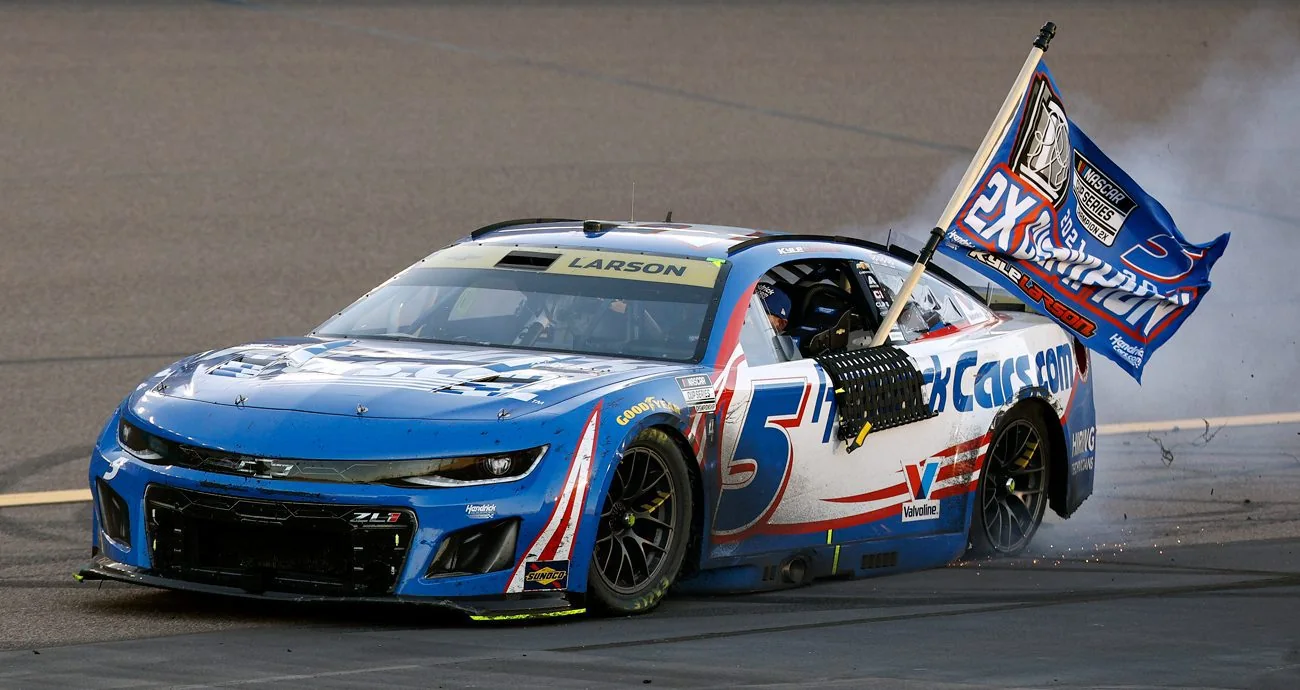
Could a title be secured during a race instead?
Yes, the points can become uncatchable when a scoring opportunity closes, even before the final checkered flag. Consider the fan-discussed hypothetical of Larson entering Homestead with a 70-point lead and winning Stage 1. His ten stage points would give him an 80-point advantage before adding his eventual finishing score. Any rival could earn at most nine from that first stage, ten from the next, 55 for winning and one for the fastest lap: 75 for the entire event.
In that example, the remaining ordinary racing points could no longer overturn the lead. It is an illustration of how stage scoring works, not a prediction of Larson’s Homestead margin or an instruction that his team would park. Final classification and inspection still govern the official result. Until Martinsville establishes the actual standings, the useful task is to understand the calculation and let the race supply the numbers.
About the author
NASCAR Schedule Editorial Team
The NASCAR Schedule editorial team turns verified schedules, timing and scoring, official announcements and race-weekend context into direct answers for fans.
View all articles by this author →Join the discussion
Comments
Sign in with Google to comment. Keep it race-focused; new comments are reviewed before publication.
Loading comments…