How Kyle Larson Won the 2026 NASCAR Cup Championship
Follow Larson's 2026 Chase turnaround, the Stage 1 points calculation that sealed his third championship, and the difference between winning the title and the finale.
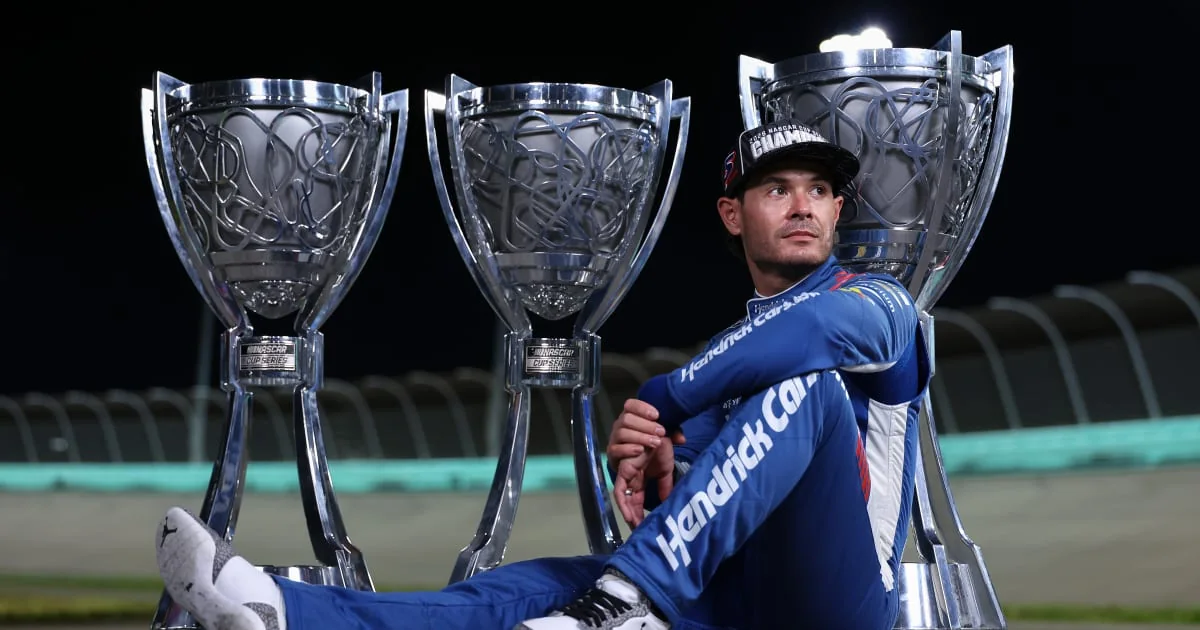
Kyle Larson won the 2026 NASCAR Cup Series championship by turning a winless regular season into three Chase victories and a points lead his rivals could not erase at Homestead-Miami Speedway. He clinched at the end of Stage 1 on November 8, then finished 12th while Ryan Blaney won the race. The decisive story was the advantage built before the finale and the opening-stage arithmetic, rather than the final-lap battle for victory. This retrospective, checked November 11, explains the turnaround, the clinch and what Larson's third title says about the No. 5 team.
What did Kyle Larson win at Homestead in 2026?
Kyle Larson secured the 2026 NASCAR Cup Series championship at Homestead-Miami Speedway on November 8. The No. 5 Hendrick Motorsports Chevrolet driver clinched during the opening stage and finished the race 12th. It was his third Cup title and his second in succession, following championships in 2021 and 2025.
The official Homestead classification records a different race winner: Ryan Blaney, driving Team Penske's No. 12 Ford. Blaney started ninth and completed the 267-lap race ahead of Tyler Reddick. Larson started fourth and also completed every lap, but the championship had already been settled long before those finishing positions were recorded.
| Question | 2026 Homestead answer |
|---|---|
| Cup season champion | Kyle Larson, Hendrick Motorsports |
| Race winner | Ryan Blaney, Team Penske |
| Larson's race finish | 12th, after starting fourth |
| Championship clinch | At the conclusion of Stage 1 |
A race winner and a season champion
Those two results describe different achievements. Blaney beat the field over Sunday's race distance. Larson accumulated the points necessary to put the season title beyond his remaining rivals. The dramatic finish at the front of the race could change the finishing order and other championship places without reopening a title contest that had already become mathematically impossible to overturn.
That is the essential starting point for understanding this championship. Watching only the final laps would show the race-winning battle but miss the decisive moment for the No. 5. Watching only Larson's final position would miss the advantage he had brought into the weekend. The explanation lies in how that cushion was built and what the opening stage left his rivals able to score.
Use the full Homestead finishing order for the individual race and the Cup results archive for the events that led to it. The championship story connects those results rather than treating the finale as an isolated winner-takes-all contest.
Why did the 2026 Chase reward this kind of comeback?
The Cup championship used a single points reset followed by ten Chase races in 2026. Sixteen drivers qualified through the regular-season points standings, and none was eliminated during the Chase. There was no final-round reset that put a small group back on equal terms for Homestead. The leader's advantage remained something the other contenders had to overcome on the track.
Larson still began with work to do. He entered the Chase as the seventh seed after a winless 26-race regular season. The published seeding structure gave the top seed 2,100 points and seventh place 2,045: a 55-point difference. His autumn surge therefore did more than protect an advantage handed to him at the reset. It erased a deficit before creating the cushion that eventually made an early clinch possible.
The 2026 format rewarded wins heavily. First place paid 55 finishing points, compared with 35 for second, while the established stage-point scale remained in place. A win was valuable even without a promise of advancement to another round. Stage results also made a strong afternoon more valuable than its finishing position alone might suggest.
As an illustration of that incentive, first versus second created a 20-point finishing-score difference before stage points were considered. That is a calculation from the scoring scale, not a claim that every Larson victory gained 20 on his nearest rival. To assess an actual weekend, you have to compare each contender's complete score, including the stages.
The analytical consequence was a different balance between attack and survival. A bad race could hurt the No. 5 badly without eliminating it. A strong result could repair the damage without a subsequent round reset wiping out the gain. As the remaining schedule shortened, a large lead became increasingly difficult to erase because fewer scoring opportunities remained.
That is why "he needed to win the finale" is the wrong frame for this title. Larson needed to outscore his rivals over the Chase after the initial seeding disadvantage. The points-system guide explains the scoring components, while the 2026 Chase guide covers the full format. His championship illustrates how those components worked together.
How did the No. 5 build and defend its Chase lead?
Larson's title run included three Chase victories: Gateway on September 13, Kansas on September 27 and Talladega on October 25. Those wins solved different problems. The first broke the drought, the second converted sustained speed into a maximum score, and the third rebuilt an advantage that had nearly disappeared. Martinsville then became an exercise in limiting the damage.
Gateway and Kansas turned speed into wins
At Gateway, Larson ended a 51-race winless streak in a race that required both tire advantage and restart execution. The No. 5 took four tires on its final stop while Joey Logano's team chose right-side tires. Larson used the extra grip, with help from teammate Alex Bowman on restarts, to take control and survive two overtime attempts.
That result moved him to second in the Chase standings, nine points behind Hamlin. The significance was larger than a drought-ending celebration: a win brought a major points payment, and the No. 5 delivered it on a day when several other contenders encountered trouble. It was an early demonstration that the team could turn a chaotic afternoon into an advantage.
Kansas was the more comprehensive performance. Larson won both stages, led 235 laps, set the fastest lap and scored the maximum 76 points. Yet he still had to recover the lead from Chase Briscoe late in the final run. Dominating the earlier distance did not spare him the need to manage changing grip and make a decisive pass near the finish.
In championship terms, the important combination was speed across the stages and execution at the end. A strong car that lost the victory would still have scored well, but completing the job increased the reward. Larson left Kansas 26 points ahead of Hamlin: the original seeding deficit had become a meaningful lead.
Phoenix showed how quickly the margin could shrink
The October 18 Phoenix race was a reminder that this was not an uninterrupted march. Larson struggled with handling before a late right-front tire failure ended his race. He finished 34th and collected only three points, leaving him just five ahead of Bell with three races remaining.
The team's account of the Phoenix setback described extensive preparation followed by a car that did not respond as expected. That distinction matters. Calling the entire result bad luck would overlook the performance difficulty that preceded the failure; calling it a collapse of the whole campaign would ignore the races still available to repair it.
The format kept Larson alive, but it did not protect his advantage. A low score still allowed multiple rivals to make large gains. The lesson from Phoenix was that the No. 5 needed another productive weekend, not simply a cautious journey toward a trophy already assumed to be theirs.
Talladega and Martinsville rebuilt the cushion
At Talladega, Larson made a last-lap charge to claim his first victory on a major drafting track. His 71-point score combined the win with stage scoring, while Chevrolet filled the first six finishing positions. The result left Hamlin 73 points behind and Bell 74 back. The nearest pursuer had changed, and the size of the lead had changed with him.
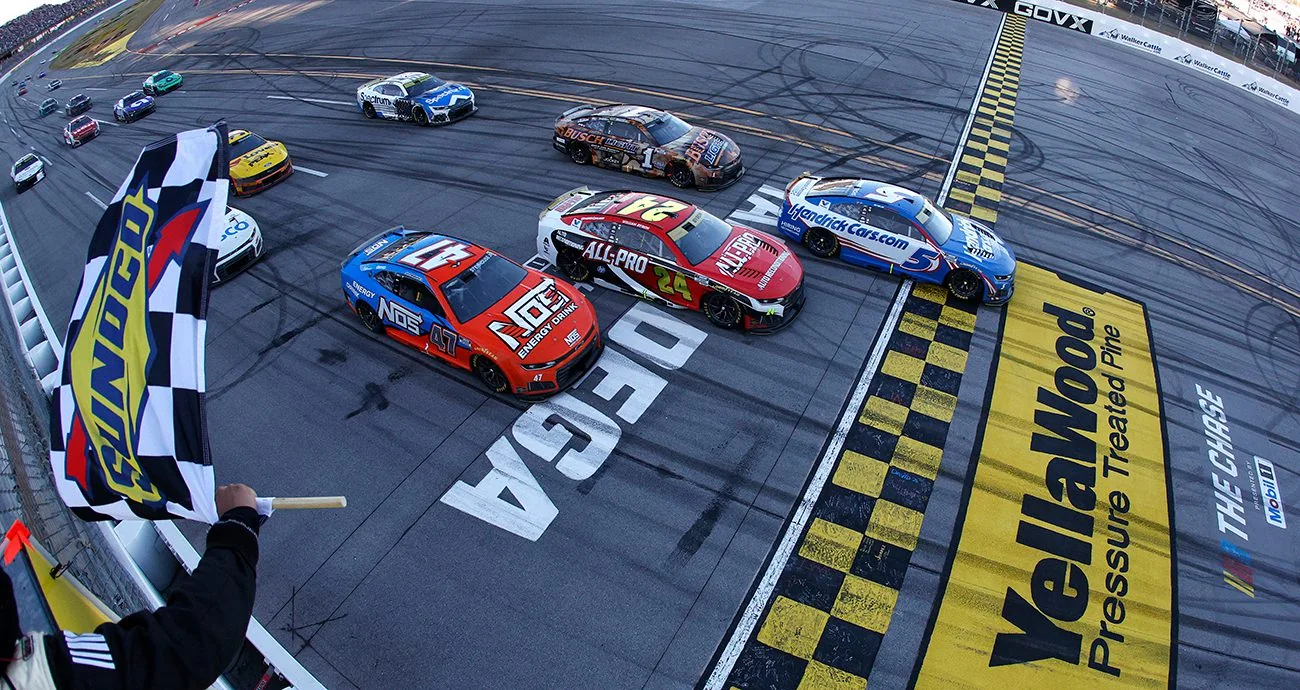
The analytical point is survival plus scoring. A trophy photograph alone does not show the value of collecting stage points before the final sprint or avoiding the crashes that damaged other contenders. Larson was present to exploit the last-lap opportunity, and the full afternoon's score made its championship impact substantial.
Martinsville was less spectacular but still essential. An early strategy left Larson a lap down; he regained the lap during a caution and recovered to ninth. His 28 points preserved a 67-point advantage over Bell and 70 over Hamlin heading to Homestead.
He had not clinched at Martinsville. He had, however, kept a difficult day from becoming another Phoenix-sized loss. The dated pre-Martinsville scenarios show what had been possible before that race; the actual recovery explains why the final calculation still strongly favored him a week later.
How did Stage 1 put the championship beyond reach?
Larson's fourth place in Stage 1 earned seven stage points. Bell finished third and earned eight, while Hamlin finished sixth and earned five. Those scores settled the championship because of the lead Larson already held and the limited points still available, not because fourth place automatically carried a title-clinching award.
Before the race, NASCAR's published scenarios gave Larson a nine-point total-score guarantee regardless of his rivals' results. That was a worst-case threshold for planning the afternoon. It was not a rule requiring nine stage points, nor a minimum that remained unchanged after the other contenders failed to maximize the opening segment.
Why the rivals' stage results changed the calculation
Bell entered the race 67 points behind. By gaining one more stage point than Larson, he reduced that deficit to 66. But the first stage had now passed, leaving Bell only one stage, the race finish and the fastest-lap bonus as opportunities to add to his total.
| Calculation | Points |
|---|---|
| Larson's lead over Bell before the race | 67 |
| Lead after their Stage 1 scores | 67 + 7 − 8 = 66 |
| Bell's maximum still available | 10 + 55 + 1 = 66 |
| Larson's minimum additional finishing score | 1 |
The last line closes the calculation. Even if Bell scored all 66 remaining points, Larson was guaranteed at least one additional point for his finishing position. Bell therefore could not catch him. Hamlin's position was even less favorable: the opening stage increased his deficit from 70 to 72 points.
This is why the seven-point stage result was enough in the race that actually unfolded. It worked together with Bell's and Hamlin's scores. It would be misleading to turn the outcome into a blanket statement that seven stage points had guaranteed the title before the green flag.
Keep the scoring components distinct when checking the arithmetic. The minimum finishing point is not an additional point awarded separately for starting and then counted again at the finish. Larson's seven stage points plus that guaranteed finishing point gave him at least eight total points. His rivals' reduced possibilities made that sufficient.
NASCAR's championship report confirmed the clinch at the conclusion of the stage. The rest of the afternoon still determined the race result and the remaining standings, but Larson's title no longer depended on another restart, pit cycle or finishing-position fight.
Why did a 12th-place finish not cost Larson the title?
Larson's later difficulties happened after the championship had become unreachable for Bell and Hamlin. They affected his race finish and the size of his final points lead, but they did not undo the opening-stage calculation. Twelfth place should therefore be read as a disappointing finale result within a successful championship campaign.
There was still a race to complete, and the No. 5 did not have a clean run to the finish. Following contact with the outside wall, Larson came to pit road with a cut right-rear tire during Stage 2. That early stop left him on a different tire schedule from the leaders. By the end of Stage 2, he had faded to 17th on worn rubber while Hamlin won the segment.
The sequence illustrates why pit timing matters beyond the time spent stationary in the box. Stopping early can solve an immediate tire problem while leaving a driver with older tires during the closing laps of the run. It is the kind of compromise covered in the race-strategy guide: fixing one problem does not make the next stint identical to a rival's.
At the front, Blaney's route to victory had its own setbacks and recovery. He needed an extra stop for a loose wheel during the first stage break, then worked back into contention. The official race recap records his winning pass of Reddick on Lap 266 of 267. That was a genuine race-winning battle, separate from the title already secured by Larson.
Larson ultimately earned 32 points for the afternoon. Bell earned 50 and Hamlin 46, reducing their deficits to 49 and 56 points respectively. Those gains are consistent with the championship math: the challengers could improve their final totals without making the lead disappear.
The outcome does not mean the No. 5 had been aiming for 12th or that the later mistakes were irrelevant to the team's assessment. It means the earlier Chase results had created enough protection for the title to survive a difficult finish. The final Cup standings measure the full championship result; Sunday's finishing order measures the last race. Both belong in an honest account of Larson's season.
What does the third title say about Larson and his team?
The third championship strengthened Larson's place among Cup's most successful drivers, but its most useful lesson is how different the route was from his earlier titles. He became the first consecutive Cup champion since Jimmie Johnson's five-title run ended in 2010, and delivered a record-extending 16th championship for Hendrick Motorsports.
Three titles across different championship tests
In 2021, Larson won ten races and finished the season by winning the Phoenix finale. In 2025, he finished third at Phoenix after a late two-tire call helped put him ahead of the other Championship 4 drivers. In 2026, the title came through ten Chase races and a points advantage large enough to settle the championship during the finale's opening stage.
That comparison explains more than simply counting trophies. The 2021 campaign paired repeated race-winning speed with execution in the title race. The 2025 finish demonstrated the value of a crew chief's decision when a late caution changed the available options. The 2026 campaign required the team to keep producing scores across a sustained championship stretch, including recovering from a result as damaging as Phoenix.
These are descriptions of the tests each season presented, not an attempt to replay one year's results under another year's rules. The formats influenced what mattered at the decisive moment. Larson and the No. 5 succeeded within each of those actual competitions.
Cliff Daniels and the work behind the turnaround
Daniels was the crew chief for all three championships. His contribution in 2026 can be discussed through specific decisions rather than a vague claim that the team "wanted it more": the tire call at Gateway, the ability to keep fighting after setbacks, and the preparation for the final points requirement all belong to the explanation.
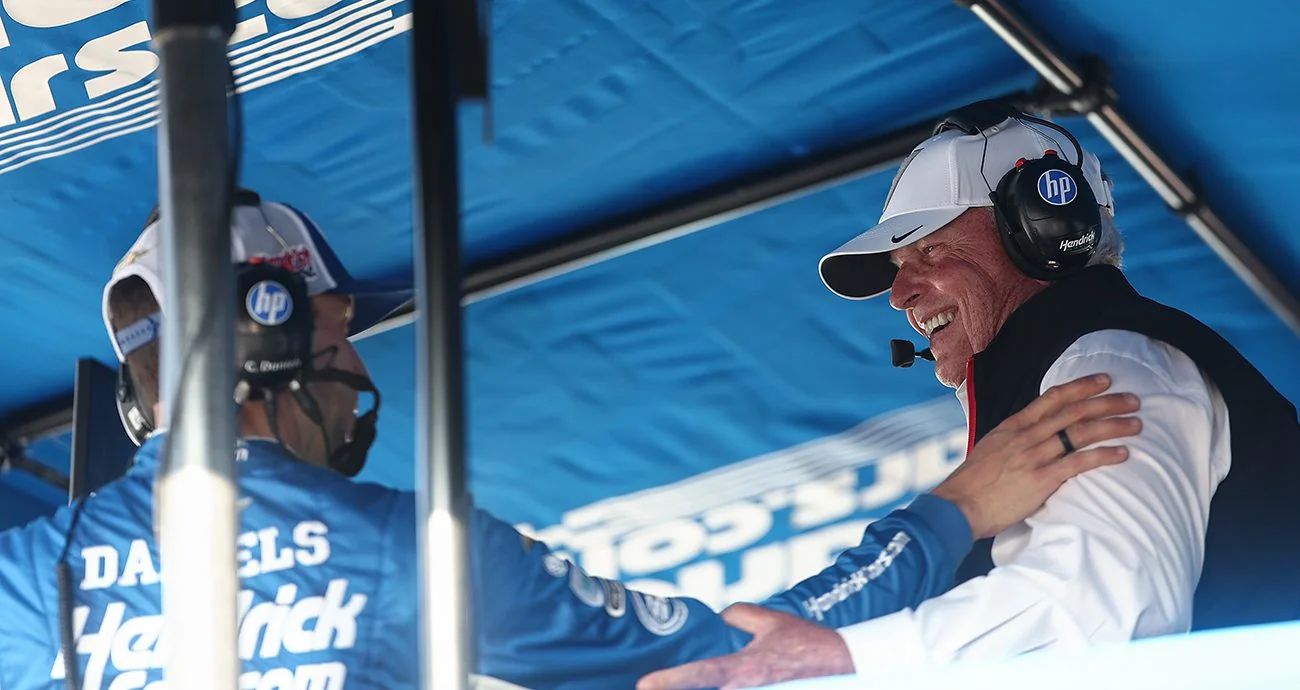
In NASCAR's pre-finale interview with Daniels, he described contingency work on parts and car systems, including how to respond to a battery or alternator problem. He also emphasized continuing to prepare a competitive car. Protecting a small scoring requirement did not mean arriving without a plan for speed or for mechanical trouble.
The season supplied evidence of both the strength and the limits of that approach. Phoenix remained a poor result despite the team's effort. Talladega then supplied the opportunity to rebuild the margin, and Martinsville demanded a recovery rather than an easy afternoon. A strong organization still has to execute the next race after a bad one.
Larson's 2026 championship was earned through that sequence: three Chase wins, productive scoring and enough recovery to arrive at Homestead with the arithmetic in his favor. The early clinch was the visible endpoint of work accumulated over the previous weeks, even while the last race continued to produce a very different battle for victory.
About the author
NASCAR Schedule Editorial Team
The NASCAR Schedule editorial team turns verified schedules, timing and scoring, official announcements and race-weekend context into direct answers for fans.
View all articles by this author →Join the discussion
Comments
Sign in with Google to comment. Keep it race-focused; new comments are reviewed before publication.
Loading comments…