Joey Logano’s Talladega Flip: What We Know About the Crash and Safety Response
A source-led account of Logano’s Talladega rollover, the two-cable recovery and the separate questions about communication and response to Riley Herbst.
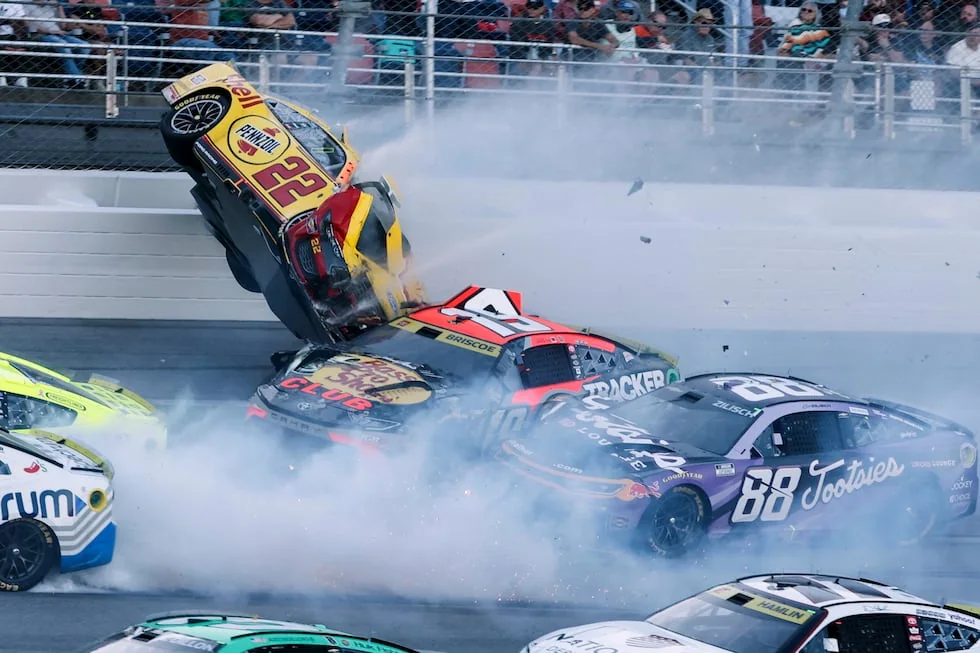
Joey Logano’s No. 22 Team Penske Ford overturned during a multicar crash on Lap 183 of the October 25, 2026, NASCAR Cup Series race at Talladega Superspeedway. Crews returned the car to its wheels, and Logano climbed out under his own power. NASCAR’s subsequent recovery explanation shows a coordinated operation involving vehicle recovery officials, medical personnel and two cables used to control the car’s movement.
The important questions extend beyond the spectacular replay. Who was talking to the driver? Why did the car need a controlled descent? And what explains the separate concern about help reaching Riley Herbst? As of October 29, the public record provides useful answers, while leaving some response and medical details outside what viewers can establish.
What happened to Logano on Lap 183 at Talladega?
The rollover followed contact in the high lane during the closing stage of the YellaWood 500. NASCAR identifies the incident as Lap 183. That lap number is a clearer reference than a short clip’s description of how many laps remained, particularly when the race subsequently ran beyond its scheduled distance. The stoppage lasted approximately 13 minutes, but that is the red-flag duration for the race, not a measurement of how long Logano waited for first contact.
How the high-lane contact became a rollover
The official race account places Ross Chastain ahead of Logano and Carson Hocevar behind him. The line compressed, contact unsettled the No. 22, and a subsequent collision involving Chase Briscoe’s No. 19 Toyota sent Logano airborne and onto his roof. Those are successive parts of the incident: the initial loss of control and the contact associated with the rollover should not be collapsed into an unsupported claim that one isolated action explains everything.
In NASCAR’s separate Inside the Race analysis, the panel examined the gaps between the cars and their closing rates. That is a useful way to watch the replay. A trailing car can be arriving faster just as the driver ahead reaches another bumper; the room available to absorb that difference disappears. The analysis discusses the tri-oval’s sensitivity to contact. It does not supply a disciplinary finding that anyone deliberately caused the crash.
Three questions therefore need different evidence: what started the loss of control, what happened when the car met other objects, and how the driver was recovered afterward. A television angle can help locate contact. It cannot, by itself, reveal every steering input, prove that a component failed or establish the driver’s physical condition inside the cockpit.
The finish does not describe the race he had been running
Logano was classified 34th, with 183 laps completed, after starting 16th and leading 23 laps. He had won Stage 2. The Cup Series results therefore show both a competitive afternoon before the crash and a poor final classification. Treating 34th as a summary of his pace misses the track position and stage performance he had already produced.
The distinction matters for the championship conversation, too. A stage result and a finishing position make separate contributions to a driver’s day; a wreck does not erase the earlier competition. NASCAR’s post-Talladega report placed Logano fifth in the Chase, 100 points behind Kyle Larson. That is the position after this race, rather than a prediction about the remaining events. The standings page is the better place to follow subsequent changes.
Who was doing what around the overturned No. 22?
The people around the car were carrying out different parts of the response. NASCAR’s October 27 recovery analysis separates officials working on the vehicle from AMR personnel working with the driver. That distinction makes the scene much easier to understand: someone inspecting the car or signaling a truck is not necessarily the person assigned to assess the occupant.
Vehicle recovery officials and medical personnel had different jobs
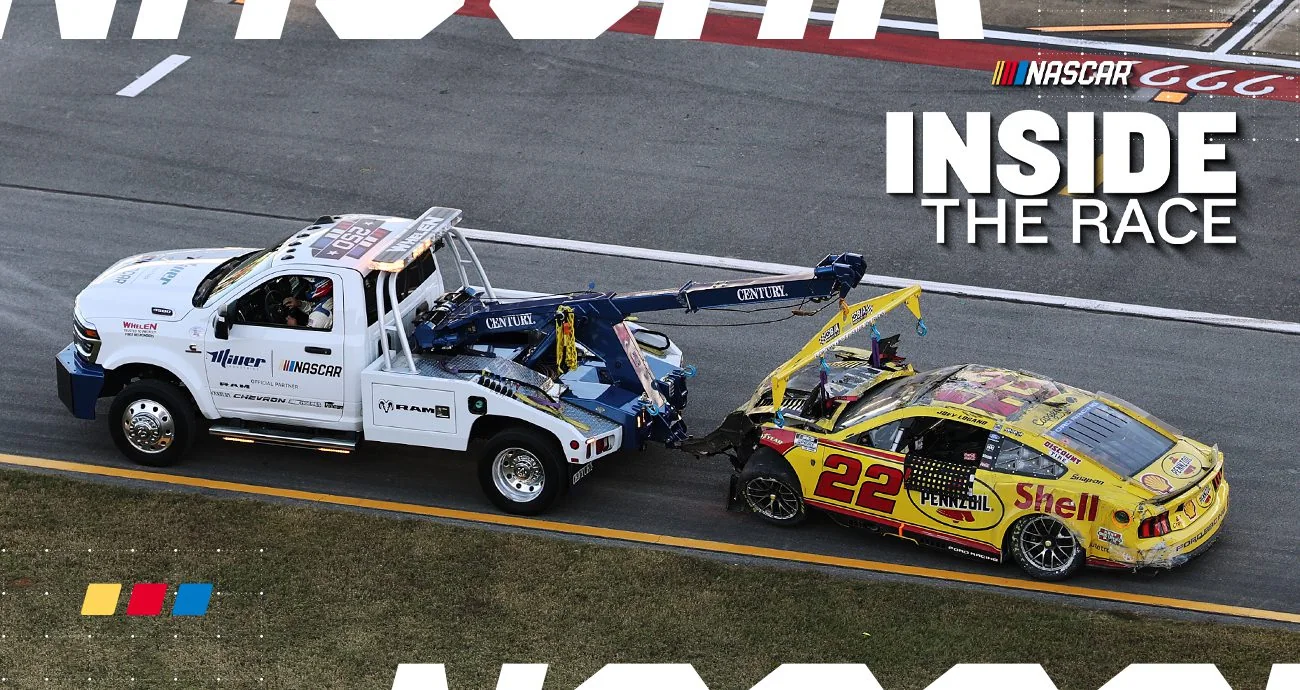
The program identifies the white-suited NASCAR officials as vehicle recovery personnel familiar with the car’s structure, while the blue-and-white AMR suits identify medical personnel. In the sequence discussed, an official checks toward the cockpit and then signals the recovery truck. The program also identifies an AMR worker communicating with Logano. Those actions belong to the same operation, but they serve different immediate purposes.
For a viewer, the practical question is which task each worker is performing. Preparing a damaged vehicle to move and maintaining contact with the person inside both matter. A worker looking away from the window may be watching the recovery equipment or the car’s position. Judging that individual solely by whether they are leaning into the cockpit can produce a misleading account of the wider response.
The analysis also notes AMR attention to Erik Jones nearby. That is a reminder that this was a scattered multicar incident, rather than a single stopped vehicle with every responder available at one window. It does not tell viewers the location of every team or the full dispatch sequence. The visible activity around the No. 22 is one part of a larger scene.
Contact at the window mattered as well as the recovery truck
Logano’s subsequent SPEED interview, reported by Kickin’ the Tires, adds the driver’s perspective. He described safety personnel speaking to him at the window and assuring him that extinguishers were ready. He praised how smoothly the car was returned to its wheels. That account helps explain what a distant grandstand or television view cannot convey: communication was taking place while the physical recovery was being prepared.
There are consequently several meaningful milestones to distinguish: someone reaching the driver, medical contact, equipment preparation, movement of the vehicle and the driver getting out. One timestamp cannot describe all of them. The official program discusses an assessment, but its presenter also acknowledges not knowing the medical protocol. It would be a step beyond that evidence to publish a supposed mandatory checklist or claim a particular medical test had been completed.
How did the crew turn the car back onto its wheels?
The recovery involved controlling the entire roll, including the moment when the car would otherwise fall onto its tires. In the official recovery explanation, the panel describes a two-cable arrangement: one initiates the rotation, and the other takes the load as the car comes over and is lowered. The goal visible in the sequence is a controlled return to the ground.
Thinking about the operation as two connected movements helps. Getting a car away from its roof answers the first problem; managing the rest of its travel answers the second. A successful start to the roll would be of limited comfort if the vehicle then dropped abruptly on the other side. The explanation draws attention to that transition rather than treating the first upward movement as the end of the job.
The second cable controlled the car after it passed its balance point
The second cable is important because the direction of the car’s tendency to rotate changes as it passes over center. In mechanical terms, lifting against the car’s weight and restraining its descent are different tasks. That is an explanation of the operation’s purpose, not a calculation of the loads involved: the public segment provides no cable-tension figures, attachment ratings or engineering measurements.
- Prepare and connect the recovery arrangement while contact with the driver continues.
- Begin rotating the overturned vehicle, keeping people clear of its movement.
- Control the descent onto the tires before the driver leaves the car.
Space around the car matters during that movement. Responders have to work close enough to attach equipment and communicate, yet avoid being in the vehicle’s path as its position changes. The program highlights keeping workers clear. That is another reason why the operation should be evaluated as a coordinated sequence, with the safety of the people handling the car part of the same concern as the person inside it.
Logano’s praise for the smoothness supplies an important additional perspective: he experienced the movement from the cockpit. His recollection of a prepared crew and a strap being passed through helps explain why the operation impressed him. It does not turn an interview into a recovery manual, or establish that precisely the same arrangement would be chosen for a differently damaged car or a different situation.
To follow the technical point in the video, watch the discussion around 2:11–2:43, where the panel identifies the cable controlling the final part of the movement. Those are timestamps within an edited analysis program, with commentary and pauses. They locate the explanation; they should not be used to calculate how many real seconds elapsed from the crash to the car reaching its wheels.
Why did radio silence and the Herbst response raise separate concerns?
Logano’s inability to reassure his team over the radio and the criticism of the response to Herbst were different problems. One concerned a broken channel of communication; the other concerned how quickly help reached another driver in a spread-out wreck. Combining them into a single story of universal delay would obscure the specific questions each raises.
A lost radio connection was not a medical update
Logano said after the race that his radios had disconnected and that he kept trying to communicate. In his later interview, he also described the loss of the in-car picture and the anxiety for those waiting to hear from him. His account of returning to an upset family makes the consequence of that silence understandable without requiring speculation about what his condition had been inside the car.
For a crew member or family member listening remotely, the absence of a reply leaves an alarming information gap. It does not identify why there is no answer. The driver’s later account provides a specific explanation for his communication difficulty, while the recovery analysis describes people speaking with him at the window. An unavailable team radio channel and direct contact at the car can therefore coexist.
That distinction changes how a replay should be narrated. Saying nobody could hear a radio response is a statement about a communication channel. Saying nobody had reached the driver is a statement about the physical response. The first does not establish the second, and neither should be turned into a diagnosis based on television silence.
The criticism about Herbst deserves its own answer
According to On3’s account of Mike Forde’s Hauler Talk explanation, an AMR team member ran from the No. 22 to Herbst’s No. 35 before the chase truck reached him. Forde acknowledged that NASCAR wanted a faster response and identified the incident as an area for improvement. That reported acknowledgment matters alongside the explanation of the personnel movement.
A truck not appearing beside a car and a driver receiving no contact are different observations. The distinction should sharpen the inquiry, rather than end it. Relevant follow-up questions include when the first responder reached Herbst, when additional equipment arrived and how resources were allocated across the wreck. The available explanation does not give a complete timestamped dispatch record from which to answer all three.
Fans can recognize the work that impressed Logano while still asking NASCAR to account for the response elsewhere. Praise for a controlled recovery of the No. 22 does not settle the No. 35 question. Equally, criticism involving Herbst does not erase evidence that personnel were communicating with Logano. The useful discussion keeps both drivers in view and asks for the specific information needed to assess each response.
What can fans conclude about safety after this crash?
The confirmed outcome is that Logano exited after the car was righted and spoke publicly about the crash. His account, the visible condition of the Ford and the explanation of the recovery are meaningful pieces of evidence. They answer different questions, however, and the encouraging outcome does not remove the need to understand why the car overturned or how the wider response can improve.
Logano’s comparison with 2021 is valuable driver testimony
Logano contrasted the incident with his April 2021 Talladega rollover, when he had described the structure pressing close to his head. After the October 2026 crash, he said he did not believe the structure had caved in around him in the same way and credited NASCAR’s work. That is a particularly relevant comparison because it comes from the driver who experienced both events, rather than an observer comparing two dramatic pictures.
His words describe what he perceived inside the car. A dimensional inspection or an engineering investigation would answer a different question: exactly how components behaved and what loads the car experienced. The public driver interview does not provide those measurements. Readers interested in the broader vehicle layout can use the stock-car construction explainer for context while keeping this specific crash assessment separate.
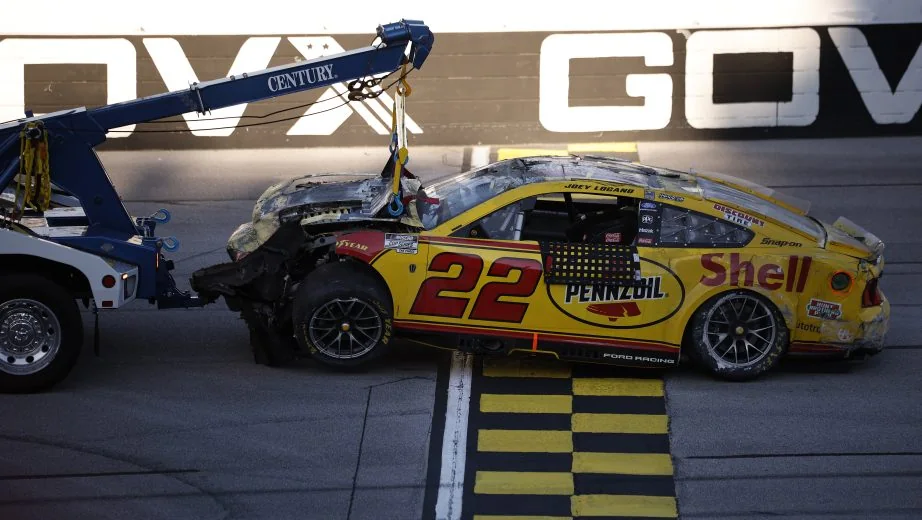
A useful safety discussion separates vehicle behavior, occupant protection and the response after the car stops. The first concerns the loss of control and rollover; the second concerns the space and forces around the driver; the third concerns access, communication and recovery. Improvement in one area does not automatically answer the other two. The same incident can demonstrate a carefully controlled recovery and still prompt questions about preventing another rollover.
The most useful follow-up would address those questions specifically: technical findings about the incident, any announced changes, and a clearer response chronology where NASCAR has acknowledged room to improve. Until such information is available, neither a declaration that everything worked perfectly nor a claim that the entire safety system failed does justice to the evidence.
For the racing calendar after Talladega, the upcoming weekend schedule provides the next sessions and races. On this incident, keep the focus on the details that matter: Logano’s experience, the controlled movement of the car, the communication gap for his family and the separate response question involving Herbst.
About the author
NASCAR Schedule Editorial Team
The NASCAR Schedule editorial team turns verified schedules, timing and scoring, official announcements and race-weekend context into direct answers for fans.
View all articles by this author →Join the discussion
Comments
Sign in with Google to comment. Keep it race-focused; new comments are reviewed before publication.
Loading comments…