What Is an Intentional Caution in NASCAR? Grant Enfinger’s Kansas Penalty Explained
Enfinger's damaged No. 9 stopped in Turn 3 late in the September 26 Kansas Truck race. NASCAR's two-lap ruling turns a common yellow-flag question into a concrete case about intent and safety.
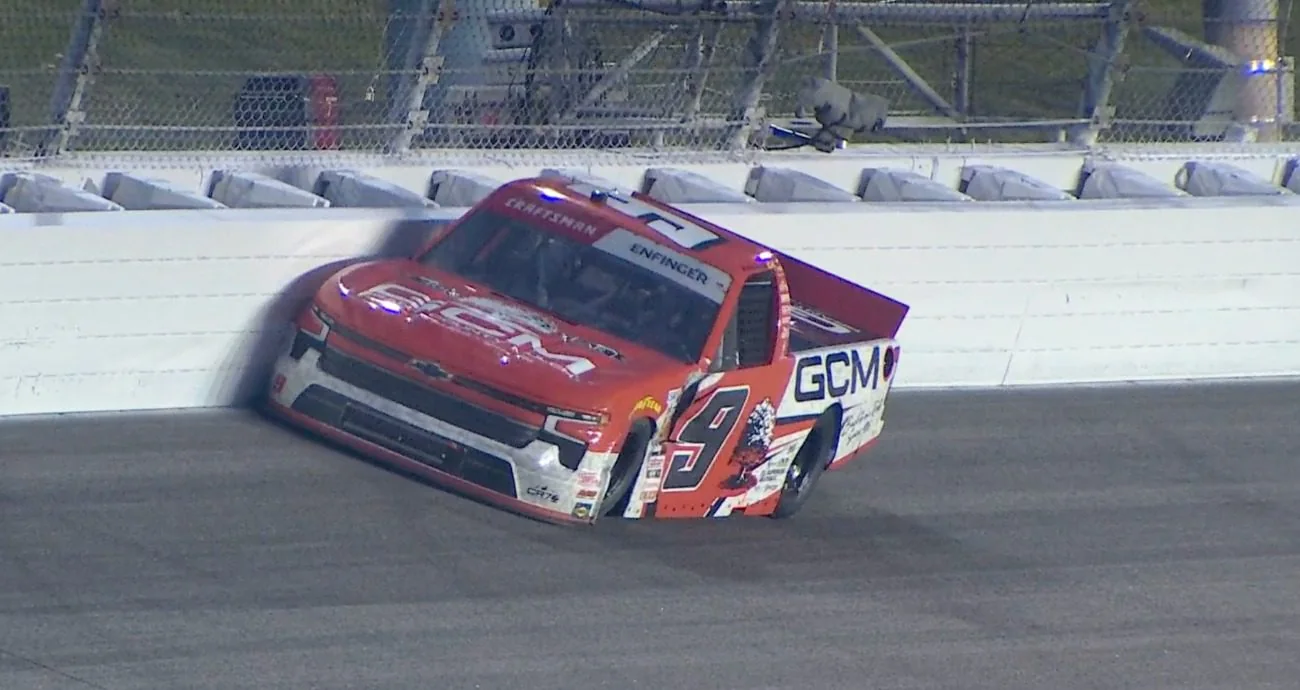
NASCAR penalized Grant Enfinger two laps after ruling that his late Turn 3 stop intentionally caused a caution in the September 26, 2026 Craftsman Truck Series race at Kansas Speedway. A tire went down and his No. 9 hit the wall first; the official infraction concerns the subsequent stop, not a claim that the mechanical problem was fake. NASCAR Statistics lists the No. 9 in the final caution report and records the two-lap sanction. Enfinger finished 31st, while Kaden Honeycutt won the race. The case shows how race control can respond to a genuine hazard and still penalize a deliberate attempt to create a yellow.
What happened to Grant Enfinger late at Kansas?
Grant Enfinger's No. 9 Chevrolet had a genuine late problem in the September 26, 2026 Race to Stop Suicide 200 at Kansas Speedway. NASCAR's incident video says a tire went down during a restart, and its race recap says Enfinger contacted the outside wall. Shortly afterward, the truck stopped in Turn 3 and a caution came out. Race control then ruled that Enfinger had intentionally caused that caution and assessed a two-lap penalty. Both parts of the story belong together: a real tire or wall problem can precede a separate judgment about how the driver handled the damaged truck.
Tire trouble and wall contact
The timing made the incident consequential. The race was well into its final scheduled segment, and the leaders had just reset after another yellow. Enfinger had been a factor earlier—his decision to stay out on older tires put him ahead of the field when heavy rain stopped the race. He led 14 laps in all, according to NASCAR Statistics. Once racing resumed, fresher tires and Honeycutt's speed shifted the lead away from him, but the No. 9 still had track position to defend and championship points to salvage.
Late in the run, the tire trouble and wall contact changed that calculation. A driver with a deflating tire may lose steering authority, create debris, or risk another crash while trying to continue. Nothing in the official ruling requires fans to believe the tire failure or wall impact was invented. NASCAR's problem was the subsequent stop in Turn 3, which race control judged to have been made with the purpose of bringing out a yellow. That is a narrower—and more useful—statement than declaring that Enfinger deliberately damaged his truck.
The stop in Turn 3 and the caution
The NASCAR Statistics cumulative report records the seventh and final caution as a four-lap period from 124 through 127, with the remark “No. 9 stopped Turn 3.” The race recap describes the wall contact on Lap 123. The infraction sheet uses lap field 122 for the intentional-caution line. Those adjacent numbers are not proof of three separate stops; race reports, lap scoring and penalty logs can attach an event to neighboring points in a sequence. To avoid inventing a frame-perfect chronology, it is enough to say that the tire/wall incident, Turn 3 stop and yellow occurred late, with roughly a dozen scheduled laps left.
For the field, a truck stopped in a turn is a real hazard regardless of what a driver intended. Officials still have to slow the race and protect the stopped vehicle and approaching competitors. For the No. 9 team, that immediate safety response did not erase a later disciplinary question: did Enfinger stop because he had no safe alternative, or did he stop in a way officials believed was meant to trigger a caution? NASCAR answered the latter in its formal penalty record. The complete classification remains available in the site's Truck Series results.
What does “intentionally causing a caution” mean?
An intentional caution is a yellow flag that a competitor deliberately causes or tries to cause through an action such as stopping or spinning, rather than a yellow that naturally follows an unavoidable incident. NASCAR's publicly available national-series penalty card from 2024 uses the key phrase “in the judgment of NASCAR Officials” and makes the penalty discretionary. That older public card is useful for understanding the category; the specific 2026 Kansas application is documented in the current race's own NASCAR Statistics infraction sheet.
NASCAR's published discretion standard
The important word is intentionally. A caution changes the race for everyone: cars or trucks slow, pit strategies open or close, a leader's interval disappears, and a restart creates new opportunities. NASCAR has long treated an engineered yellow as a race-manipulation problem. In an official 2013 explanation after a separate scandal, NASCAR named intentionally causing a caution among unacceptable ways to artificially alter finishing positions. The same explanation recognized normal racing contact, performance problems, fuel or tire management and alternative pit strategy as ordinary competition. That contrast remains a helpful conceptual guide, although the older communication should not be mistaken for a complete 2026 Truck Series rulebook.
The public 2024 penalty card also helps correct a common misconception: it did not list an automatic two-lap punishment for every intentional caution. It said NASCAR could penalize at its discretion. At Kansas, officials selected a two-lap sanction for the No. 9. A different incident could be judged differently depending on the evidence and applicable rules. The fact that the Kansas infraction sheet includes a specific two-lap note is the evidence for this penalty's size.
Why a damaged truck can still draw a legitimate yellow
There is no contradiction between a driver having a real failure and NASCAR ruling that the driver's later action intentionally caused a caution. Imagine a tire shredding so badly that the vehicle cannot steer or reach a safe lane: stopping may be the only responsible choice, and race control should protect that truck. Now imagine a vehicle can continue safely to pit road but is stopped on the racing surface to force a field reset. The same yellow may be necessary to protect the scene, yet the stop can be penalized afterward. The public record does not reveal every handling limit or radio message in Enfinger's cockpit, so that hypothetical is an explanation of the line, not a claim to know exactly what he could drive.
Officials cannot wait for a disciplinary hearing before displaying a safety flag. They react first to the obstacle, then decide whether the behavior that created it merits punishment. That sequence makes more sense than asking fans to choose between “the tire was real” and “NASCAR's penalty was real.” Both can be true. The site's general NASCAR rules guide covers what a caution does; the Kansas decision shows why causing one on purpose is a separate offense.
Why was Enfinger penalized two laps?
Because NASCAR formally judged the No. 9's Turn 3 stop to have intentionally caused a caution, it imposed a two-lap in-race penalty. That is the answer in the official infraction sheet, not a conclusion derived from a social-media replay. The report lists “Intentionally causing a caution” for Enfinger's truck and records “2 Laps” in the penalty notes. NASCAR's race recap independently describes the same call after the wall contact.
| Official record | What it says | What fans should not infer |
|---|---|---|
| Infraction report | No. 9 intentionally caused a caution; two-lap sanction noted. | The sheet does not publish all the radio or telemetry behind the judgment. |
| Cumulative race report | Final caution: laps 124–127, No. 9 stopped in Turn 3. | The caution log is not a transcript of Enfinger's intentions. |
| Final classification | Enfinger finished 31st with 129 of 134 laps completed. | The five-lap deficit is not a direct conversion of only the two-lap sanction. |
Why exactly two laps rather than one, a fine, or only a warning? The public documents establish the penalty NASCAR chose, but do not explain a mathematical tariff for the number two. The available NASCAR penalty card from 2024 treats intentional caution as a discretion call; it does not publish a universal two-lap amount. It would be misleading to tell readers that NASCAR automatically penalizes every intentional caution by two laps. The safe conclusion is that officials found the conduct crossed the line and selected two laps in this Kansas race.
The sheet also shows a separate No. 9 pit-road speeding infraction earlier in the race and a pitting-before-open entry near the late incident. Those are distinct procedural rows. They help explain why the team's day deteriorated, but they should not be folded into the intentional-caution sanction as if they were one compound charge. NASCAR's race recap summarized Enfinger's afternoon as a combination of the rain-delay lead, speeding, wall trouble and the two-lap call. Each occurred at a different point in the race.
Finally, a caution yellow serves two purposes that should not be confused. On the track it gives officials time to protect a stopped truck and everyone approaching it. Afterward, a penalty can remove the competitive advantage that race control believes was sought or deter repetition. The yellow was not “canceled” when the sanction was announced. The rest of the field had already slowed and lined up for a restart; the No. 9 then had to bear the consequence of NASCAR's ruling.
How did the yellow change the closing run?
The final caution mattered because it converted a leader's on-track advantage into a restart with everyone bunched together. NASCAR Statistics lists the No. 9 Turn 3 stop as the reason for caution seven, which ran from laps 124 through 127. Kaden Honeycutt had taken the lead back from Layne Riggs just before that period, and the field subsequently lined up for another green flag. For a leader, that means giving up a hard-earned time gap; for challengers, it creates one more chance to use lane choice, restart timing and clean air to alter the outcome.
A late reset for leaders and Chase contenders
The late restart had Honeycutt's No. 11 Toyota at the front with Riggs' No. 34 Ford outside. Earlier, Riggs had briefly grabbed the lead after a two-tire pit call, but Honeycutt's four-tire pace put the No. 11 back ahead. A yellow interrupted the attempt to stretch that lead. The restart did not change the ultimate winner: Honeycutt stayed in front to the finish, 1.358 seconds ahead of Christian Eckes. Riggs later brushed the wall in the last two laps and fell to 19th. The yellow created an opportunity, but it did not mechanically cause Riggs to overdrive the corner or erase Honeycutt's speed advantage.
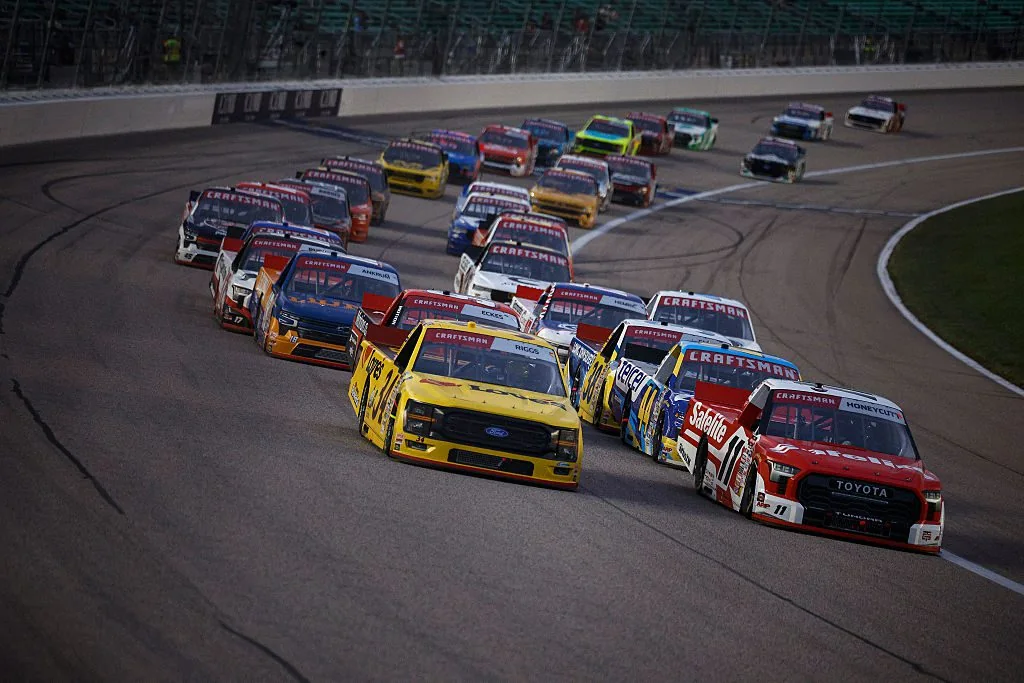
That is why an intentionally generated caution is more than a technical offense. It can force leaders to defend track position all over again, give drivers on fresher tires a new runway, and alter the number of green-flag laps left. In a short race, even four yellow laps can materially change what strategies are possible. NASCAR's cumulative report counts seven cautions and 47 laps under yellow for the 134-lap event, so the final caution was one part of an already interrupted afternoon rather than the only reset.
The difference between a safety response and a strategy benefit
Race control had to protect a stopped vehicle in Turn 3. Displaying the yellow was the correct safety mechanism for the hazard that existed at that moment. The later two-lap ruling addressed the separate question of whether the stop had been engineered to produce that mechanism. One can accept the yellow as necessary and still accept that a competitor who intentionally made it happen should lose position. Those ideas work together rather than conflict.
The public record does not prove whom, if anyone, Enfinger hoped to help. It would be speculative to say he aimed to aid Riggs, disadvantage Honeycutt, regain a lap or trigger pit stops. NASCAR's official line identifies the offense as intentionally causing a caution, not a named conspiracy or beneficiary. The race impact we can observe is narrower but concrete: the leaders lost their gap, the field restarted, Honeycutt held the lead, and Enfinger's own result worsened under the penalty.
What does the official final result show?
The final classification makes the scale of Enfinger's lost afternoon clear, but it is not a one-line explanation for every lost lap. NASCAR's full result lists him 31st of 36 starters after completing 129 of 134 laps. He had started 10th and led 14 laps, much of that from the sequence in which staying out on older tires put him in front before the long rain stoppage. His finish came after multiple separate problems, including pit-road speeding, tire and wall trouble, and the intentional-caution sanction.
Enfinger's finish and other recorded infractions
A two-lap penalty and a five-lap deficit at the checkered flag are not contradictory. The first is the amount officials assessed for the intentional caution; the second is the total difference between laps credited to Enfinger and the winner. A driver can lose additional laps while repairing damage, serving other penalties, or simply being unable to maintain the field's pace. The public final table does not allocate each of Enfinger's missing laps among those causes, so doing that arithmetic for him would be guesswork.
The event notebook also shows why a race can turn quickly in the Chase. Enfinger led when the field was halted by rain, but his older tires left him exposed when green-flag speed returned. He then had a pit speeding call and a late damaged-truck episode. The final result does not erase the fact that he briefly had track position and 14 credited laps led; nor does leading during a red flag make the eventual penalty less real. Those facts describe different phases of one long race day.
The winner and stage facts that anchor the story
Kaden Honeycutt won both stages and the race in the No. 11 Tricon Garage Toyota. He led 111 of the 134 laps and earned 75 points from the event, with a margin of 1.358 seconds over Christian Eckes. Brent Crews finished third. NASCAR completed postrace inspection without issues, confirming the winner. These verified numbers help show that the final caution did not turn the race into an Enfinger victory or overturn a dominant No. 11 performance.
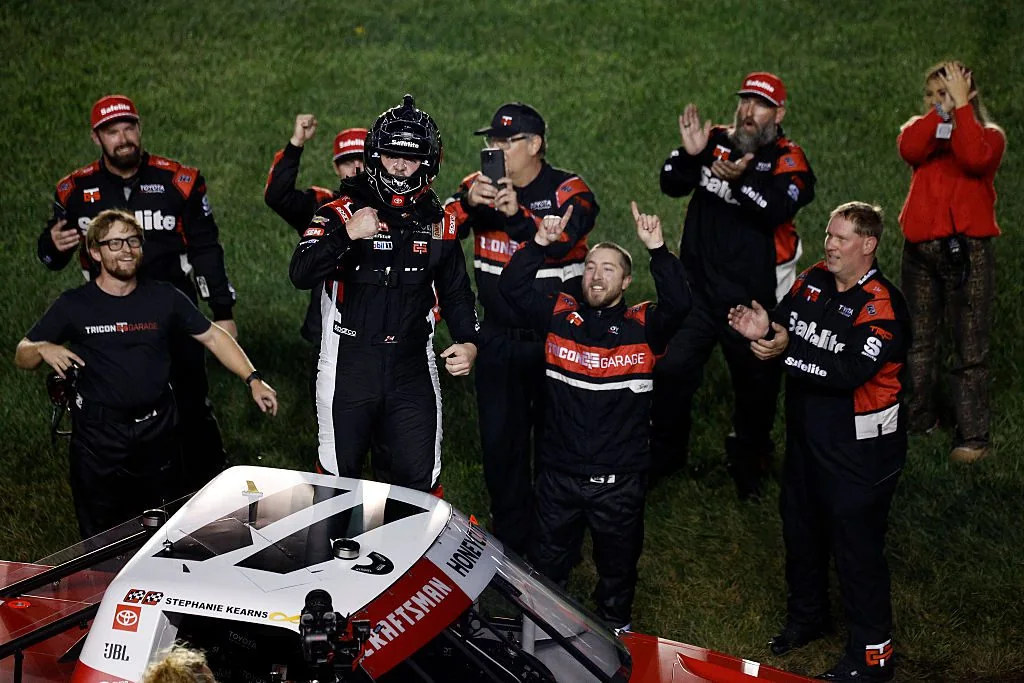
The post-Kansas Chase snapshot also put Honeycutt 37 points ahead of Riggs and Enfinger 118 behind Honeycutt in ninth. Those are race-two-of-seven figures, not permanent end-of-season positions. Readers following subsequent events should consult the site's current NASCAR standings rather than assume the Kansas gaps stay fixed. The penalty is important because it contributed to a damaging points day, but the complete result shows the No. 9 was already navigating several setbacks before the final whistle.
What is the practical lesson for fans and teams?
The Kansas ruling is a useful test case for one of NASCAR's hardest judgment calls. Race control cannot ignore a stopped vehicle in a live turn; it must protect drivers and workers. Yet it also cannot let a competitor choose a yellow flag as a strategy tool. Enfinger's tire problem and wall contact explain why the No. 9 was damaged. The published penalty says officials believed the later stop intentionally produced the caution. Both points should be retained when discussing the decision.
For a fan evaluating a future incident, four questions are more useful than declaring a driver guilty or innocent from a freeze-frame. First, what physical problem is independently visible or reported? Second, where did the vehicle stop relative to the racing groove and pit entry, and did a safe route appear possible? Third, what do official race-control records, team radio or onboard data actually disclose? Fourth, did NASCAR publish a penalty, and what precise category did it use? A video can establish the hazard, but seldom proves the private purpose behind a driver's action. The sanctioning body's judgment may rely on evidence that a public highlight does not contain.
Teams have the parallel practical problem: when a truck is damaged, the driver must choose the safest available option under pressure, often with incomplete information about tire integrity or steering. It is reasonable for a crew to tell the driver to avoid endangering others; it is not reasonable to assume that any stop in a convenient place will be treated as automatically unavoidable. The public NASCAR penalty language leaves room for officials to judge the specific maneuver and its intent. The two-lap call at Kansas shows that race control was willing to use that discretion during the 2026 Truck Chase.
The result should also be read proportionately. Enfinger was not disqualified from the Kansas race. He was not credited with a win that was later taken away. He finished 31st in the official result after a long, uneven afternoon, and the two-lap infraction is one documented contributor. Honeycutt's stage sweep and victory remained final after inspection. Those concrete outcomes are stronger evidence than a theory that the entire finishing order was engineered by one stop.
As later races unfold, a fresh results page and current penalty sheet are better guides than recycling the Kansas clip as a universal rule. The 2024 public card says the penalty amount is discretionary, and the 2026 Kansas paperwork shows how officials applied that discretion once. What the next damaged vehicle should do depends on its actual condition and the safety options available in that moment. What fans can insist on is careful reporting: name the real failure, name the official finding, and avoid turning unknown driver intent into an asserted fact.
About the author
NASCAR Schedule Editorial Team
The NASCAR Schedule editorial team turns verified schedules, timing and scoring, official announcements and race-weekend context into direct answers for fans.
View all articles by this author →Join the discussion
Comments
Sign in with Google to comment. Keep it race-focused; new comments are reviewed before publication.
Loading comments…