Sammy Smith’s 2027 TRICON Move: The Truck Deal and Talladega Double Explained
The confirmed TRICON agreement, two different Talladega winning entries, and the right way to evaluate Smith’s move between NASCAR national series.
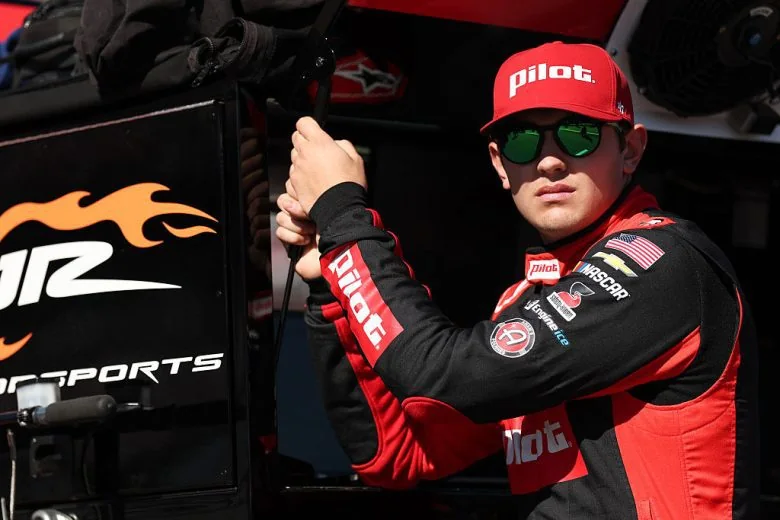
Sammy Smith will race full time for TRICON Garage in the No. 15 Toyota in 2027. That agreement is separate from the two Chevrolets he drove to victory at Talladega in October 2026: Spire Motorsports’ No. 7 truck on Friday and JR Motorsports’ No. 8 O’Reilly Auto Parts Series car on Saturday. He had not already switched to TRICON for those wins.
The contract announcement came before the double, which makes the chronology important. A driver moving between national series can still produce an excellent weekend in his current rides. As of October 29, the confirmed facts explain the seat and the race results; they do not reveal every private reason behind the career decision.
What exactly has TRICON confirmed for Sammy Smith in 2027?
TRICON’s October 23 announcement confirms a full-time Truck Series seat for Smith, rather than a test, a handful of appearances or an option awaiting a race result. The team named the entry and manufacturer. That is the firm starting point for understanding the move; the excellent weekend that followed should be added to the story without changing when the agreement was announced.
The full-time seat is the No. 15 Toyota
Smith is assigned the No. 15 Toyota Tundra TRD Pro for his first full Truck Series schedule. The team release uses the 2027 name, NASCAR FedEx Freight Truck Series. The completed October 2026 race belongs to the NASCAR Craftsman Truck Series season. A future naming change should not be used to relabel the event he has just won.
Full time matters because the commitment changes the scope of his season. An occasional start offers a chance to compete in a particular truck on a particular weekend. A full schedule creates a continuing program across the calendar, with repeated opportunities to develop the working relationship between driver and team. It is that larger commitment, rather than a first-ever Truck appearance, that the announcement establishes.
His teammates and the details still to come
The announced roster places Smith alongside returning and incoming drivers, with a separate rotating entry. TRICON identified these assignments:
| Entry | 2027 driver arrangement |
|---|---|
| No. 5 Toyota | Dawson Sutton, full time |
| No. 11 Toyota | Kaden Honeycutt, returning |
| No. 15 Toyota | Sammy Smith, full time |
| No. 17 Toyota | Gio Ruggiero, returning |
| No. 1 Toyota | Rotating driver lineup |
For fans evaluating the opportunity, the surrounding organization is relevant. Smith is joining an existing multi-truck operation, with named teammates, rather than an unannounced team being assembled around one driver. The roster does not establish an internal order of preference, guarantee identical results or tell us how every resource will be assigned. It gives a concrete picture of the program he is joining.
The release deferred crew chief pairings and team partnerships to later announcements. Those details deserve attention because a driver’s season is the product of a working group: preparation, communication and execution develop together. A known driver and truck number do not make an unannounced crew chief or sponsor a confirmed fact. Follow the subsequent team announcements for those pieces rather than filling the gaps with assumptions from an old paint scheme.
Why were his Talladega wins in two different Chevrolets?
Smith competed for two different organizations during the weekend, and neither was the Toyota team he will join in 2027. The driver is the link between the wins. The entries themselves belong to different series, use different numbers and carry their own team identities. Keeping those identifiers together avoids turning a career announcement into an imaginary midweekend transfer.
| When | Series and entry | Organization and manufacturer |
|---|---|---|
| October 23, 2026 | Truck Series, No. 7 | Spire Motorsports, Chevrolet |
| October 24, 2026 | O’Reilly Auto Parts Series, No. 8 | JR Motorsports, Chevrolet |
| 2027 announced program | Truck Series, No. 15 | TRICON Garage, Toyota |
The 2026 Spire and JR Motorsports entries were separate from TRICON
Friday’s victory goes to Smith in Spire’s No. 7 Chevrolet, with Brian Pattie identified as his crew chief in the official race report. Saturday’s win goes to his No. 8 JR Motorsports Chevrolet. Even a number can mislead when detached from the series: the No. 7 on the O’Reilly grid is not the same entry as the Spire truck carrying that number on Friday.
Chevrolet’s presence in both victories does not make Spire and JR Motorsports one organization. Manufacturer, team and entry number describe different relationships. The same driver can appear in more than one team’s results, and a new contract can change more than the badge on the vehicle. In this case, the announced Toyota program is a future change of both team and manufacturer.
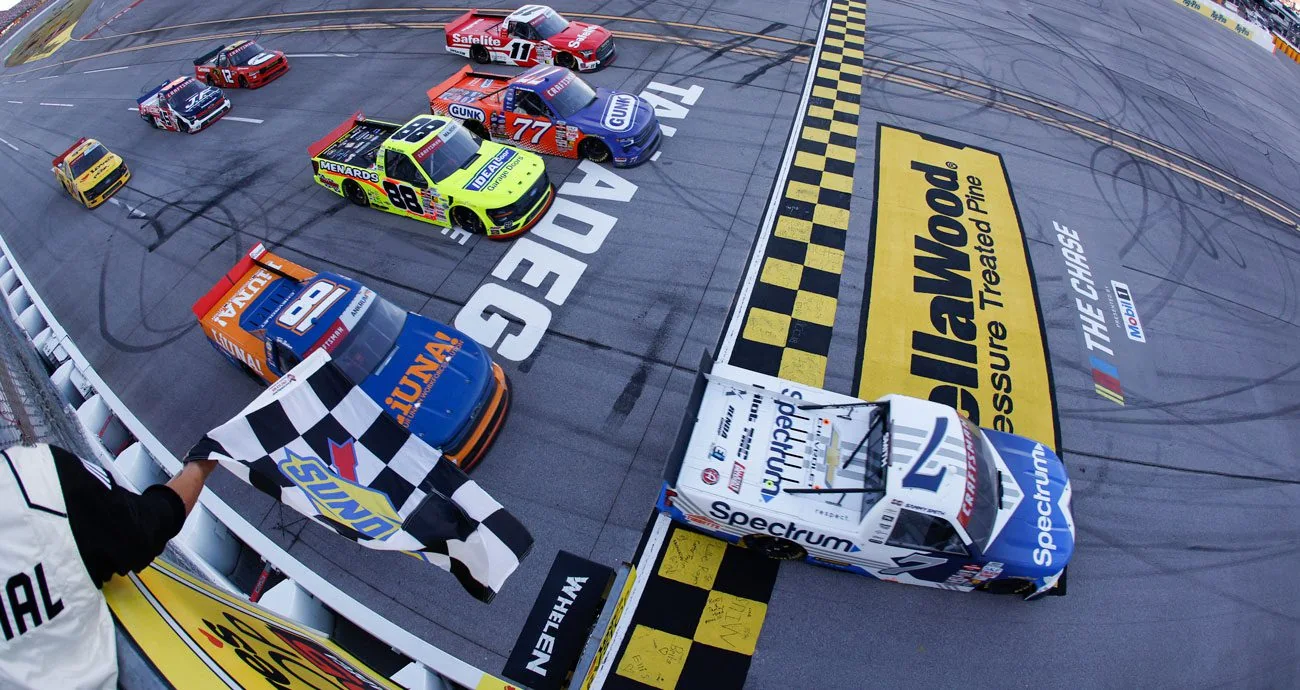
The Truck Series results and O’Reilly Series results are therefore separate records worth reading separately. The trophies belong to the same driver, but the preparation, crew work and race execution were delivered through different entries. Crediting the correct teams preserves an important part of what made the double possible.
The distinction also helps when reviewing photographs or career summaries. A 2026 victory picture can illustrate Smith’s experience without showing his future team’s equipment. Conversely, an announcement of a Toyota seat does not revise the manufacturer attached to earlier Chevrolet victories. The date and the series are essential parts of the identification, especially during a weekend when the same name appears at the top of two result sheets.
How did Smith turn the weekend into a Talladega double?
The two victories came through different patterns. Smith led the most laps in the Truck race, then won the O’Reilly race by leading only the last lap. Both required being in position when the finish developed, but the amount of time spent at the front was very different. That contrast is more revealing than describing the entire weekend as uninterrupted domination.
Friday brought his first Truck Series victory
The Love’s RV Stop 225 was Smith’s first Truck Series win, achieved in his 11th series start. He led 21 of the 86 completed laps and beat Tyler Ankrum by 0.091 seconds after NASCAR Overtime. The four-wide scramble behind him was the battle for second, not a four-way tie for the victory. The final classification and completed lap count establish the result more precisely than an isolated finish photograph.
Gio Ruggiero won Stage 1 and Tanner Gray won Stage 2. Smith’s race-leading lap total therefore did not mean he had swept the intermediate awards as well. The race included five cautions, and his opportunity had to survive changes in track position before the final restart. In his postrace comments, he credited Pattie and the Spire crew while emphasizing that they had put themselves in a useful position.
The closing sequence left him ahead of the group contesting the remaining top-five places. It is a reminder that a superspeedway finish has more than one contest unfolding at once: the winning margin, the battle immediately behind and the championship drivers’ relative positions can all tell different stories. Postrace inspection concluded without issue, confirming the victory.
Saturday rewarded a last-lap run rather than the most laps led
In The Progress Group 250, Carson Kvapil led 67 of 94 laps in the No. 1 JR Motorsports Chevrolet. Smith led one: the final lap. The margin was 0.084 seconds. NASCAR’s separate account of Kvapil’s afternoon describes the line breaking apart after Sam Mayer tried the low side, followed by the surges and blocks that opened the finish.
Smith received drafting help during the run, with NASCAR’s report describing a push from Justin Allgaier and Smith thanking Jesse Love afterward. Those accounts explain why the winner’s move was connected to the cars around him. They do not establish a hidden order requiring Kvapil to lose. The leader had to choose which threat to cover while the cars behind acquired runs in different lanes.
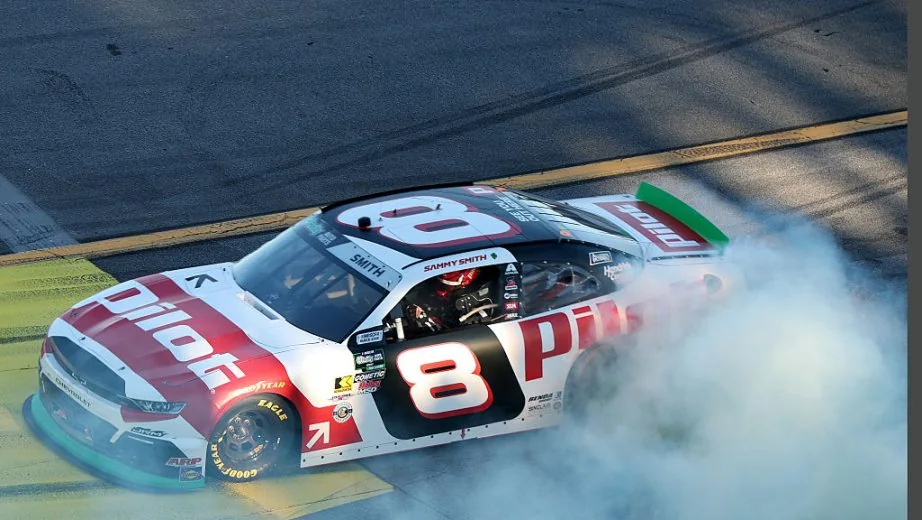
Kvapil won the first stage and Allgaier the second, while Smith ended a 53-race O’Reilly winless streak by taking the checkered flag. Inspection again confirmed the result. The three-win O’Reilly career total in Friday morning’s contract announcement was a snapshot before Saturday’s victory, not a number to repeat unchanged after the double.
What did the wins mean for points and the 2026 Chase?
Smith’s two wins were equally valid race victories, but they did not produce points in two driver championships. The official Friday Truck result lists him first with zero driver points. Saturday’s O’Reilly result lists him first with 63. Reading the points column alongside the finishing position answers the apparent contradiction: winning the race and being eligible to earn that series’ driver points are separate matters.
A race trophy and a championship points claim are different things
Under the 2026 points rules reproduced by Jayski, a driver may earn driver points in only one of NASCAR’s three national series and must declare that series before the first event of the season. Smith’s current-season program is in O’Reilly, and the actual Talladega classifications show how his two appearances were scored. Friday’s zero does not mean the win was removed, unofficial or awarded to the runner-up.
Owner points are a separate championship record attached to entries. A driver’s points column should therefore not be used to infer that the vehicle contributed nothing to its team’s owner standings. Equally, a future contract with a different organization does not transfer the credit for this weekend’s entry. The identity of the team that fielded the vehicle still matters when following owner competition.
The other common trap is applying the old elimination-era meaning of a win. NASCAR’s 2026 Chase is determined by accumulated points after the postseason reset, with no elimination rounds and no automatic advancement through winning. The 2026 Chase format guide explains that structure. A late-season victory is valuable, but it does not create a new championship berth or automatically settle the title.
A win pays 55 finishing points under the current system; a driver’s event total can also include other earned points. That is why Saturday’s official total should be read as the full race-day award rather than mistaken for a different basic value assigned to winning. Stage performance matters to the contenders even when the race winner is someone else, as Kvapil’s and Allgaier’s afternoon demonstrated.
After Talladega, NASCAR’s Smith profile listed him seventh in O’Reilly with 2,293 points, 108 behind the leader. That dated position belongs to the 2026 season. It is not a prediction for his TRICON campaign or a starting balance for next year. To follow subsequent changes, use the current standings and keep the series selected correctly: the driver’s Friday trophy, Saturday score and future seat answer three different questions.
How should fans judge the move without inventing a motive?
The useful question is what the confirmed opportunity allows Smith to do. Moving from a full O’Reilly schedule to a full Truck schedule changes the competition and the working environment. Calling that movement a verdict on his ability, without considering the actual program or hearing his explanation, says more about a series hierarchy than about the contract itself.
A change of series does not reveal the terms of a contract
Smith did explain part of his immediate approach. In his October 24 press appearance, he said he had devoted additional attention to executing Truck races at Talladega and Martinsville because that was where he was heading the following year. He also described being motivated to win again before leaving JR Motorsports. Those are concrete statements about preparation and competitive intent; they do not disclose salary, contract negotiations or every factor behind the move.
His record now includes O’Reilly victories in four consecutive seasons, as NASCAR’s driver profile notes after Talladega. That supports describing him as an established national-series winner. It cannot tell us which alternatives were available for 2027 or how he weighed them. A strong result after signing elsewhere and a decision to change programs are compatible facts, not a contradiction requiring an invented explanation.
The same care applies to expectations. Two wins at one superspeedway offer real evidence of execution in those races. They do not establish what every short-track, intermediate or road-course weekend will look like with a different team. Smith can bring experience to TRICON while still facing the ordinary task of building performance in a new program.
What to watch when the full Truck schedule begins
The first distinction will be sustained work across the calendar rather than isolated appearances. Watch whether Smith and the team convert starting position into useful race position, recover when circumstances change and complete competitive days across different track types. Those are practical evaluation criteria, not a prediction that one particular finishing average or win total is guaranteed.
The crew chief pairing will help define that working relationship when it is announced. Pit execution, adjustments and communication provide context for the final result, while comparisons with teammates can help distinguish a difficult day for the entire organization from a problem confined to one entry. A full-season assessment needs that context as well as the headline number of wins.
Use the series schedule to follow the events and the team’s announcements to follow the personnel. For now, the sequence is clear: a future No. 15 Toyota agreement, a Friday No. 7 Spire Chevrolet win, and a Saturday No. 8 JR Motorsports Chevrolet win. The Talladega double strengthens the story of his current racing; the full TRICON season will supply the evidence for judging the next chapter.
About the author
NASCAR Schedule Editorial Team
The NASCAR Schedule editorial team turns verified schedules, timing and scoring, official announcements and race-weekend context into direct answers for fans.
View all articles by this author →Join the discussion
Comments
Sign in with Google to comment. Keep it race-focused; new comments are reviewed before publication.
Loading comments…