Why Carl Edwards Left NASCAR and What He Is Doing Now
Carl Edwards left full-time NASCAR racing on his own terms. Explore his original explanation, championship near-misses, Hall of Fame career and documented 2026 media role.
Carl Edwards stepped away from full-time NASCAR racing in January 2017 because he felt fulfilled by his career, wanted more time for the people and interests outside it, and wished to preserve his long-term health. He was still a competitive Cup driver. As of November 11, 2026, his documented public return includes Hall of Fame recognition and Prime Video analysis, rather than an announced full-time driving comeback. Understanding the decision means separating what he said at the time, what he later clarified about Homestead, and what his newer media work actually involves.
What Carl Edwards is doing now in 2026
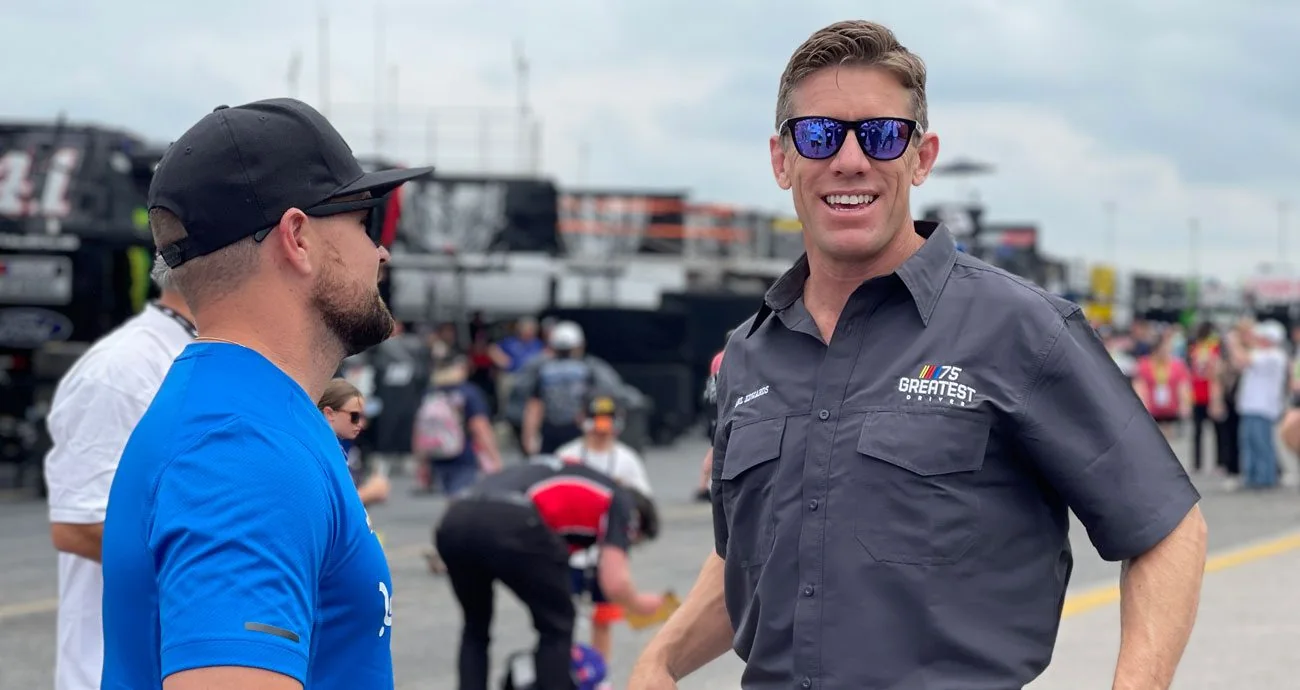
Carl Edwards' documented NASCAR work in 2026 includes television analysis, rather than a newly announced full-time driving job. In its May announcement, Prime Video's coverage plan named him for the Coca-Cola 600 desk, with features and remote contributions during the other four races in its package. That is a specific role in a May–June broadcast window, not a promise that he appears at every race or will return to the same job in 2027.
The distinction matters when a headline says Edwards is “back.” Fans may be seeing him discuss a restart or interview a driver without seeing him on an entry list. NASCAR's announcement separated the regular broadcast booth from the rotating trackside guests. Edwards' role belongs in that media picture; it does not change the date when he stopped racing full-time.
From a viewer's perspective, his usefulness is easy to understand. An experienced driver can explain why a car loses momentum after a defensive move, how being boxed into a lane changes a restart, or why a driver accepts a short-term track-position loss. Those are interpretations of racing situations, not evidence that Edwards has secretly prepared a comeback. Our guide to NASCAR announcers and pit reporters explains the different jobs around a broadcast.
His life away from the track is less public. In a dated 2024 Hall of Fame interview, NASCAR described his emphasis on family and disaster-relief work in Missouri. That supplies useful context for his priorities, but it does not establish his present-day schedule or whereabouts. As of November 11, 2026, the clearest answer to “what is he doing now?” is a documented return to public NASCAR life through recognition and media work, with any competitive return requiring a separate announcement.
Why Edwards stepped away in January 2017
Edwards announced his decision on January 11, 2017, at Joe Gibbs Racing headquarters. He was 37 and still had a front-running Cup ride. His original explanation set out three reasons: satisfaction with his career, a desire to spend his time differently, and the wish to leave racing healthy. None required him to believe he had suddenly lost the ability to compete.
He felt fulfilled by his racing career
The absence of a Cup championship did not make the whole career unfinished in his eyes. Edwards described the value of working his way into racing, meeting its challenges and becoming the best competitor he could be. A driver's personal measure of achievement can differ from the statistic a fan puts at the top of a résumé.
That helps explain why “he should have kept going until he won a title” misses his reasoning. It treats another season as an obligation, whereas his announcement described a decision about what he wanted from his own life. He could appreciate the opportunity to win again while deciding that repeating the commitment was no longer his priority.
He wanted time for life outside the cockpit
The time issue extended beyond weekends spent at a speedway. Edwards spoke about racing occupying his thoughts throughout the day. NASCAR's same-day account identified family as his main priority and reported that he had no formal replacement career arranged. The announcement was not the unveiling of a television job waiting in the background.
His exit also created a real sporting transition. Daniel Suárez's promotion to the No. 19 accelerated after Edwards stepped away, with Dave Rogers and the crew continuing into a rookie driver's Cup season. That was a change in how an existing competitive team would operate, rather than evidence that its previous driver had run out of options.
He wanted to protect his long-term health
Edwards' health explanation concerned preserving what he had. The contemporary reporting explicitly said he was not leaving because of an injury. His point was that racing carries risks and he wanted to limit his future exposure. It should not be rewritten as an undisclosed diagnosis or a claim that he had been medically forced out.
Taken together, the three reasons describe a voluntary decision with a personal timetable. His careful “stepping away” language left possibilities open, but did not commit him to a comeback. Acknowledging that distinction explains both the abruptness of his departure and why later invitations to appear at races do not contradict it.
Why the 2016 Homestead finale still matters
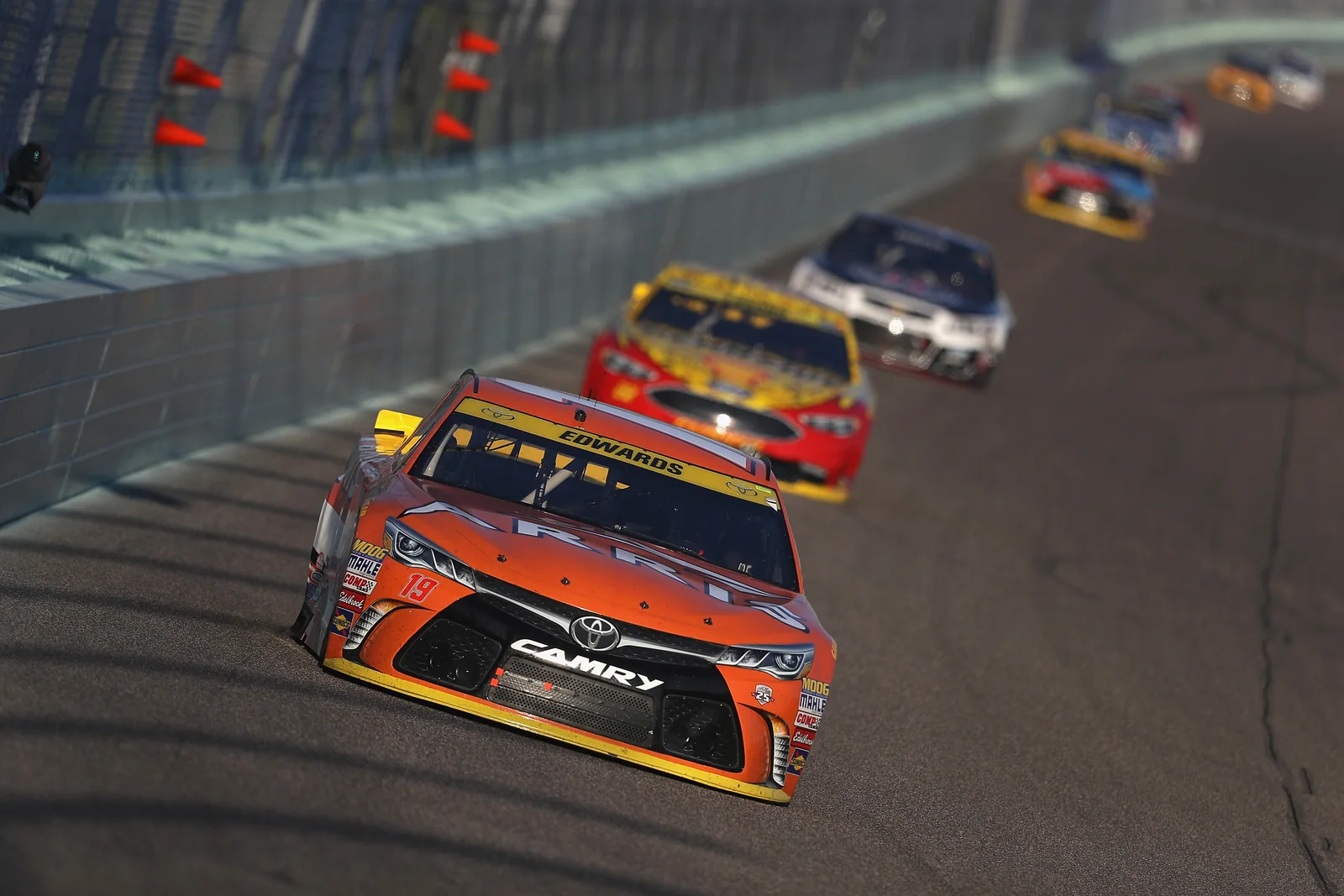
The November 20, 2016 Ford EcoBoost 400 explains why Edwards' departure surprised so many people. He was competing for the championship in a fast No. 19 Joe Gibbs Racing Toyota, not merely completing a farewell season. The NASCAR Statistics race-results sheet, archived by Jayski, records 47 laps led before his accident and a 34th-place finish. Jimmie Johnson won the race and the championship.
On the decisive late restart, Edwards lined up second beside leader Kyle Larson, with Joey Logano behind him. Logano moved low; Edwards tried to cover that lane; contact sent the Toyota into the wall. The contemporary NASCAR report explains the competitive pressure behind the move. Edwards later visited Logano's pit box and characterized it as hard racing.
For a viewer, this is the difference between having winning pace and surviving the moment when track position must be defended. A fast car can lose its opportunity in one compressed restart. But identifying that sporting mechanism does not establish a driver's private reason for leaving weeks later. The race outcome and the career decision are related parts of the timeline, not interchangeable facts.
How Edwards later described the turning point
Edwards addressed that distinction directly in a 2024 NASCAR interview: he rejected the idea that the way 2016 ended caused him to leave. He returned to time, fulfillment and gratitude rather than presenting his exit as a protest against the result. That clarification deserves more weight than a theory built around a dramatic crash clip.
A 2025 Hall of Fame reflection added another layer. Edwards described reassessing his priorities while preparing for the next season, and being grateful for the life that followed. Those reflections explain how a disappointing ending could be part of his perspective without making “he quit because he lost” an adequate account. Watching the full sequence, rather than only the impact, also preserves the distinction between championship pressure, his conduct afterward and a later personal choice.
The career behind the missing Cup championship
Edwards won 28 Cup races in 445 starts, but never a Cup championship. He did win the 2007 championship in NASCAR's second national series, then known as the Busch Series. His official Hall of Fame nominee biography places those accomplishments within a 72-win national-series career. Calling him a NASCAR champion can therefore be accurate only when the series is specified; calling him a former Cup champion is not.
The range matters as much as the total. His victories came in Cup, the second series and Trucks, and his Cup success included different types of tracks. The contemporary assessment of his résumé highlighted 38 second-series victories, six Truck wins, and a nine-win Cup season in 2008. Those figures describe sustained high-level performance, not one brief run of favorable results.
The 2011 championship was the narrowest example of how strong performance can end without the title. Edwards and Tony Stewart finished level on points after Stewart won the Homestead finale ahead of Edwards. Stewart's five wins to Edwards' one broke the tie. NASCAR's retrospective on that battle shows why a single “runner-up” entry hides so much: Edwards was competing at the front through the decisive race, and the championship required a tiebreaker.
His later move from Roush to Joe Gibbs Racing also matters. It changed the organization, manufacturer and number around him, yet the expectation remained that he could win. NASCAR's career gallery traces the transition into the No. 19 and victories in the 2015 Coca-Cola 600 and Southern 500. It is a useful reminder that his final team was not a sentimental holding position.
A fair reading of the career holds two thoughts together: he missed the biggest title, and he had already built a substantial body of work. Neither erases the other. The Cup champions list answers who won each season; it cannot, by itself, measure the quality of every driver who challenged them. Edwards' decision makes more sense when his achievements are evaluated across the full career rather than against one empty line.
How Edwards returned to NASCAR's public stage
Edwards' visibility grew through several different events, rather than one announcement reversing his departure. Recognition, an interview at a speedway, Hall of Fame induction and a broadcast contract each describe a different kind of involvement. Keeping them in order makes the story easier to follow and prevents an old appearance from becoming a supposedly new race deal.
The 2023 honors and renewed connection
In April 2023, Edwards was named among NASCAR's 75 Greatest Drivers. That was recognition of what he had achieved, not a statement about what he would race next. The honor gave a generation of fans another reason to revisit the No. 99 and No. 19 years.
At Nashville that June, he also addressed the obvious comeback question. In his direct interview, he explained that competing in Cup would require substantial preparation and complete commitment, while saying he had no driving plan then. He did not equate being welcomed back at the track with being ready to enter a race. The preparation point is important: familiarity with a venue and experience in past cars are not the same as a current competitive program.
Hall of Fame induction and the Prime Video desk
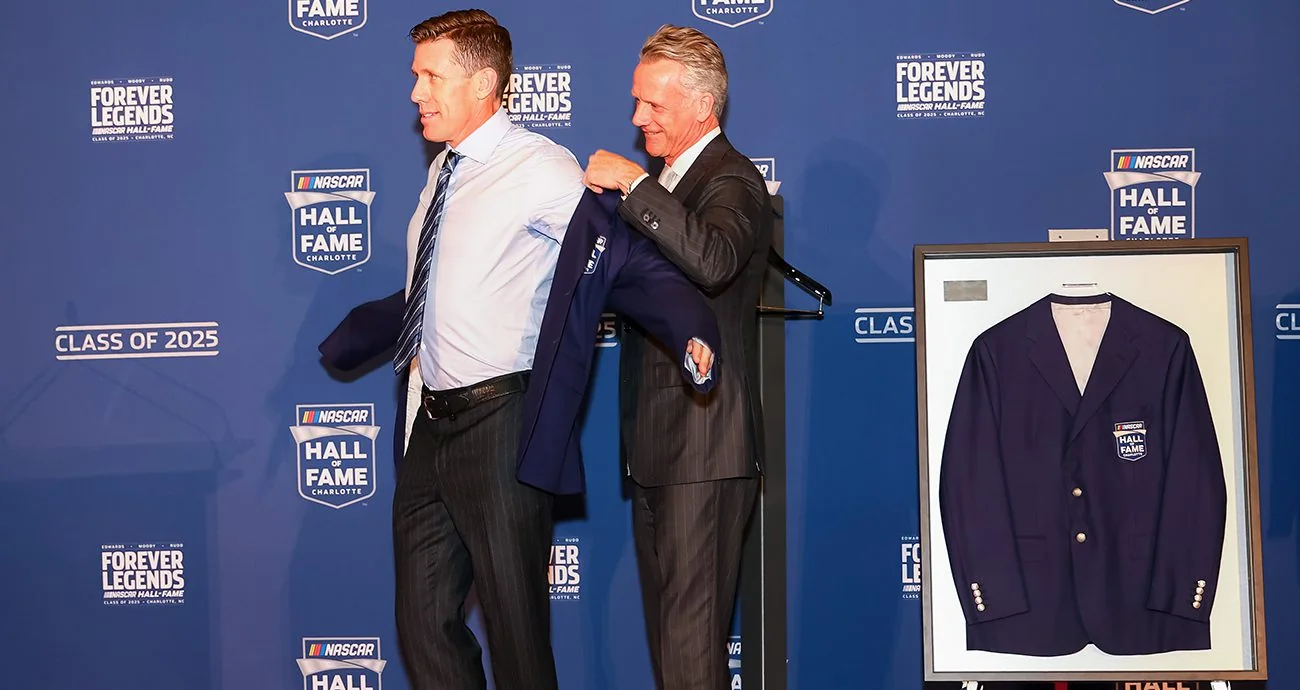
Election to the Class of 2025 came in 2024; the actual induction took place on February 7, 2025. Edwards joined Ricky Rudd and Ralph Moody in the class. His speech emphasized gratitude toward the people who had helped build his racing life. It was a celebration of a completed body of work, not a launch for a replacement Cup team.
On March 11, 2025, Prime Video announced him as a pre- and post-race studio analyst with Danielle Trotta and Corey LaJoie. That role gave his experience a practical new outlet. A broadcast can use a former driver's understanding of decision-making without asking him to reproduce a full-time driver's schedule.
For fans returning after a long gap, these dates explain why Edwards may seem newly present without appearing in the running order. To find the right race coverage, use the NASCAR viewing guide and the relevant year's broadcast listing. A 2025 announcement is useful history; it should not be mistaken for this week's assignment.
Is Carl Edwards coming back to drive for Kaulig?
A real Kaulig program has helped make the question plausible, but it does not establish an Edwards deal. Ram and Kaulig announced a rotating Free Agent Driver Program for the No. 25 Truck Series entry. A seat designed for guest drivers naturally invites suggestions about popular veterans. A suggestion remains different from a team naming its driver for an event.
The specific claim about Edwards driving the No. 25 at Nashville in 2026 does not match the official Nashville Truck entry list: it names Carson Ferguson in that truck. Kaulig's September Kansas race advance also describes its rotating drivers without announcing an Edwards appearance. Those are concrete checks of dated claims, not a guarantee about every possible future invitation.
What would actually confirm a race entry
A useful announcement names the driver, team, vehicle number, series and event. The race entry list then connects that announcement to an actual weekend, and qualifying and results establish what happened next. “Carl Edwards returns” beside a Ram photograph does not supply that chain. Neither does a television appearance at the same venue.
The series label is particularly important. Driving a Truck race would not automatically mean returning full-time to Cup, and a single guest appearance would not by itself create a championship campaign. Fans following a genuine announcement should be able to identify its place on the NASCAR schedule and distinguish a planned entry from a completed start.
As of November 11, 2026, an Edwards–Kaulig driving comeback is not established by the announcements discussed here. That conclusion does not require predicting that he will never race again. His own earlier explanation emphasized the preparation and commitment he would need. Until a specific new agreement is announced, keep the television role, a hypothetical guest drive and a full-time return as three different possibilities. Our driver-move tracker follows confirmed deals separately from open seats and rumors.
How to follow Edwards' NASCAR story from here
The most rewarding way to revisit Edwards is to watch more than his final crash. NASCAR's official classic-race collection links his first Cup victory at Atlanta in 2005, the 2011 championship finale and the 2016 Homestead race. That sequence shows a young winner, an established title contender and a veteran handling another high-pressure finish. Check the linked player for current availability.
Watch with a racing question in mind. At Atlanta, focus on how the final approach sets up a finish rather than waiting only for the backflip. In the 2011 finale, separate Edwards' own execution from Stewart's ability to answer it. At Homestead in 2016, follow the order before the restart and the lane choices that followed. These are different competitive problems, even though the later career narrative often compresses them into one championship near-miss.
Darlington in 2015 offers another useful comparison. NASCAR's race account describes how the No. 19 crew's final stop helped put Edwards ahead. Watching that kind of team contribution gives extra context when a former driver discusses pit-road execution on television. The driver is part of a larger process; the finish is the product of more than a fast qualifying lap.
For clips and replay discovery, use our official highlights and full-race replay guide. When looking for a new Edwards appearance, start with the dated broadcaster or event announcement. That keeps his historical driving career, later analysis and any future competitive news in the right place, while allowing each to be appreciated on its own terms.
About the author
NASCAR Schedule Editorial Team
The NASCAR Schedule editorial team turns verified schedules, timing and scoring, official announcements and race-weekend context into direct answers for fans.
View all articles by this author →Join the discussion
Comments
Sign in with Google to comment. Keep it race-focused; new comments are reviewed before publication.
Loading comments…