2027 NASCAR Cup Silly Season Tracker: Confirmed Drivers, Open Seats and Rumors
An evidence-labeled 2027 Cup lineup tracker current through September 8, 2026.

2027 NASCAR Silly Season at a glance
As of September 8, 2026, four major 2027 Cup moves are official: Corey Heim will drive 23XI Racing’s No. 35, Jesse Love will take the Wood Brothers No. 21, Austin Hill will run Richard Childress Racing’s No. 33, and Riley Herbst will move to Legacy Motor Club’s new No. 84. Legacy has also confirmed that John Hunter Nemechek will leave after 2026, but it has not named a replacement for the No. 42.
| Car/team | 2027 status | Evidence level |
|---|---|---|
| No. 35, 23XI Racing | Corey Heim | Team announcement |
| No. 21, Wood Brothers Racing | Jesse Love | Team announcement |
| No. 33, Richard Childress Racing | Austin Hill | Team announcement |
| No. 84, Legacy Motor Club | Riley Herbst | Team announcement |
| No. 42, Legacy Motor Club | Driver not announced | Vacancy confirmed |
| No. 60, RFK Racing | Ryan Preece | Option exercised |
| No. 34, Front Row Motorsports | Todd Gilliland | Contract extension |
| No. 48, Hendrick Motorsports | Alex Bowman for 2027 | One-year extension |
This is a tracker, not a prediction board. “Confirmed” means a team, driver or NASCAR report tied the person to a specific ride. “Open” means the organization has announced a departure without a successor. Everything else remains unresolved, even if a rumor sounds plausible. For the baseline 2026 roster, see the current Cup drivers and teams guide.
The most important pattern is that the rookie market and team-expansion market overlap. Heim replaces an incumbent; Love replaces Josh Berry at Wood Brothers; Hill formalizes RCR’s post-Kyle Busch No. 33 plan; Herbst gets a newly created Legacy seat. Those are four different transaction types, and they create different downstream opportunities.
The four moves already reshaping the 2027 Cup grid
The confirmed moves are not interchangeable. One promotes a long-term development driver into an existing car, two elevate O’Reilly Series contenders into traditional Cup programs, and one uses a new chartered entry to keep an incumbent in the series. Understanding those paths explains why some doors closed while the No. 42 remains genuinely open.
Corey Heim takes over the 23XI No. 35
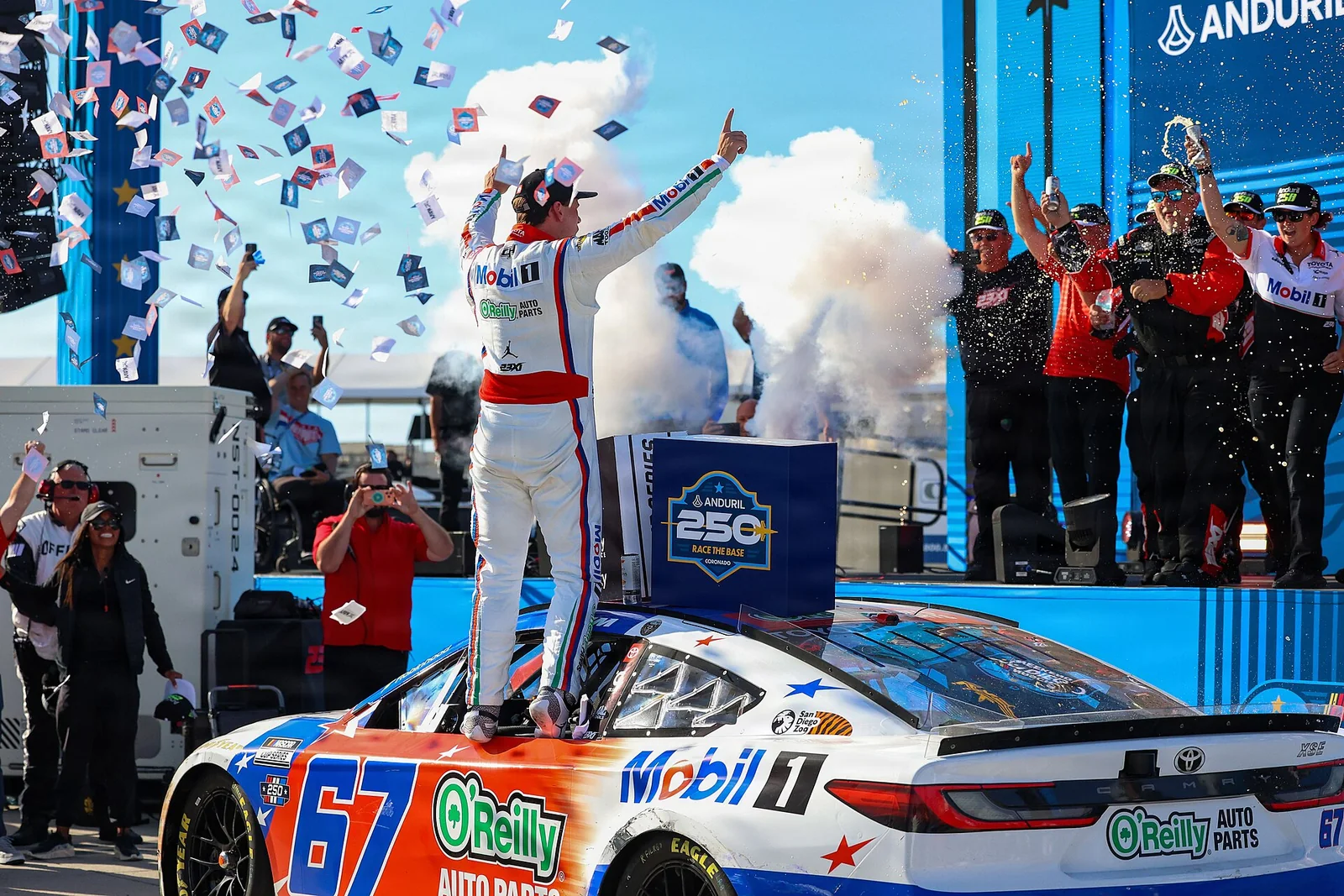
23XI Racing named Corey Heim as the full-time driver of the No. 35 Toyota for 2027. It is the cleanest succession in the market: Heim has served as a 23XI development driver since 2024, made Cup starts for the organization and built a championship-level Truck résumé. The team used a part-time 2026 schedule to expose him to different track types before handing him a complete season.
The move is also a replacement, not expansion. Riley Herbst’s two-year run in the No. 35 ends after 2026, so Heim joins Bubba Wallace and Tyler Reddick inside the existing three-car structure. That continuity matters for information flow. Heim can learn from two established teammates, while 23XI evaluates him against the same Toyota simulation, engineering and pit-process system he already knows.
Jesse Love and Austin Hill complete two different promotions
Jesse Love will move to Wood Brothers Racing’s No. 21 Ford after winning the 2025 O’Reilly Auto Parts Series championship and defending that title in 2026. The 21-year-old has already made Cup starts, but Wood Brothers represents a full-time change of manufacturer and organization. The historic single-car team’s technical alliance with Team Penske gives Love a larger Ford data group while still making his own car the weekly focus.
Austin Hill’s path stays inside Richard Childress Racing. RCR confirmed Hill for a full 2027 season in the No. 33 Chevrolet after he had accumulated Cup experience alongside his O’Reilly program. The number is important because RCR temporarily retired Kyle Busch’s No. 8 after Busch’s death in May. Hill is not being presented as a direct substitute for Busch’s legacy; he is leading the next competitive chapter under a number RCR already used.
Both promotions remove accomplished drivers from RCR’s second-tier lineup, which is why the team separately announced Chandler Smith and Carson Brown for its 2027 O’Reilly cars. The Cup moves therefore have a visible development-chain effect rather than being isolated contract news.
Riley Herbst moves to Legacy’s new No. 84
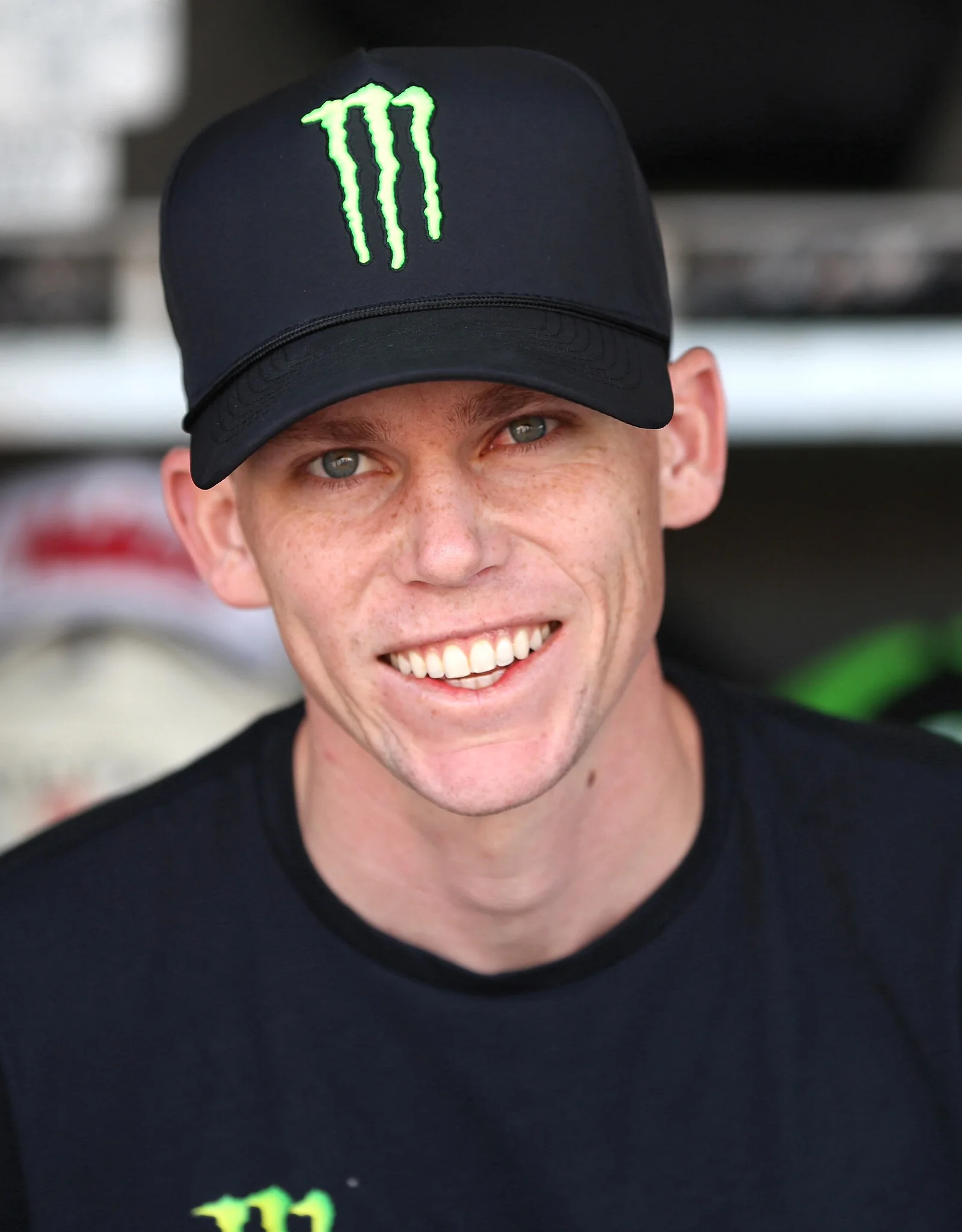
Herbst found a seat without leaving Toyota. Legacy Motor Club announced him for a newly created third full-time entry, the No. 84, with continued Monster Energy backing. That distinction corrects an easy misconception: Heim did displace Herbst from the 23XI No. 35, but Herbst’s Legacy opportunity does not depend on replacing John Hunter Nemechek in the No. 42.
Legacy’s expansion gives Herbst a reset after two Cup seasons while preserving manufacturer familiarity. The No. 84 will demand additional personnel, cars and pit-crew depth, so the move is also an organizational capacity test. A sponsor-backed driver can help make expansion possible, but the competitive verdict will come from how quickly the third entry reaches the performance level of its teammates.
For a current performance check on every driver involved, use the NASCAR standings. A contract announcement defines the opportunity; it does not settle how a rookie or new pairing will perform.
Extensions that remove major seats from the market
Silly Season trackers often overemphasize moves and understate retention. Three 2027 decisions matter precisely because they close plausible destinations. They reduce the number of competitive cars available to a free agent and prevent every short stretch of poor results from becoming a vacancy.
Ryan Preece stays with RFK Racing
RFK Racing co-owner Brad Keselowski confirmed that the organization exercised Ryan Preece’s option for the No. 60 Ford. Preece joined RFK in 2025 on a multiyear arrangement, and the option allows the team to evaluate development across more than one campaign. His 2026 Clash victory supplied a headline, but RFK’s decision is better read as commitment to the overall trend than a reaction to one result.
The confirmation removes the No. 60 from rumor lists and keeps RFK’s three-car data structure intact. For Preece, continuity means another winter with the same engineering language and teammates. For the market, it means a potential candidate cannot simply point to the No. 60 as an assumed landing place.
Todd Gilliland remains a Front Row cornerstone
Front Row Motorsports extended Todd Gilliland to continue in the No. 34 Ford. The team framed the 26-year-old as a long-term piece of its three-car organization, making the contract more than a one-season bridge. Driver continuity is particularly useful for a team managing multiple entries because feedback from the same person helps measure whether offseason changes actually improved the car.
Gilliland’s agreement also limits speculation around Ford’s available Cup inventory. Unless Front Row announces another change, a rumor connecting a prospect to the No. 34 conflicts with a direct team statement. Trackers should mark the car occupied and move on.
Alex Bowman gets one final full-time season in the No. 48
Hendrick Motorsports signed Alex Bowman to a one-year extension covering 2027, and Bowman announced that he will step away from full-time Cup competition afterward. That creates an unusual two-year timeline: the No. 48 is closed for 2027 but becomes a known 2028 question. Mixing those seasons is the source of many misleading headlines.
The extra year gives Hendrick time to plan a transition instead of making a rushed 2027 choice. It also gives Bowman a defined final full-time campaign with the team. Any candidate discussion belongs to the 2028 market unless Hendrick changes its announced plan. Fans following when that future season’s races become official can use the 2027 schedule release guide, but schedule timing and driver contracts are separate processes.
Legacy Motor Club still has a No. 42 decision to make
The No. 42 Toyota is the clearest confirmed vacancy in the current story. Legacy Motor Club has said John Hunter Nemechek will not return after the 2026 season. The organization did not pair that announcement with a successor, and Riley Herbst’s No. 84 announcement the next day filled a different, newly created car.
John Hunter Nemechek is officially leaving
Nemechek joined Legacy’s full-time Cup lineup for 2024, but the team announced on September 2 that the relationship will end after 2026. The wording establishes a departure, not a retirement and not a destination. Nemechek remains the current No. 42 driver through the end of this season, so performance and team obligations continue while both sides plan separately for 2027.
Reports surrounding the split have generated colorful theories, including claims about internal confrontation. Jimmie Johnson publicly pushed back on that narrative. Without on-record evidence, a tracker should not convert a denied rumor into the explanation. Personnel decisions can combine results, sponsorship, chemistry and long-term planning; Legacy has not published a complete causal account.
A vacancy is confirmed; a replacement is not
The disciplined status label is therefore simple: No. 42 — open, replacement not announced. That is more useful than a speculative list presented as a depth chart. A credible candidate would need a connection supported by team comments, a reputable report or a formal announcement. Cup experience, Toyota history and sponsorship may make a name logical, but logic alone is not reporting.
The same standard applies to Nemechek. He has national-series experience and prior Toyota relationships, yet no official 2027 program had been announced by September 8. “Free agent” describes his market status; it does not identify his next series or team. Future updates should change the table only when evidence changes, with the date visibly revised.
Legacy’s decision will matter beyond one car because it completes a three-driver structure alongside Erik Jones and Herbst. The team must decide whether the No. 42 needs experience to anchor expansion, a younger development bet, or a commercially supported driver. That is an editorial description of the choice—not a claim about which way Legacy will go. Follow the NASCAR analysis archive for the eventual announcement rather than treating social engagement as confirmation.
Why expansion and car numbers matter this year
A driver name does not tell the whole Silly Season story. Fans also need to know whether a team is swapping drivers, adding capacity or renumbering an existing operation. Those distinctions determine whether the market gained a seat and why another driver became available.
23XI promotes from within rather than adding a seat
Heim’s No. 35 announcement is a succession inside 23XI’s established three-car lineup. The team did not announce a fourth full-time car; it chose its development driver over the incumbent for one existing seat. That makes the performance comparison relatively direct. Heim inherits an organization and number already racing weekly, while Herbst takes his sponsor and experience elsewhere.
For 23XI, the advantage is preparation. Heim’s part-time Cup starts were designed to reduce the jump from Trucks to a full Cup calendar. For the wider market, the consequence is that a top prospect is no longer available and no additional Toyota seat appeared.
Legacy’s No. 84 creates a third full-time opportunity
Legacy’s No. 84 is different because the organization is expanding. The new car gives Herbst a place without occupying the No. 42 vacancy. It also expands Toyota’s weekly data pool inside Legacy, provided the team can staff and execute the third entry at a comparable level.
A charter supports guaranteed starting access, but competitive capacity still requires race cars, engineers, road crew, pit crew and leadership. Third-car expansion can accelerate learning when data is shared well; it can also stretch an organization if resources are not ready. That makes the No. 84 one of 2027’s most important team-development stories, independent of Herbst’s individual results.
RCR’s No. 33 carries a sensitive transition
RCR moved from the No. 8 to the No. 33 following Kyle Busch’s death and said the No. 8 would be reserved in connection with Busch’s family legacy. Austin Hill then gained race experience in the renumbered entry before receiving the full-time 2027 assignment. The correct description is that Hill will lead RCR’s No. 33 program—not that he is taking over Busch’s identity.
That framing respects both competitive reality and the reason the number changed. Hill still faces the normal Cup challenge of adapting his race craft to longer events, deeper fields and a car that reacts differently in traffic. RCR must also rebuild continuity around the driver and crew. Fans can locate every weekend on the NASCAR schedule, but the No. 33’s progress will be a season-long evaluation rather than a one-race verdict.
Across all three organizations, the lesson is the same: count cars before counting openings. A new number may represent expansion, a renamed existing car or a part-time entry. Only a team announcement can settle which one it is.
How to read rumors without turning them into “news”
Silly Season is fun because negotiations happen before public confirmation. A useful tracker can acknowledge that uncertainty without manufacturing certainty. The test is not whether a move feels logical; it is whether the evidence supports the label attached to it.
Use a three-level evidence test
- Confirmed: a team or driver announcement names the car, season and role, or a direct team executive states the agreement on record.
- Credibly reported: a reputable NASCAR reporter cites sourced negotiations or an expected agreement, but the team has not announced it. This is still not a signed lineup entry.
- Speculation: fans connect performance, manufacturer history, sponsor relationships or an open seat without sourced reporting.
The status can move upward as evidence arrives. Riley Herbst, for example, went from an obvious market question after Heim’s promotion to confirmed No. 84 driver only when Legacy announced it. The No. 42 remains open because the departure is official while the replacement is not. That asymmetric evidence is common and should be displayed honestly.
Sponsor clues and social follows are not contracts
Sponsorship matters because teams need funding and brands may follow drivers, but a logo is not proof of a future ride. Agreements can be negotiated separately, shared across entries or changed before announcement. The same is true of social-media follows, deleted posts, shop sightings and vague podcast comments. They can generate questions, not confirmed rows in a table.
Performance arguments also require restraint. A driver’s place in the current standings helps explain pressure, but contracts reflect more than points: technical feedback, sponsor commitments, organization fit and timing all matter. A bad month does not automatically open a car, just as a hot streak does not create one.
This tracker will therefore age by visible updates, not silent rewrites. When a team names the No. 42 driver or Nemechek confirms a destination, the relevant status should change with a new “as of” date. Until then, “unknown” is not a content gap. It is the accurate answer.
2027 NASCAR Silly Season FAQ
Who are the confirmed 2027 Cup rookies?
Corey Heim and Jesse Love are confirmed for their first full-time Cup seasons, with 23XI Racing’s No. 35 and Wood Brothers Racing’s No. 21 respectively. Austin Hill is also confirmed for a first full-time Cup campaign in RCR’s No. 33 after making earlier part-time starts. NASCAR determines official Rookie of the Year eligibility, so “new full-time driver” should not be treated as an eligibility ruling.
Is the Legacy Motor Club No. 42 seat open?
Yes. Legacy confirmed John Hunter Nemechek will depart after 2026 and had not announced his replacement as of September 8. Riley Herbst is joining the separate new No. 84 entry, so his signing does not fill the No. 42.
Where will John Hunter Nemechek race in 2027?
No destination had been announced publicly by September 8. He should be listed as a free agent or destination unknown, not assigned to a rumored team. A future team or driver announcement will settle the question.
When will the 2027 Cup lineup be final?
There is no single mandated public deadline for every driver announcement. Teams may confirm programs through the offseason, and part-time or open entries can remain unsettled close to Daytona. The practical lineup becomes clearer as contracts, charters, sponsors and entry plans are announced. The NASCAR schedule answers where the series races; it does not guarantee that every driver pairing is final.
For now, the core picture is firm: Heim, Love, Hill and Herbst have named 2027 homes; Preece, Gilliland and Bowman have confirmed continuity; Legacy’s No. 42 and Nemechek’s destination are unresolved. Any tracker that goes further should show its evidence—or call the extra names speculation.
About the author
NASCAR Schedule Editorial Team
The NASCAR Schedule editorial team turns verified schedules, timing and scoring, official announcements and race-weekend context into direct answers for fans.
View all articles by this author →Join the discussion
Comments
Sign in with Google to comment. Keep it race-focused; new comments are reviewed before publication.
Loading comments…