Why Rainouts Set the 2026 NASCAR Chase Starting Lineup: The 70/30 Metric Explained
A dated, fan-first explanation of the 2026 Cup Chase rainout starting-lineup metric, with Kansas worked examples, the competing fairness arguments and links to official grids/results.
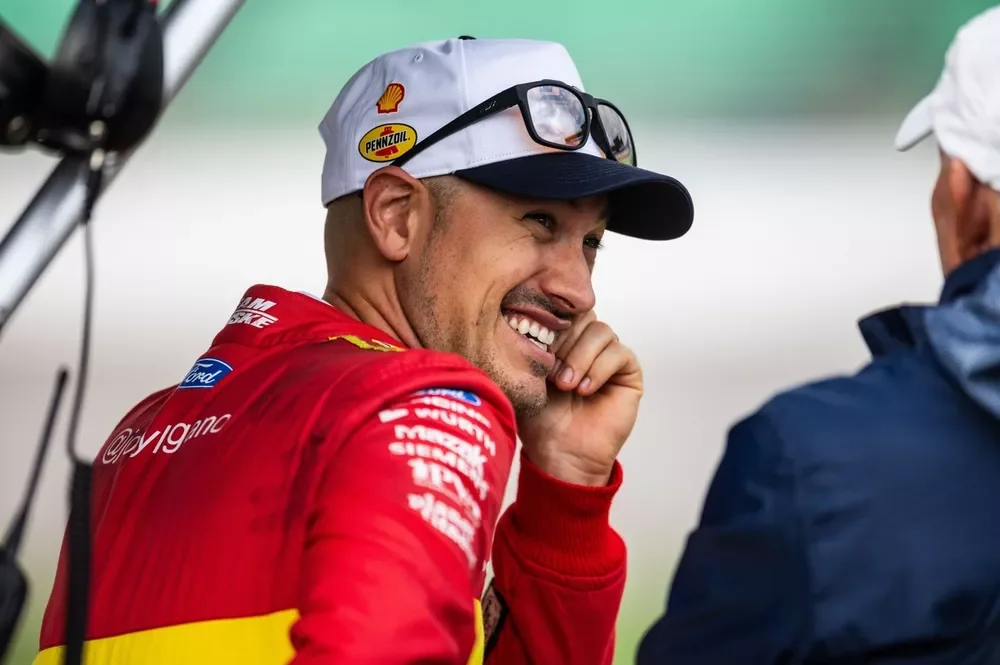
As of September 28, 2026: Rain canceled Cup qualifying at Kansas, so NASCAR put Joey Logano on the pole using a performance metric: 70% of his previous-race finishing rank plus 30% of his team's owner-points rank. Kyle Larson started second and won the September 27 race. The same fallback had already set 2026 Chase grids at Darlington and Bristol. This explainer shows the actual Kansas arithmetic, why the published qualifying order looks reversed after a rainout, and how the rule can affect stage-point opportunities without predicting a race winner. For the next weekend, always verify NASCAR's newly posted grid.
What happened to Cup qualifying at Kansas in the 2026 Chase?
Rain canceled NASCAR Cup Series practice and qualifying at Kansas Speedway on September 26, 2026, so no driver earned a pole by posting the quickest qualifying lap. NASCAR used its rule-book performance metric to set the grid for the next day's Hollywood Casino 400. Joey Logano's No. 22 Team Penske Ford was assigned first place, with Kyle Larson's No. 5 Hendrick Motorsports Chevrolet alongside him. The phrase “Logano won the pole” describes the official starting position, not a timed run.
That distinction matters because four cars did briefly record practice laps before the weather stopped the session. Those laps were not a completed field-wide practice or a qualifying round, and NASCAR did not use them to rank the starters. Fans who saw a speed on a timing screen could reasonably wonder why that number did not control the front row. The answer is that a handful of interrupted practice laps cannot stand in for the scheduled qualifying process; the prescribed fallback took over when the session was canceled.
Kansas snapshot: Saturday, September 26: Cup qualifying canceled. Sunday, September 27: the 267-lap Cup race ran to a result. Logano started first through the metric; Larson won the race. The starting spot and finishing position answer different questions.
This was the fourth Cup Chase race of 2026, and NASCAR said rain had disrupted qualifying in three of the first four. The repeated use of the fallback made what is normally a little-noticed procedural rule a championship talking point. One week of a strong finish can become an advantage on the next weekend's grid, while a contender caught in an accident can carry that poor finish into the next start. Neither effect says anything by itself about how fast a car will be over a full green-flag run.
Because Kansas has already been completed, readers looking for the finishing order should use the site's Cup Series results. The rest of this guide explains exactly how NASCAR got from the prior race and owner standings to that rainout lineup, and what can and cannot be concluded from it.
How does NASCAR calculate a rainout starting lineup in 2026?
For the 2026 Cup Series rainouts documented in NASCAR's Chase coverage, the performance metric combines two ranks: 70% of a car's finishing position in the previous race and 30% of its current position in team-owner points. A lower score is better. The calculation rewards the most recent result strongly but gives sustained team performance a smaller stabilizing role. It is a numerical ranking of entrants, not a speed estimate for the track where rain has canceled qualifying.
Put plainly, multiply last week's finishing position by 0.70, multiply the owner's points rank by 0.30, and add the two. NASCAR's published table is the authority for each weekend; do not calculate from the driver's championship seed and assume it is the owner standings. Driver and car-owner standings can diverge when drivers change cars, miss events, or are ineligible for points. This is one reason a simplified social-media arithmetic post may be close without reproducing every official position.
The 70/30 score, with Logano and Larson at Kansas
Kansas provided a clean illustration. Logano won at Bristol the previous weekend, and the official Kansas metric table showed his No. 22 at 1.600. Larson finished second at Bristol, and his No. 5 appeared at 1.700. Those published scores are consistent with the No. 22 occupying third in owner points and the No. 5 first: 0.70 × 1 + 0.30 × 3 = 1.60 for Logano, compared with 0.70 × 2 + 0.30 × 1 = 1.70 for Larson. The prior race's one-position difference outweighed the two-position owner-points difference. It put Logano ahead by one tenth of a metric point.
| Car | Previous finish | Owner-points rank used in example | 70/30 score | Kansas rainout grid |
|---|---|---|---|---|
| Logano No. 22 | 1st | 3rd | 1.600 | 1st |
| Larson No. 5 | 2nd | 1st | 1.700 | 2nd |
This version of the formula should not be confused with an older, four-factor NASCAR performance metric sometimes repeated in search results. The current NASCAR Darlington report explicitly states the 70/30 split. Nor is a bonus for posting the fastest lap in the previous race a separate component of this calculation. A race result already has its own championship-points consequences, but the metric ranks the car by finishing position, then adds owner-points rank.
Qualifying order is not the same as the rainout grid
NASCAR publishes a metric table before the weekend even when a normal time trial is planned. In ordinary single-car qualifying, that score helps determine when a driver makes a lap. The cars with the weaker scores generally run first and the best scores later, when the circuit can offer a more favorable surface. If qualifying takes place, actual qualifying speed decides the starting lineup, subject to inspections and race-day changes.
At Kansas, the official pre-event qualifying order put Logano 36th to run and Larson 35th to run in a 36-car Cup field. When weather erased the time trial, the same lowest scores became grid positions one and two. This apparent reversal is the heart of the confusion: “36th in qualifying order” meant last scheduled to attempt a lap, not a 36th-place start. For the standard qualifying formats and how timed results become an official grid, see our NASCAR qualifying guide.
Why did the Chase see repeated metric grids?
The 2026 Cup Chase did not introduce a new rainout scoring formula, but weather repeatedly forced NASCAR to use it at the worst possible time for a championship contender. The first four Chase weekends ran in this order: Darlington, World Wide Technology Raceway at Gateway, Bristol, and Kansas. Qualifying was canceled at Darlington, Bristol, and Kansas. Gateway was the exception, with a normal pole award before its race. Three metric-set grids in four weeks made previous-race luck unusually visible in the next week's track-position fight.
Darlington exposed the previous-race penalty
The opener at Darlington is the sharpest example of how a rainout can magnify an accident from the preceding event. Lightning and threatening weather erased Cup practice and qualifying. Tyler Reddick was assigned the pole. NASCAR's official lineup placed Carson Hocevar 34th and Chris Buescher 35th after incidents in the regular-season finale at Daytona. Ryan Blaney, also hurt by the Daytona outcome, started 24th. Those locations reflected the metric's heavy previous-finish component, not a Darlington speed chart. Their crews would still have to learn tire fall-off and balance under race conditions, but they were already carrying more traffic to pass.
There is a legitimate reason a poor finish counts: it is an actual competitive outcome from the prior week, and the rule is known in advance. Yet a superspeedway wreck at Daytona is a noisy signal of how a car will drive on Darlington's abrasive 1.366-mile oval. The rainout linked two very different tracks by a formula. A fan can accept the published procedure while questioning whether that particular input predicts the next race well.
Bristol and Kansas changed who benefited
At Bristol, a lightning delay canceled Friday's Cup practice and qualifying. Larson had won at Gateway the Sunday before, so his metric placed him on the pole for the Night Race. At Kansas one week later, the benefit shifted to Logano after he won Bristol, while Larson started second. These are not three identical stories about one driver receiving an undeserved advantage. The rule repeatedly favored the car with a strong immediately preceding result; which team that was changed with the races.
The timeline is also a reminder that a canceled qualifying session does not cancel the competitive work ahead. Bristol was still won on the track by Logano after Larson's metric pole. Kansas then produced a different race winner from its metric pole sitter. This makes the grid meaningful without making it destiny. The 2026 Cup Chase format explains why each stage and race finish continued to matter across ten events, even when Saturday's weather removed one way to gain a starting advantage.
Is the rainout metric fair to championship contenders?
There is no uncontested answer, because “fair” describes two different things here. The rule is consistent and known: the same 70/30 inputs apply after a Cup time trial is canceled. But a previous finish is an imperfect forecast of next week's pace, especially when that finish was shaped by a multi-car accident on a very different circuit. Rain deprives every entrant of the chance to replace that forecast with an actual timed lap. During a ten-race championship, the lost opportunity feels bigger than it would in an ordinary spring race.
A prior finish can punish a fast car twice
Suppose a competitive team is caught in a late crash, finishing in the 30s. The result already costs race points. If qualifying is washed out the following week, the 70% component also places that same finish heavily into its starting score. The team must then pass more cars to recover track position. At a track where traffic and tire fall-off make passing expensive, starting deep can reduce the chance to collect Stage 1 points. This is a plausible competitive chain, not proof that any individual contender would have won a stage from a better grid slot.
Darlington provided a real example of the first part of that chain: Hocevar and Buescher began in the mid-30s after Daytona trouble. Reporting by Motorsport.com recorded Larson and his crew chief favoring an owner-points-only grid when qualifying rains out. Larson felt the Darlington start left valuable early-stage points harder to reach. That position has an understandable logic: a season-long ranking might be less distorted by one superspeedway accident. Yet it would place still more advantage with teams already high in the standings and remove the latest week's performance from the calculation.
Owner points reward sustained execution
The existing 30% owner-points term prevents a single bad finish from being the only factor. Teams that execute across many weeks retain some protection. Denny Hamlin has publicly opposed a random draw and discussed putting more weight on standings instead; Ryan Blaney has argued the metric is generally defensible even though an unusual sequence can make it painful. Bubba Wallace has described how the metric can feel logical for deciding qualifying order but confusing when rain turns it into the whole grid. These are different proposals and reactions, not an announced NASCAR rule revision.
The trade-off: More weight on the previous finish rewards fresh form but magnifies one accident. More weight on owner points smooths that accident but favors established leaders. A random draw treats teams symmetrically before the draw but abandons earned results. None measures actual speed on a wet, unqualified Saturday.
Fans in a Kansas race-week thread also debated a multi-race average or a bigger standings component. Those comments show why the question matters, but they do not establish consensus. The best way to judge any proposal is to ask what it optimizes—recent form, sustained results, or equal chance—and whether it would produce a clearer, more credible championship picture without creating another arbitrary edge.
What did the Kansas race show about a metric pole?
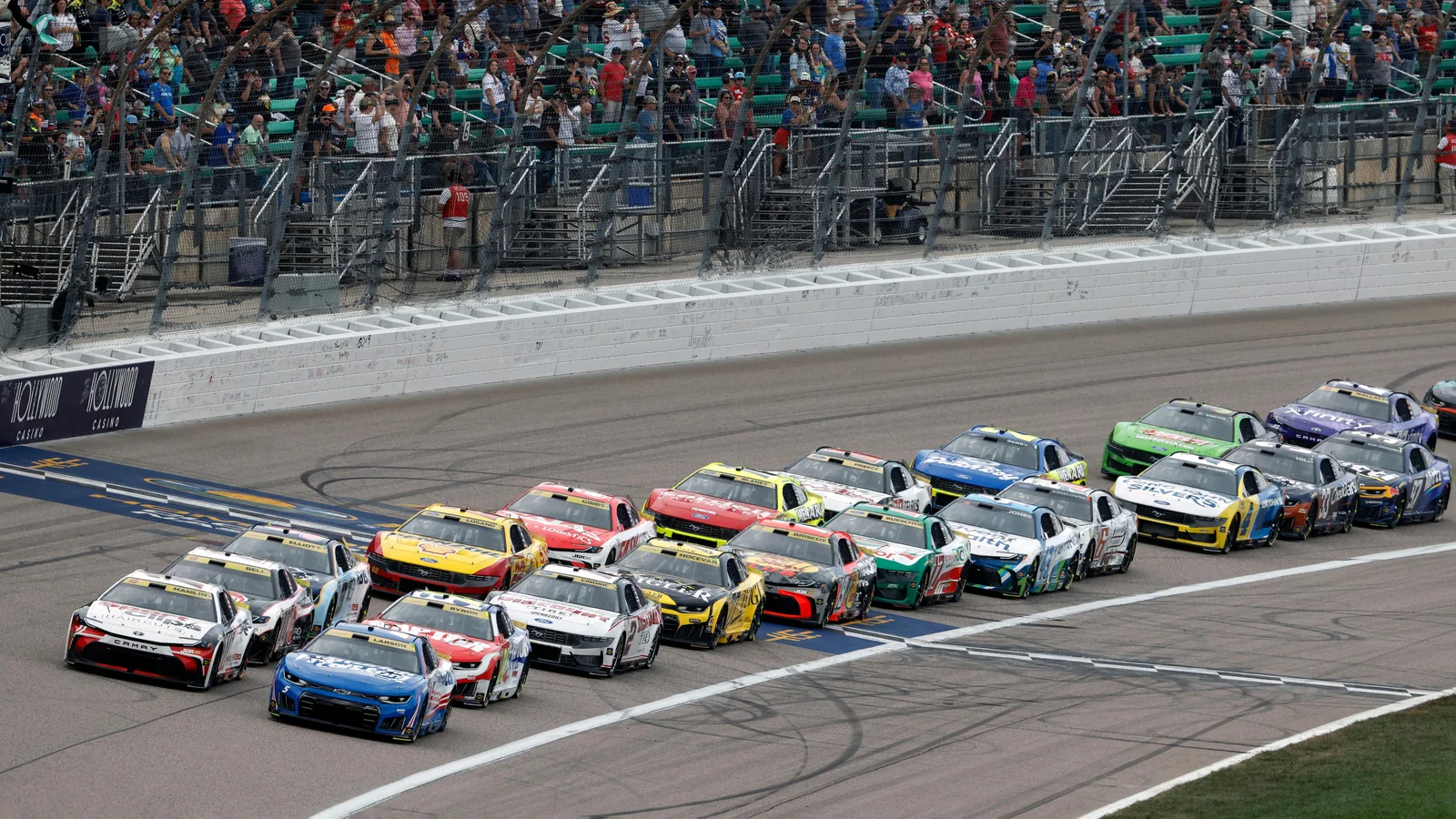
The Kansas result is a useful check on the argument that an assigned pole decides the race. Logano led the field away because the metric placed him first. Larson started beside him and won the 267-lap Hollywood Casino 400. NASCAR's results and final-laps coverage confirm Larson as the winner after Sunday's race. That does not mean the pole was worthless. It means the opening grid was one advantage among many that teams still had to convert through pace, traffic management, stage decisions and pit execution.
Starting first usually gives a driver an unobstructed view into Turn 1 and control over the initial lane choice. At a 1.5-mile intermediate oval such as Kansas, clean air can support pace early in a run, while a car starting farther back must negotiate traffic before its own setup has fully declared itself. Grid position can also influence pit-stall selection, which may ease entry or exit during later cycles. Those are general mechanisms that make a rainout lineup consequential. They are not evidence that the No. 22 led a particular number of Kansas laps, won a specific stage, or lost because of one pit stop; this guide does not make those claims without a complete verified race chronology.
Race pace can overwhelm initial placement. Even a front-row car must maintain speed through longer green runs, handle changing tire grip and avoid mistakes or interruptions. When teams adjust their cars during a race, a speed ranking that never came from an actual time trial is especially limited as a prediction. The Kansas winner emerging from the other front-row spot is therefore compatible with two ideas at once: the metric gave Logano a valuable starting place, and Larson's race-day performance determined the victory.
This is also why it would be misleading to answer “who qualified fastest at Kansas?” with Logano's name. There was no completed Cup qualifying session to supply that answer. The correct historical labels are metric pole sitter Logano and race winner Larson. Anyone checking finishing order, stage classification or later changes to the official result should use a current NASCAR results page rather than extrapolate from Saturday's canceled session.
Where should fans check the next official starting lineup?
A formula explainer cannot tell you the next race's starting lineup in advance. The inputs change after each event, the owner standings move, and the weather decision belongs to NASCAR at the track. Begin with the current race-weekend schedule to see whether practice and qualifying are planned and when the session is supposed to happen. A published qualifying order is useful, but it is only the planned running sequence while time trials remain on the schedule.
Read the final grid, then watch for race-day changes
If a session is canceled, look for an official NASCAR cancellation report and its linked starting lineup. That grid gives the numeric positions and identifies the metric pole. Compare it with the team's pre-race notices rather than relying on a television graphic captured before the final update. If qualifying does occur, use the actual qualifying results instead of treating the pre-event metric scores as grid spots. In either case, take one more look near race time for inspection penalties, backup-car changes or other instructions requiring a car to drop to the rear.
A 2026 example shows why the final step matters. At North Wilkesboro, rain set the Cup grid by the rule book, and Ross Chastain was listed 13th. NASCAR also reported that his car would go to the rear before the start and serve a pass-through penalty after inspection failures. The numbered lineup and the physical order at the green flag were therefore not identical. This is an example of a documented event-specific penalty, not an automatic consequence of a rainout.
- Before the session: note the scheduled format and qualifying order.
- After the weather call: verify NASCAR's posted grid and whether the metric actually replaced timed laps.
- Before the green flag: check rear-of-field and inspection updates.
- After the race: switch to the official finish; a pole is not a result.
The site's standings can provide championship context, while Cup results should answer what happened after the green flag. For ordinary dry-weekend time trials, the broader qualifying format guide covers how lap times, special-event formats and later lineup changes work. Keep those four records—qualifying order, time-trial result or rainout grid, physical start, and finish—separate and the next weather-delayed Chase weekend becomes far easier to read.
About the author
NASCAR Schedule Editorial Team
The NASCAR Schedule editorial team turns verified schedules, timing and scoring, official announcements and race-weekend context into direct answers for fans.
View all articles by this author →Join the discussion
Comments
Sign in with Google to comment. Keep it race-focused; new comments are reviewed before publication.
Loading comments…