How NASCAR Drafting Works: Slipstream, Side-Drafting and Dirty Air
A fan-facing explanation of NASCAR airflow, drafting partnerships, alongside battles, cooling limits and the decisions behind a superspeedway run.
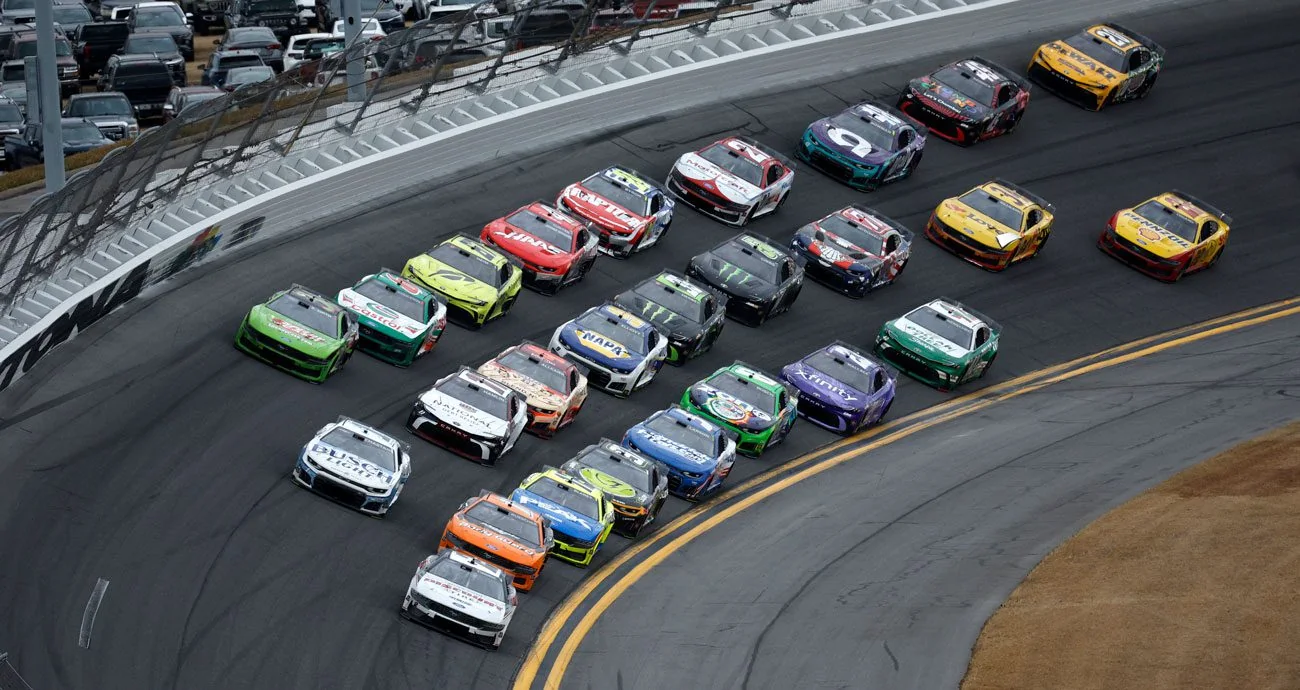
NASCAR drafting reduces aerodynamic drag by positioning cars close enough to influence one another's airflow. A following car can use that benefit to gain speed or save fuel; a closely following partner can help the leader as well. Side-drafting changes the interaction by moving alongside, while a bump draft adds physical contact. Dirty air describes the handling cost that can accompany a useful tow.
This guide explains those differences for Cup Series viewers, with rules-package context checked on October 19, 2026. The critical question is what the car needs next: less resistance, more cornering grip, cooling air or help from another driver.
What drafting changes when NASCAR cars run together
Drafting changes the aerodynamic forces acting on neighboring cars. A moving stock car displaces air around its nose, roof, sides and underside, leaving a wake behind it. Another car entering that wake encounters a different pressure and flow pattern from the one it would experience alone. In a useful nose-to-tail draft, the following car has less aerodynamic resistance to overcome.
The leading car can benefit too. A closely following car changes the airflow and pressure behind it, reducing part of the pressure drag that would otherwise resist the leader. That mutual interaction explains why a coordinated line can run faster than an isolated car. It also explains why the leader watches the car behind even before it becomes a passing threat: losing a partner can change the speed available to both.
Less drag can buy speed or lower fuel use
Aerodynamic drag rises roughly with the square of relative airspeed when the other factors remain comparable. At racing speed, a small change in resistance matters. Drafting does not increase the engine's rated horsepower or give the driver an additional power button. It changes how much of the available power is needed to maintain the car's motion through the air.
The driver can spend that benefit in different ways. Keeping more throttle can create a closing-speed advantage; easing the accelerator can hold a position with less fuel use. A car following patiently at partial throttle is therefore still using the draft effectively. The visible lack of passing may reflect what the team wants from that part of the race, rather than the absence of aerodynamic help.
There is still air between the cars. A broadcast description of a vacuum or a car being sucked forward is shorthand for a pressure interaction, not an empty tunnel. Distance, lateral position, car shape and the surrounding pack all change the effect. No fixed number of miles per hour can be added for each extra car in every NASCAR draft.
For viewing purposes, separate a car's solo pace from its performance with help. Qualifying can expose how fast a car runs alone, while the race adds neighbors and constantly changing geometry. The Cup stock-car guide explains the hardware underneath that interaction. A slower isolated car can remain competitive in a group, but it must preserve access to that group and the air benefit it provides.
Why a helpful slipstream can become dirty air
A slipstream and dirty air are descriptions of consequences within a disturbed airflow, not two separate substances. The draft can reduce resistance while the same wake changes the downforce and balance needed to corner. The relevant question is which effect limits performance at that point on the lap.
The grip limit changes the value of the wake
On a straight, reducing drag can let the driver gain speed without needing more engine output. In a fast corner, the tires must also generate the force that turns the car. Aerodynamic loading helps them do that. If following another car takes away useful front load, the front may drift outward, producing the condition drivers call aero push or aero tight.
The driver then has choices, all with a cost. Lifting reduces speed so the available grip can manage the corner. Moving away from the leader's path may find a more favorable flow but require a longer line. Dropping back can restore the car's behavior while surrendering the opportunity to attack. From the grandstand, those responses can look like an inexplicably hesitant driver. Onboard steering and throttle information can reveal the actual constraint.
Mechanical setup and tire condition still matter. A balanced car on fresh tires may tolerate a traffic position differently from a car already struggling through the center of the turn. Clean air does not make every setup good, and dirty air does not erase every driver's opportunity to pass. A television explanation should identify the car and corner phase rather than treating the entire pack as aerodynamically identical.
Track and rules package matter more than a fixed speed gain
The relationship changes with the venue, body configuration and power restrictions. NASCAR's July 15, 2026 announcement for the August Daytona Cup race illustrates the point: officials reduced the planned rear spoiler from seven inches to four and target power from 510 to 465 horsepower. They anticipated faster solo laps but approximately similar pack speeds. Those were announced expectations for that Daytona change, not measurements that apply to every superspeedway race.
The aim included helping a driver turn a run into an overtake after leaving the draft. Lower engine output alone therefore tells only part of the story; drag and grip changed alongside it. Avoid importing an old spoiler dimension, a generic Formula 1 airflow percentage or a fixed drafting speed bonus into another event. Find the venue on the NASCAR schedule, then listen for the rules package and tire discussion attached to that weekend.
How side-drafting changes an alongside battle
Side-drafting uses proximity beside another car to change its aerodynamic environment. A common position places the approaching car's nose near the rival's rear quarter. Air displaced around that nose interacts with the neighboring car's rear body and spoiler region, changing the forces that let it maintain momentum. The objective is to affect relative speed in the battle, rather than simply follow a low-drag path.
That is a different relationship from two drivers cooperating nose-to-tail. A car can use a tow to catch a rival, move alongside to impede that rival's advance, then separate to complete the move. The sequence may look like an attacker briefly moving toward the other car and then away. The first movement can be about managing air; the second can be about reclaiming speed and racing room.
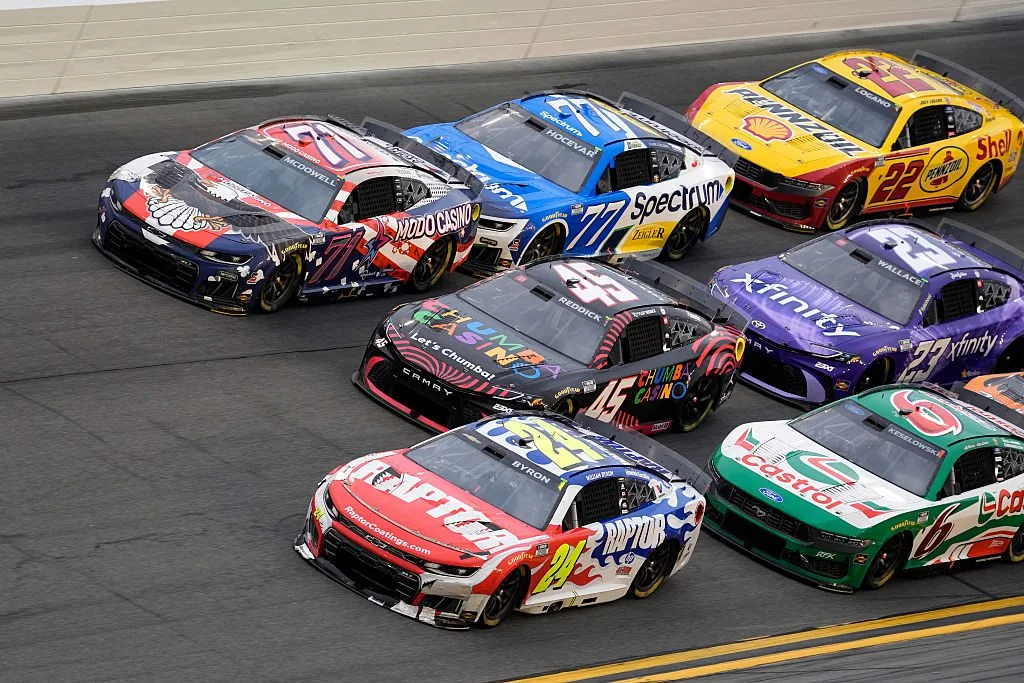
Physical contact is not required for the aerodynamic interaction. A replay showing cars close together is therefore insufficient evidence that a bumper or door strike caused a slowdown. Equally, proximity alone does not prove that an intentional side-draft explains every change in pace. The useful evidence is a sequence: closing rate before the cars overlap, their lateral gap as they align, and what happens as they separate.
Nor does side-drafting create a universal increase in the attacker's absolute speed. Slowing a rival relative to the attacker can help even when neither car is accelerating as it did in the tow. The surrounding lane may meanwhile lose ground to another line. A driver can win a local exchange while making both participants vulnerable to a third group. That is why the fastest route to the finish sometimes involves delaying a fight with a temporary partner.
The influence depends on geometry, body configuration and nearby cars. It is misleading to reduce the move to a guaranteed number of miles per hour or to say that one side of every Cup car is always the winning side. Watch the overlap and the supporting line behind each driver. Those details explain more than a still photograph, and they leave room for the fact that airflow changes as both cars move.
A bump draft adds contact to an aerodynamic partnership
A bump draft combines an existing aerodynamic relationship with a physical push from the following car. The rear car's nose touches the front car's bumper and transfers force through that contact. Two cars can draft without touching; once a push occurs, another mechanism has joined the airflow interaction. Confusing the two makes a no-contact tow sound like an accident waiting to happen.
The purpose of a cooperative push is to help the line advance. That differs from a bump-and-run, where contact is used to disturb a rival's line and create a passing opportunity. The same broad location of contact does not establish the same intention or result. In a replay, consider whether the front car was being helped to accelerate with its partner or displaced so the following driver could pass.
Why alignment, closing rate and trust matter
A push has consequences beyond its size. Where the bumpers meet, how much faster the following car is traveling, and whether the front car is turning all affect the response. An offset impact can create a turning influence instead of a clean forward shove. The leading driver may need to correct the car, and that correction happens in limited space surrounded by other cars.
The following driver must react to changes that begin farther up the line. If the front car lifts or checks up for traffic, the closing speed can change before an onboard camera makes the cause obvious. The spotter's view of several cars becomes useful because the driver is looking through a very small part of the developing situation. A push that helped on one straight is not automatically appropriate at the next moment.
Be careful with blanket claims that NASCAR banned all touching while drafting. The often-cited January 2014 announcement concerned sustained tandem drafting in the then-Nationwide and Truck series, and it distinguished that practice from brief bump drafting. Cup also has its own history of technical changes affecting how long cars can remain connected. An old lower-series headline does not establish the rules for a contemporary Cup event.
That history is a reason to identify the series and the exact action under discussion. A tow, a brief push, sustained bumper contact and contact that spins a rival are different observations. For the surrounding flag and penalty procedures, the rules explainer provides the broader context. Aerodynamic benefit describes performance; it does not settle every officiating decision about the way a driver used it.
Fuel saving and cooling turn the draft into a trade
Saving fuel in the draft can affect the race even when a team does not eliminate a pit stop. If the car uses less fuel during the run, it may need a smaller refill to cover the next target distance. When fuel delivery is the longest part of service, a shorter refill can change the pit-road order. That turns apparently patient laps in a pack into preparation for an aggressive position gain later.
The benefit is conditional. If tire work already takes longer than the fuel needed, saving a little more may not shorten the stop. If a driver loses the pack while conserving, the time lost on track can overwhelm the service gain. A crew chief therefore watches the fuel target alongside position and traffic. Fuel economy is one resource in the decision, rather than a separate contest to use the fewest gallons.
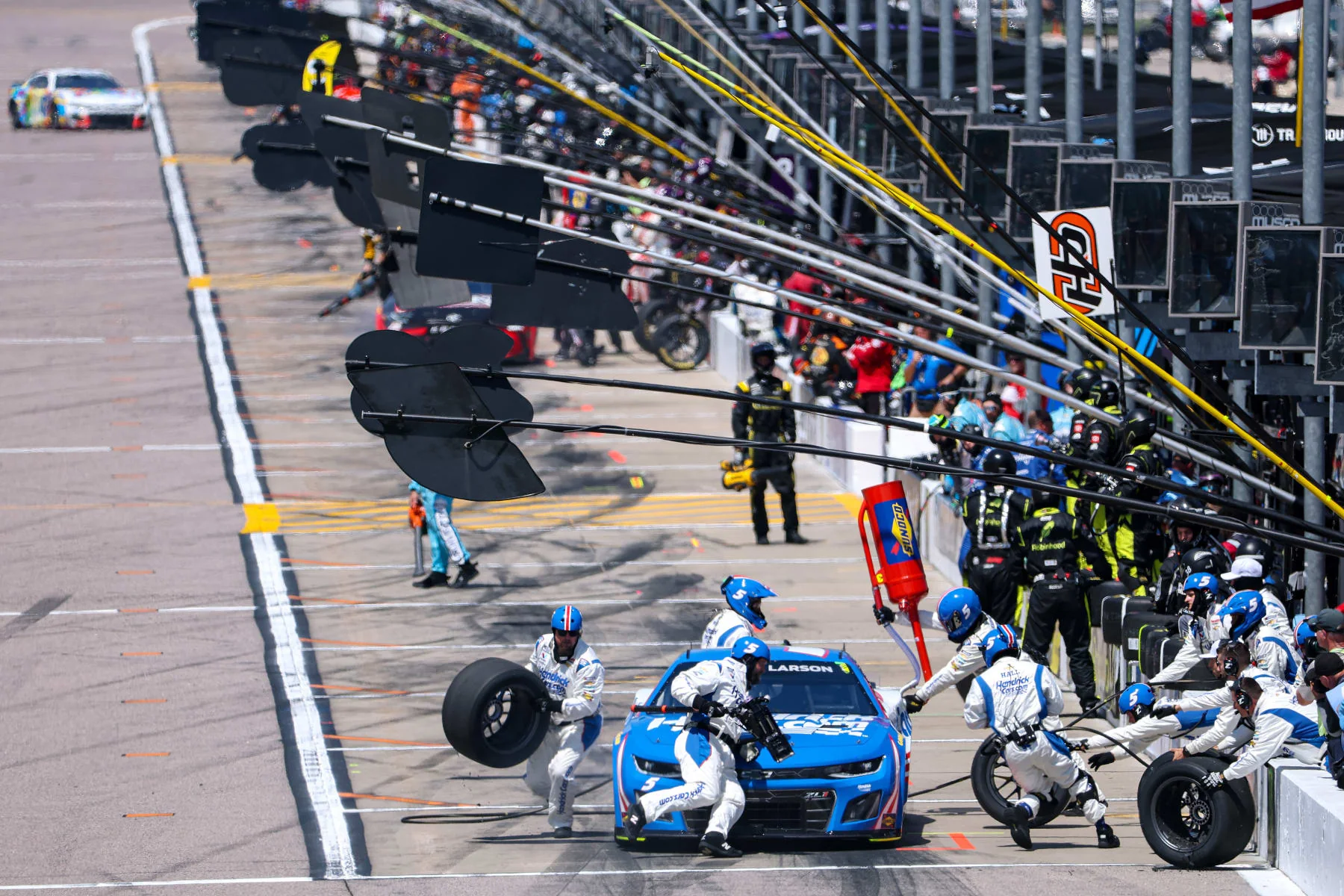
Cooling creates another constraint. Air moving through the nose helps carry heat away through the cooling system. Sitting in a wake can reduce the useful airflow reaching that system, even while the car needs less power to overcome drag. Lower power demand and poorer heat rejection can occur together. The resulting temperature depends on both, plus the car's preparation and surrounding conditions.
The Next Gen layout brought radiator and engine-intake airflow through the front grille area, with radiator air exiting through the hood ducting. That makes the condition of the airflow and the grille opening relevant to the car's operation. A driver edging out of line may be trying to cool the car or manage its balance rather than beginning a pass. A piece of debris can create another problem that a photograph of close following cannot diagnose.
Listen for the team naming its constraint. A fuel-saving target calls for controlled consumption; a rising-temperature warning may call for more air; a last-lap attack spends the speed advantage differently again. There is no universal water-temperature number or duration of safe pushing for a fan to infer from a generic guide. The revealing information is what the radio asks the driver to change, and whether the car can remain connected to a useful partner while doing it.
How to read a drafting run on television
Read a drafting battle as a sequence rather than a single dramatic closing shot. First locate the car generating a run, then the gap it closes, then the lane it chooses. Finally, watch whether it clears the rival, remains alongside or falls back. Those are different outcomes, and the important change in airflow may occur between the exciting approach and the apparently disappointing finish.
| What you see | The question to ask |
|---|---|
| A car closes nose-to-tail | Is it spending the tow on speed or managing a fuel target? |
| The attacker moves beside a rear quarter | Does the lateral interaction change the rival's momentum? |
| A bumper push | Does the pair remain aligned as traffic changes ahead? |
| A car offsets without attacking | Is the radio discussing cooling, balance or preparation for a run? |
| A promising lane stalls | Who stopped following, checked up or became exposed to more drag? |
Follow the support behind the attacking car
For a hypothetical final-lap example, picture the second car closing rapidly on the leader. If the third car follows it into an attacking lane, the move retains a partner. If that third car stays with the leader, the attacker may become isolated just as it leaves the favorable wake. The initial closing rate was real, but the conditions supporting it have changed. The result is not proof that the driver imagined the run.
A slingshot attempt uses speed built while following, then asks that stored advantage to survive outside the tow long enough to complete the pass. An early move may spend the advantage before the finish; a late move may leave too little distance. A leader can respond with positioning and an aerodynamic interaction alongside. Another lane can arrive while both are occupied. Timing makes sense only in relation to all those moving cars.
The wide camera is usually best for understanding partners and lane continuity. An onboard view helps explain the driver's corrections and the gap immediately ahead, while the radio can reveal the fuel or temperature target the picture lacks. Compare these views before deciding that a driver should simply have moved out sooner. The same car's options can change within a few seconds.
Find the next race through the TV schedule, then compare the final order with the race results. Results establish who finished where; the full sequence explains how they got there. Drafting expertise lies in converting temporary airflow and temporary cooperation into a lasting position at the moment that matters.
About the author
NASCAR Schedule Editorial Team
The NASCAR Schedule editorial team turns verified schedules, timing and scoring, official announcements and race-weekend context into direct answers for fans.
View all articles by this author →Join the discussion
Comments
Sign in with Google to comment. Keep it race-focused; new comments are reviewed before publication.
Loading comments…