NASCAR vs F1: Cars, Speed, Tracks, Rules and Race Strategy
A current NASCAR Cup versus Formula 1 comparison covering car architecture, speed, tracks, race formats, contact, pit strategy, cautions, safety cars and the different skills each championship rewards.
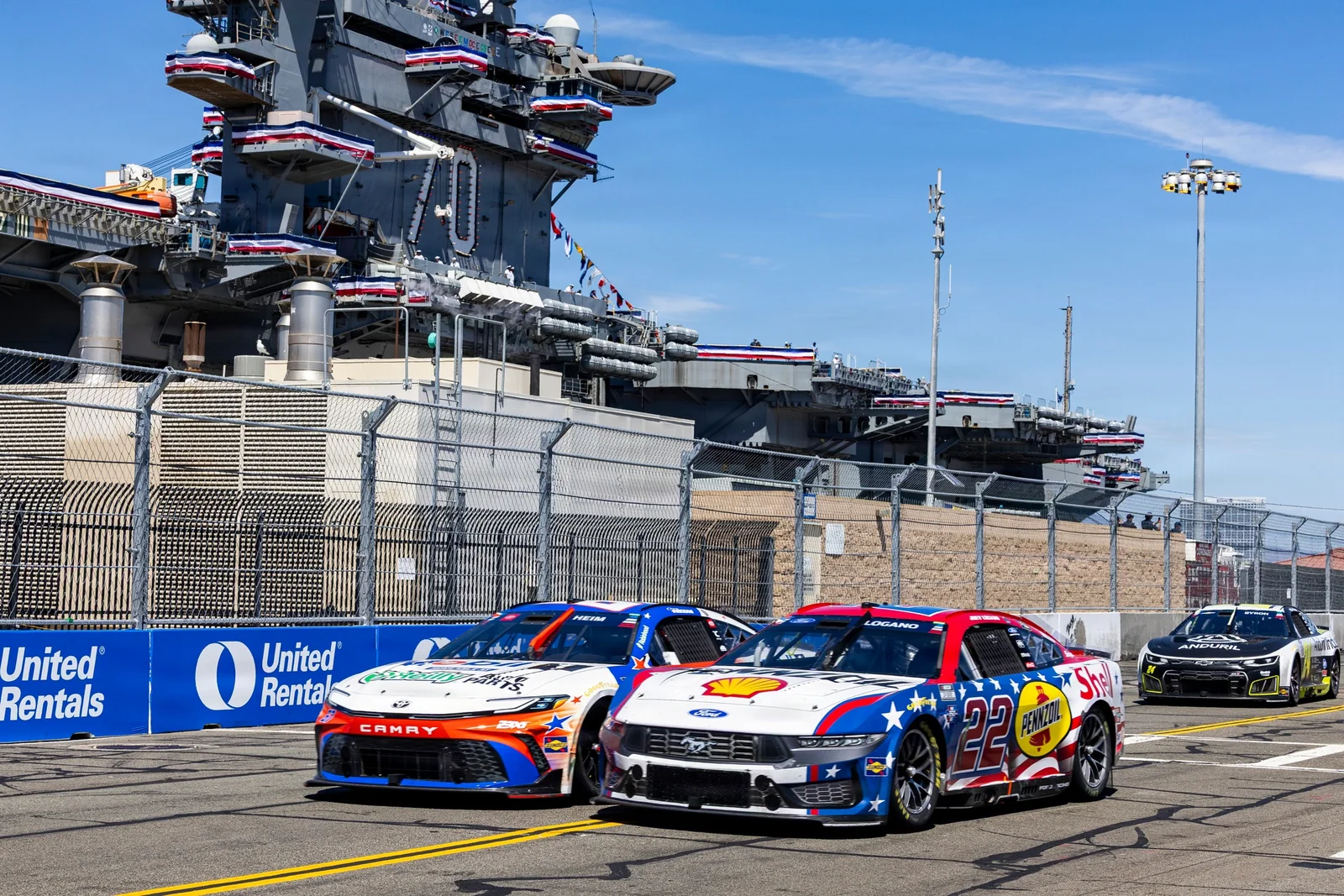
Formula 1 is generally faster over a road-course lap, while NASCAR Cup racing is built for a different test: sustained speed, close drafting and durable cars across many oval formats. A 2026 F1 car is far lighter and uses powerful hybrid deployment plus active aerodynamics to brake later and carry more speed through corners. A NASCAR Next Gen Cup car is heavier, enclosed and designed to race inches from rivals for long distances.
That does not make every “NASCAR vs F1” speed claim interchangeable. Top speed, average speed, acceleration, cornering and lap time answer different questions, and NASCAR's aerodynamic and horsepower packages can vary by track. The useful comparison is how the cars, circuits, rules and strategy combine to produce two distinct kinds of elite motorsport.
NASCAR vs F1 at a glance
| Category | 2026 NASCAR Cup | 2026 Formula 1 |
|---|---|---|
| Car concept | Closed-wheel stock-car silhouette; purpose-built Next Gen racer | Open-wheel, open-cockpit single-seater |
| Structure/body | Steel-tube chassis, composite body and bolt-on front/rear clips | Carbon-composite survival structure with exposed wheels and complex wings |
| Published weight | About 3,300 lb on NASCAR's base Next Gen sheet | 724 kg plus nominal tyre mass in most sessions; 726 kg plus nominal tyre mass in qualifying sessions |
| Power system | 358 cu in naturally aspirated V8; target output depends on track package | 1.6 L turbo V6 hybrid with major electrical deployment and energy recovery |
| Driven wheels | Rear-wheel drive through a five-speed sequential transaxle | Rear-wheel drive through a highly regulated hybrid drivetrain |
| Aero emphasis | Track-specific spoiler/diffuser package, stability and close-racing wake | High downforce plus active front/rear aero and energy-based overtaking tools |
| Typical circuits | Short/intermediate ovals, drafting tracks, road and street courses, Roval | Purpose-built road circuits and temporary street circuits |
| Core race test | Traffic, drafting, tire/fuel windows, restarts and long-distance durability | Braking/cornering precision, aero efficiency, tire compounds and energy use |
Read the table as a design comparison, not a universal result
NASCAR is the sanctioning organization, so “a NASCAR car” could mean machinery from several divisions. This guide uses the Cup Series Next Gen platform—the top-level car most readers intend—rather than every vehicle under the NASCAR umbrella. The stock-car name describes production-car heritage and silhouette, not a showroom vehicle with racing stickers.
The figures also need context. NASCAR's own base sheet leaves horsepower and spoiler specification dependent on track type and size. In 2026, target output reached 750 hp at road courses and many shorter ovals, while NASCAR announced a 465-hp package for the August Daytona race. F1's hybrid system combines combustion, battery deployment and recovery limits, so simply adding two headline component ratings does not describe power available at every point of a lap. The useful takeaway is architecture: F1 prioritizes low mass, downforce and energy management; Cup prioritizes robust close racing, repeatable packages and performance across radically different ovals and road layouts.
NASCAR Cup car vs F1 car: architecture and engineering
Put the cars side by side and the philosophical split is obvious. A NASCAR Cup car is a large, closed-body machine built around a steel-tube chassis and a standardized Next Gen platform. A Formula 1 car is an open-wheel, single-seat prototype whose carbon-fiber survival cell, power unit and aerodynamic surfaces are developed by its constructor within the rules. Both are purpose-built race cars, but they solve different problems.
The NASCAR Next Gen Cup car
NASCAR's published Next Gen baseline is about 3,300 pounds, 193.4 inches long and 78.6 inches wide. Under the symmetrical composite body sits a steel-tube structure with bolt-on front and rear clips, double-wishbone suspension and a five-speed sequential transaxle. The engine is a naturally aspirated, fuel-injected 358-cubic-inch V8. Its output and the aerodynamic package vary by track, which is why a single horsepower number does not describe every 2026 Cup race.
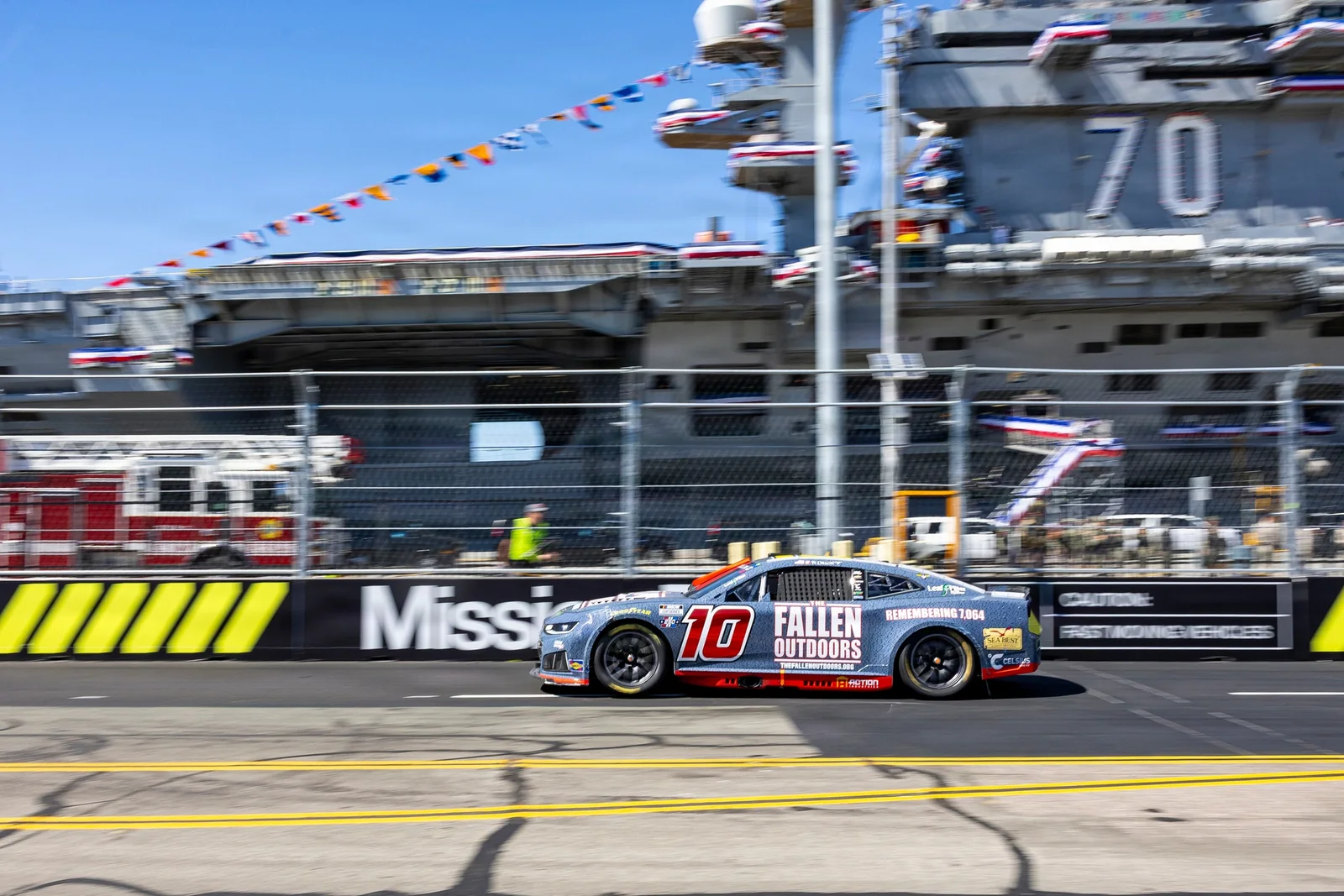
The platform uses common components to control costs and keep competition close, yet Chevrolet, Ford and Toyota retain approved body identities and engine programs. The underbody includes a splitter and diffuser rather than relying only on the silhouette above it. Those design choices let the same core car run superspeedways, short ovals and road courses after teams change setup and NASCAR assigns the appropriate rules package. That range is visible across a season of Cup Series results.
The 2026 Formula 1 car
An F1 car is far lighter. Under the current 2026 technical rule, the minimum is 724 kilograms plus nominal tyre mass in most sessions and 726 kilograms plus nominal tyre mass in Sprint Qualifying and Qualifying. The new car is also shorter and narrower than the preceding generation. The driver sits inside a carbon-fiber survival cell, with the wheels uncovered and the front and rear wings exposed. Its 1.6-liter turbocharged V6 works with a much more prominent electrical system; the MGU-H disappeared, while electrical deployment and recovery became a larger part of performance. Advanced sustainable fuel is also part of the formula.
Aerodynamics are active rather than fixed in one configuration. Front and rear elements can reduce drag on designated straights, while the energy-based Overtake Mode gives a following driver another tactical tool when the eligibility conditions are met. That does not make the car an automatic straight-line winner in every imaginable test. F1 performance comes from the complete package: low mass, immense braking ability, downforce, tire grip, energy management and circuit-specific setup.
Why contact and repair look different
A Cup car's fenders and bumpers generally make light rubbing more survivable, and its replaceable clips can make some structural repairs more practical. That is not a license for consequence-free contact: a cut tire, bent suspension or damaged underbody can still ruin a race. In F1, wheel-to-wheel contact can launch or break a car, and relatively small wing or floor damage can erase crucial downforce. The architecture therefore shapes the spectacle—sustained close packs and occasional body contact in NASCAR, versus greater separation and more delicate aerodynamic management in Formula 1.
Which is faster, NASCAR or F1?
Formula 1 is normally faster around a conventional road circuit. Its much lower mass, aerodynamic load and powerful brakes let it decelerate later and carry more speed through corners. NASCAR can produce enormous sustained speed on a banked superspeedway, but that is a different test. “Faster” needs a measurement attached to it.
Four speed claims that are easy to confuse
- Top speed: the highest instantaneous number, usually reached near the end of a long straight.
- Lap-average speed: distance divided by lap time, including corners and braking zones.
- Cornering and braking: the ability to retain speed through a turn and shed it late on entry.
- Race pace: repeatable laps while managing traffic, tires, fuel or electrical energy.
F1's official Monza page illustrates the distinction. Lando Norris's 2024 pole averaged 263 km/h, about 163 mph, over the whole lap. The same circuit description says cars approach roughly 350 km/h, about 217 mph, before slowing to around 70 km/h for the opening chicane. One number describes an average; the other describes the end of a straight. F1's advantage on road circuits is built as much in that braking-and-turning transition as in maximum velocity.
For 2026, active aerodynamics also divide the job. Straight Mode opens front and rear elements to reduce drag, while Corner Mode returns them to a higher-downforce position. FIA's launch guidance expected the reset to make early 2026 lap times slightly slower than the previous generation before development recovered performance. That context matters: a historic F1 record and a current 2026 car are not automatically interchangeable.
Why NASCAR's 212.809 mph record needs context
Bill Elliott's 212.809 mph qualifying lap at Talladega in 1987 remains one of NASCAR's most famous speed marks. It was a lap average on a 2.66-mile, steeply banked oval, set before restrictor plates were introduced at superspeedways. It is neither a current Next Gen benchmark nor a normal race-lap number. Modern Cup packages deliberately balance speed with safe pack racing, and drafting changes what an individual car can achieve.
The honest conclusion is therefore conditional. Put the cars on a twisty circuit and the F1 machine should be decisively quicker because of braking, mass and cornering grip. Put Cup cars in a Talladega pack and NASCAR delivers sustained oval speed and close proximity that F1 is not designed to reproduce. The varied oval and road-course entries on the NASCAR calendar are also why one Cup speed figure cannot represent the season. Without a controlled same-day, same-track test, precise “seconds faster” claims are guesswork.
Tracks and race weekends: oval variety vs a global circuit tour
NASCAR and F1 both demand circuit-specific setup, but their calendars test different kinds of versatility. NASCAR Cup's identity is rooted in American ovals, from sub-one-mile short tracks to intermediate tracks and the immense banking of Daytona and Talladega. Cup also races on permanent road courses and temporary street layouts. Formula 1 moves internationally among purpose-built road circuits and street circuits, with elevation, surface, climate and corner type changing from stop to stop.
NASCAR changes shape without leaving stock-car racing
Oval does not mean uniform. Martinsville's tight turns and repeated braking ask a different question from a fast intermediate oval, while Daytona's long banks produce drafting packs and shared aerodynamic momentum. A road course adds right turns, heavier braking zones and more conventional passing points. NASCAR can respond with a different horsepower/aero package, tire allocation and setup window while retaining the same basic Next Gen platform.
A Cup weekend is often compact. Practice and qualifying may share one day, followed by the race the next day, although event formats and weather can change the order. At Watkins Glen in May 2026, for example, NASCAR listed Saturday practice and qualifying before a Sunday 100-lap race. The race itself was divided into three stages, with scheduled stage ends at laps 20 and 50. Those numbers describe that event, not a universal template. Use the live NASCAR calendar and TV schedule for current session times.
F1's standard weekend—and its Sprint exception
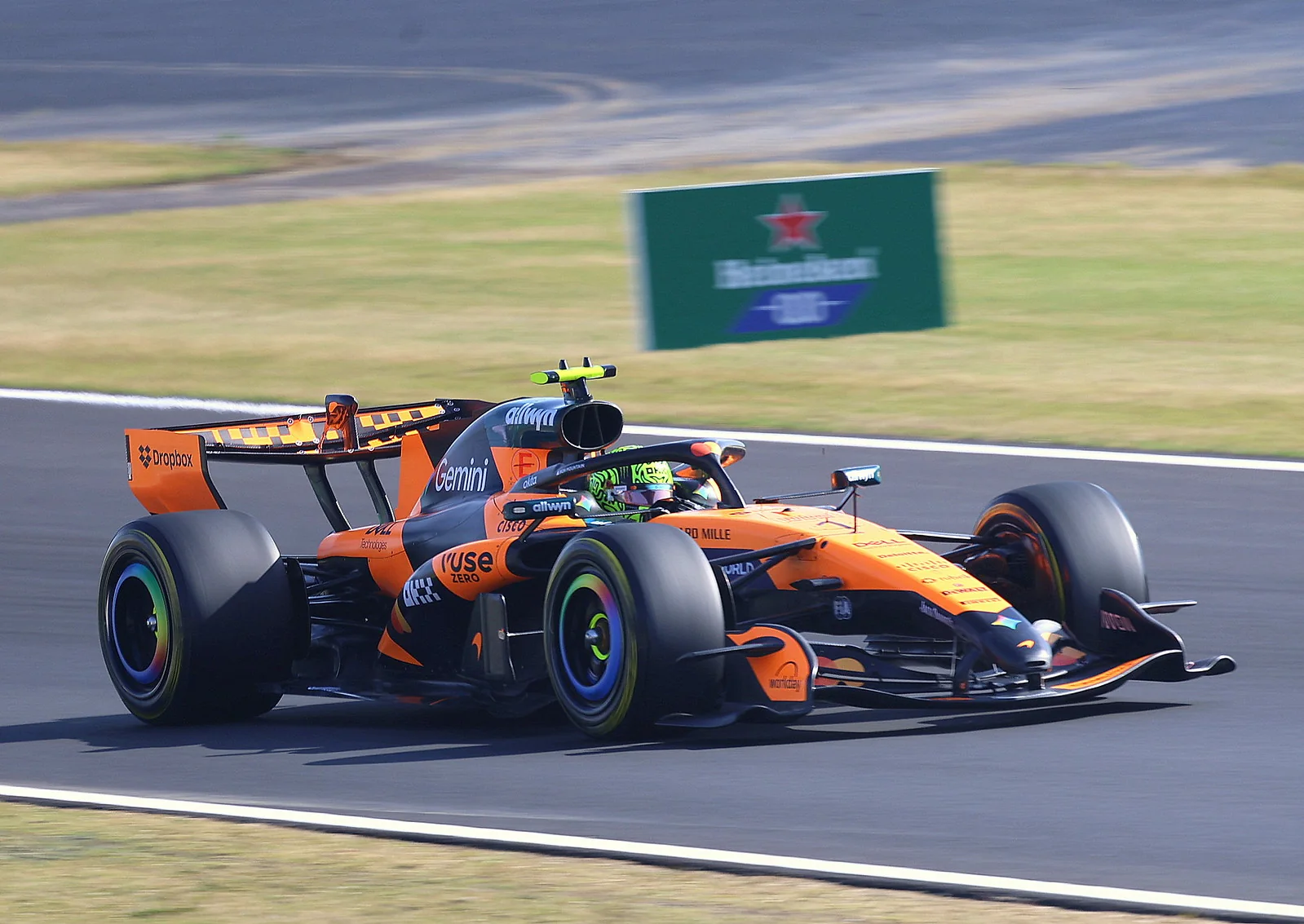
A standard F1 weekend has two Friday practice sessions, a third practice on Saturday, three-part qualifying and the Sunday Grand Prix. Qualifying progressively eliminates drivers through Q1 and Q2 before the remaining ten contest pole in Q3. The usual race distance is the minimum number of laps needed to exceed 305 kilometers, with Monaco's lower-distance exception.
A Sprint weekend compresses learning. Teams receive only one Friday practice before Sprint Qualifying. Saturday holds the 100-kilometer Sprint and then qualifying for Sunday's Grand Prix. The Sprint awards points but does not replace the main race. That reduced practice changes risk: a setup decision must be made with much less representative running.
The broad contrast is rhythm. NASCAR's calendar repeatedly changes the geometry of close racing—short-track traffic, intermediate-oval air, superspeedway drafts and road-course braking. F1 keeps the Grand Prix concept recognizable while its global circuits change the aerodynamic and energy-management problem. In both series, the current event page matters more than a remembered “normal” timetable because schedule revisions, Sprint formats and weather can all alter a weekend.
Rules, cautions, scoring and pit stops
The rulebooks reward different kinds of control. NASCAR breaks most Cup races into stages and repeatedly manages a large, closely packed field. F1 runs the Grand Prix as one continuous points-paying race, then uses tightly defined Safety Car, Virtual Safety Car or red-flag procedures when conditions require intervention. The practical differences are easiest to see in four areas.
| Race element | NASCAR Cup | Formula 1 |
|---|---|---|
| Race segments | Scheduled stages award points before the finish | The Grand Prix awards points from the final classification; Sprint is a separate short race at selected weekends |
| Neutralization | Full-course yellow gathers the field and usually leads to a double-file restart | Safety Car, Virtual Safety Car or red-flag procedure, depending on the hazard |
| Pit-stop work | Tires, fuel and permitted adjustments; service time versus track position | Extremely fast tire changes; compound choice and traffic on exit are central |
| Season title | Top 16 in points enter a reseeded 10-race Chase in 2026 | Most points over the season wins; no postseason playoff |
NASCAR's 2026 points update is a major change
A Cup victory is worth 55 race-finish points in 2026, while second earns 35 and the scale descends from there. Drivers can also score at the first two stage ends, from 10 points for first down to one for 10th. After the 26-race regular season, the top 16 in points qualify for a 10-race Chase. There is no “win and in” qualification and no round-by-round elimination. The field is reseeded once, then the eligible driver with the most points after the finale becomes champion. The current NASCAR standings therefore matter every week, not only after a victory.
A NASCAR yellow does more than slow the cars. Officials gather the field, manage when pit road opens, let drivers choose restart lanes and assemble a double-file order. A well-timed stop can turn fresh tires or fuel into track position, while a slow stop can bury a contender in traffic. Scheduled stage structure also creates known strategic landmarks, although an incident close to a stage end can extend the time spent under caution. NASCAR said in July 2026 that it was studying shorter caution procedures; that was a discussion, not a rule change to assume.
F1 rewards uninterrupted accumulation
Formula 1 awards Grand Prix points to the top 10—25 for the winner, then 18, 15, 12, 10, 8, 6, 4, 2 and 1. There is no Chase. Drivers and constructors accumulate points across the season, with Sprint points added at selected events.
Under a 2026 Safety Car, cars slow and form a queue; normal overtaking is prohibited until the prescribed restart point, subject to narrow procedural exceptions. That closes time gaps and can make a tire stop cheaper in elapsed race time. It can also erase a leader's hard-earned margin and create a new strategic decision for everyone behind. The interruption does not create NASCAR-style stage points. Check the NASCAR results after a Cup race to see both the final order and how stage scoring contributed to the larger championship picture.
Race strategy: traffic, tires, fuel and electrical energy
Neither series is a contest to hold the accelerator down until the checkered flag. NASCAR's crew chief and F1's race engineers continually trade immediate lap time against a later advantage. The ingredients overlap—tires, traffic, pit timing and neutralizations—but fuel plays a more visible tactical role in Cup, while F1's 2026 hybrid system adds an electrical deployment problem to its tire race.
How NASCAR strategy changes with the track
On a large oval, running position can determine whether a car has clean air or turbulent traffic. At a drafting track, drivers save fuel in the pack, coordinate lanes and try to reach the final stop near the front. On an abrasive oval, fresh tires may be worth far more than the places surrendered on pit road. On a road course, braking, tire life and the possibility of pitting before a stage break pull the calculation in another direction.
Two 2026 races show why there is no universal NASCAR plan. Michigan prompted debate over saving fuel, running long and reacting to an early caution. At Darlington, practice showed roughly 1.5 seconds of lap-time falloff across ten laps. Teams had to decide whether to consume more sets with extra stops or preserve fresher rubber for a late restart that might never arrive. The correct call depends on the car's long-run pace, the driver's ability to protect tires, stage position and the probability of a yellow.
Track position is the common currency. A short fuel stop can gain places now but shorten the next window. Staying out earns stage points or clean air but leaves older tires. Pitting under green can produce a faster sequence, yet a caution before the cycle completes may trap the car a lap down. That is why a finish can look surprising even when the underlying pace in the Cup Series results was strong.
F1 adds tire sequencing and energy deployment
F1 teams estimate the time lost entering pit lane, changing tires and returning to traffic. An early stop can put a driver onto fresher rubber and generate fast laps before a rival responds. Staying out can preserve track position, create an offset for later in the race or exploit a rival's slow tire warm-up. Weather and a Safety Car can invalidate either plan within seconds.
The 2026 regulations add another layer. Drivers and engineers choose where to harvest electrical energy and where to deploy it for acceleration, defense or attack. The FIA adjusted these parameters after the opening events, including limits on race Boost and different deployment allowances in key acceleration zones versus other parts of the lap. That makes energy a strategic resource rather than a fixed “extra horsepower” button.
What to watch during either race
- Gap to the pit window: can a stop be completed without returning behind slower traffic?
- Tire trend: are lap times falling steadily, or is clean air more valuable than new rubber?
- Fuel or energy target: is the driver lifting early, harvesting or sitting in a draft to spend performance later?
- Neutralization risk: would a caution or Safety Car make stopping cheaper and rearrange the order?
- Endgame inventory: does the team retain a fresh Cup tire set, a favorable F1 compound or enough fuel/electrical energy to attack?
Use the final NASCAR race results as the endpoint, then read the stage order and pit sequence to understand how the outcome was built. In both championships, good strategy turns available speed into position; it cannot manufacture pace the car never had.
Which should a new fan watch?
Watch NASCAR first if you want close packs, frequent restarts, oval traffic and visible contact. Watch F1 first if you want constructor technology, road-circuit precision, international venues and tire-and-energy strategy. Neither choice is a verdict on which drivers are more skilled. The series ask elite drivers to master different cars, risk profiles and race rhythms.
Choose NASCAR if...
You enjoy battles that can involve several lanes and many cars at once, or you want the track type to transform the show from week to week. A short track emphasizes braking, rotation and bumper-to-bumper traffic. A superspeedway emphasizes drafting partnerships and timing. An intermediate oval puts clean air, tire wear and pit execution under pressure. Stages and double-file restarts also create clear moments when a new viewer can reset the running order and understand the stakes.
Choose Formula 1 if...
You enjoy comparing technical concepts, watching one qualifying lap decide track position or following a world tour of distinctive road and street circuits. The gaps can look larger, but a battle may be developing through tire life, pit timing or electrical energy before the pass appears on screen. F1 also rewards following practice and qualifying because setup choices shape Sunday's race.
A simple two-race trial
- Try one NASCAR short-track or drafting race and note the stages, pit cycle and restart lane choices.
- Try one standard F1 Grand Prix and watch qualifying first; during the race, follow tire ages and gaps around the pit window.
- Pick the tension you enjoyed—or keep both. They rarely ask the same question in the same way.
For NASCAR, check the live TV schedule because Cup coverage moves among network and streaming partners during the season. For F1, availability varies by territory; Formula 1 advises checking its local broadcast partners, while F1 TV carries sessions only in selected markets. A synchronized calendar is useful for converting international start times.
Quick answers
- Which is harder, NASCAR or F1?
- There is no single objective answer. F1 places extraordinary demands on braking, cornering load, precision and energy management; Cup adds heavy-car control, long-race traffic, oval-specific technique and sustained close proximity.
- Do NASCAR and F1 race each other?
- No. They are separate championships with different cars and rules. Drivers can cross disciplines, but there is no regular official NASCAR-versus-F1 race that settles the comparison.
The fairest conclusion is that F1 is the quicker road-course machine and NASCAR Cup is the more contact-tolerant, oval-centered form of close racing. Start with the next event on the NASCAR calendar, then compare it with an F1 weekend on a circuit you recognize. The contrast is the point.
About the author
NASCAR Schedule Editorial Team
The NASCAR Schedule editorial team turns verified schedules, timing and scoring, official announcements and race-weekend context into direct answers for fans.
View all articles by this author →Join the discussion
Comments
Sign in with Google to comment. Keep it race-focused; new comments are reviewed before publication.
Loading comments…