Junior Johnson, Moonshine Cars and the Roots of NASCAR
Junior Johnson's story connects Appalachian car building with superspeedway ingenuity and a championship-winning racing business.
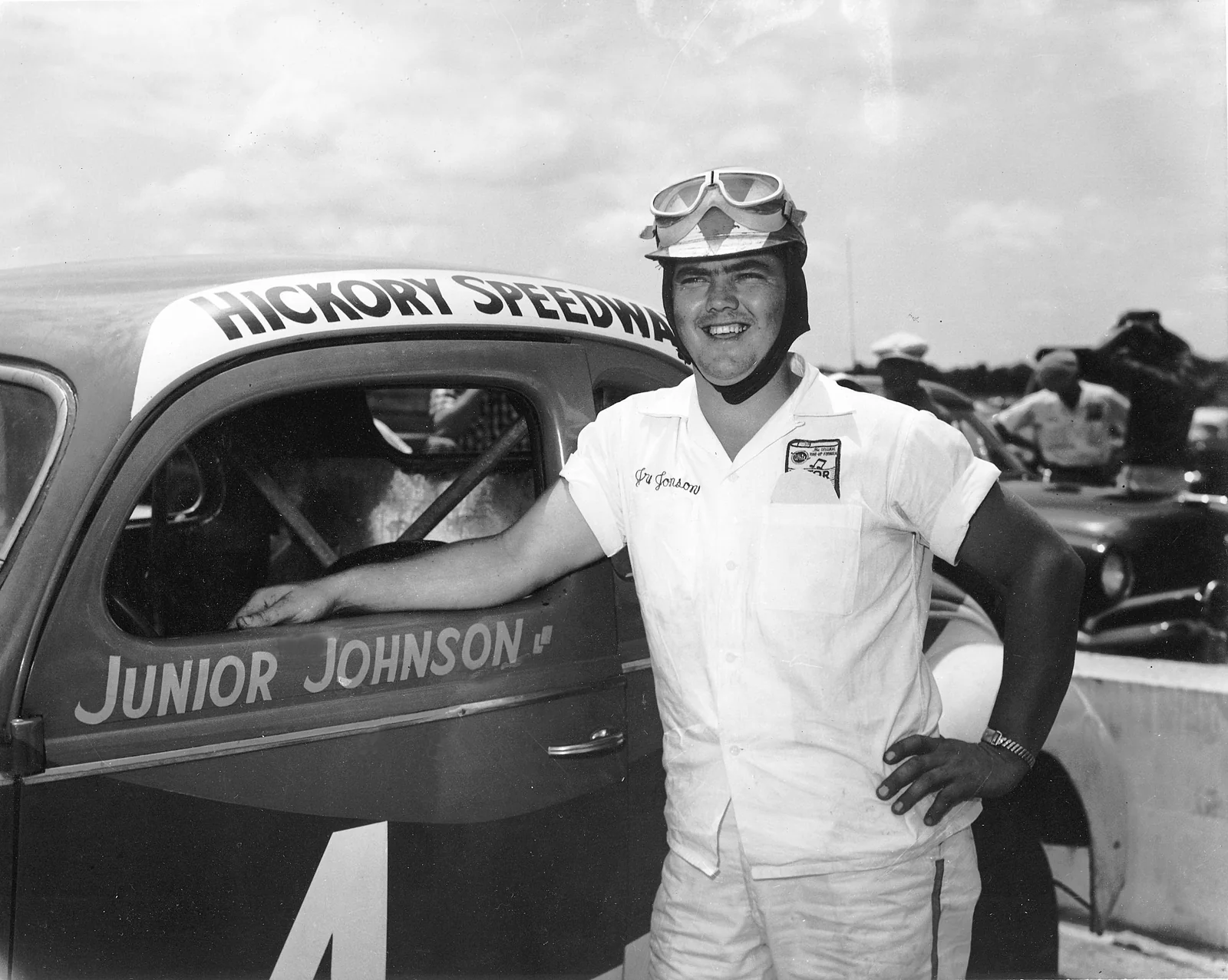
Junior Johnson is one of the clearest connections between NASCAR and the moonshine trade: a Wilkes County runner who became a 50-time winner in the sport's premier division, won the 1960 Daytona 500 and built teams that earned six championships. His importance reaches beyond the familiar chase-through-the-mountains story. He understood cars as a driver, mechanic and businessman.
The connection is real, but it needs careful telling. Johnson did not single-handedly create NASCAR, and a famous story about a fast road car is not the same evidence as an official race result. His career is most revealing when the machinery, local network and racing record are considered together.
How Junior Johnson connected moonshine country with NASCAR
Johnson came from a community where farming, mechanical work and the untaxed liquor business overlapped. Born in 1931, Robert Glenn Johnson Jr. grew up around Ronda and Ingle Hollow in North Carolina's Wilkes County. The family farm and the manufacture and transport of whiskey were part of that environment. Racing later gave his driving ability a public stage, but his familiarity with machinery began outside the speedway.
The word “moonshine” can obscure two related activities: producing illicit liquor and moving it to buyers. Johnson's story involves both the family business and the driving required to distribute its product. National Prohibition's repeal did not instantly end the trade. Taxes and local restrictions continued to create a market for untaxed alcohol, which helps explain why the moonshine connection remained relevant during NASCAR's early years.
This history also explains why a racing museum preserves more than winning cars. Johnson built a full-size whiskey still for the NASCAR Hall of Fame, where it became part of the account of the sport's early community. The artifact connects a famous competitor to the work and economy around him. It does not turn every entertaining escape story into a verified race statistic.
A regional network, not a single founding story
Wilkes County was one center of this culture, rather than the whole map. The Hall of Fame identifies Dawsonville, Georgia, with Raymond Parks; Virginia with Curtis Turner and Wendell Scott; and Alabama-to-Atlanta liquor running with Tim Flock. These connections involved owners and mechanics as well as drivers. Money, workshop knowledge and personal introductions could travel through the same network as the cars.
That broader network is the important explanation. The availability of capable drivers and well-developed machinery helped organized stock-car competition grow, but organizing a championship also required promoters, tracks, common rules and reliable administration. Johnson's later prominence should not move his premier-series debut backward into NASCAR's founding year. His first appearance in the top division came at Darlington in 1953.
The NASCAR origins guide covers the organization's founding dates. Johnson's individual story answers a different question: how a person formed by that regional economy could carry practical car knowledge into professional racing and eventually run a championship organization. It is a transition from one working environment to another, with new competitive demands, rather than a claim that a road runner automatically became a successful racer.
What made a moonshine car different?
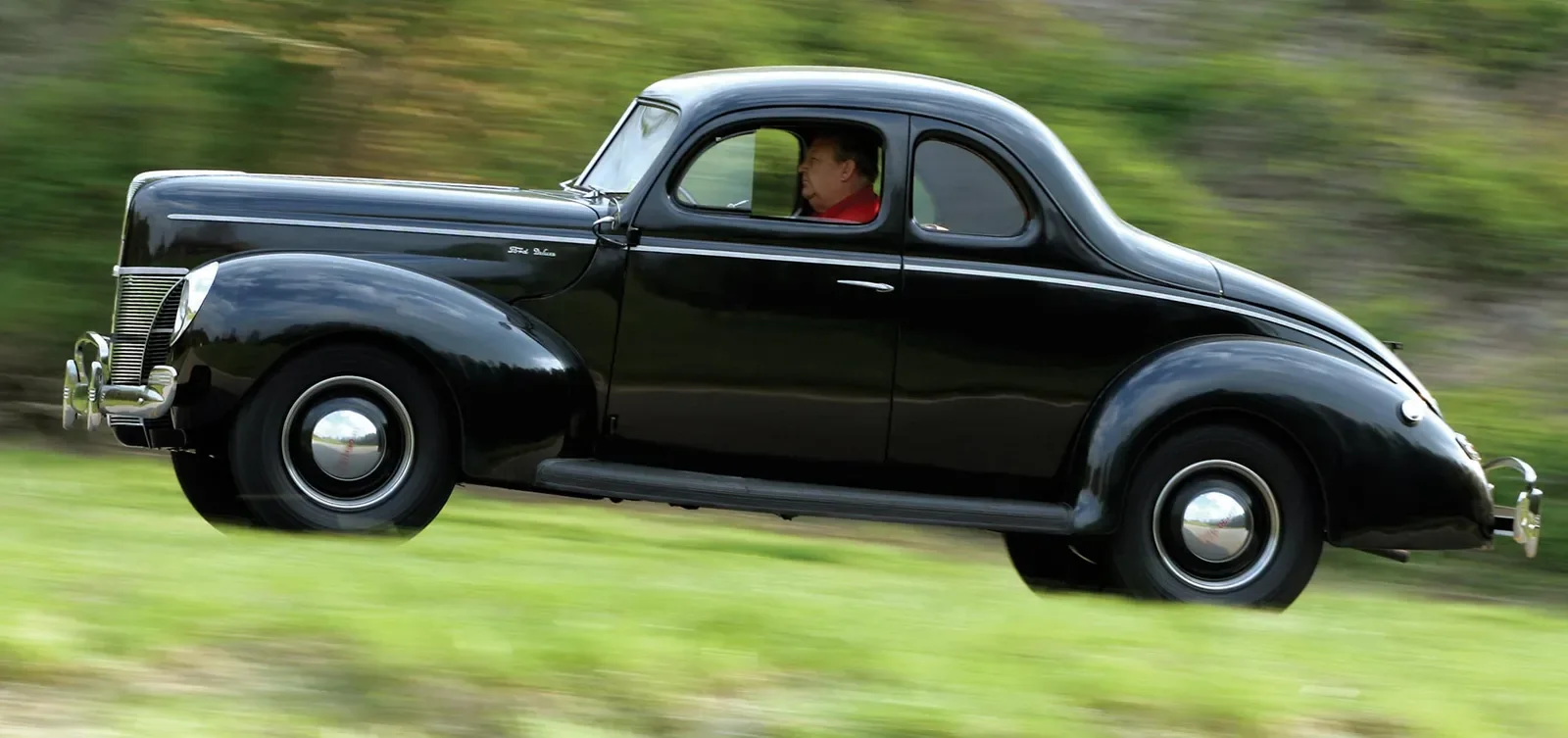
A moonshine car was a working vehicle built around a demanding combination: carry a substantial load, survive rough roads and avoid drawing attention. Horsepower mattered, but it was only one part of the problem. The mechanical choices become more understandable when the car is treated as a transport system rather than a glamorous hot rod.
Carrying a load without looking unusual
The NASCAR Hall of Fame describes stronger suspension components, engine modifications and removal of passenger seating to create cargo space. These changes served related purposes. Additional weight changed how the car sat and handled; fragile containers made ride control important; and extra capacity was useful only if the car could complete its journey. A convincing ordinary appearance helped the vehicle blend into everyday traffic.
The engineering implication is that preparation had to work with the load aboard. A car that felt quick when empty might behave very differently when laden. Springs, available space and durability were therefore as meaningful to its job as an impressive engine specification. This is an explanation of the design problem, not a claim that all runners used one standard package.
Engines, airflow and the limits of a good story
HOT ROD's interviews with Johnson and his friend Willie Clay Call give the machinery names. The collection described in its 2005 report included 1940 Fords, a 1966 Dodge Coronet with a 426 Hemi and a 1961 Chrysler New Yorker. These were Call's preserved working cars. They should not all be relabeled “Junior Johnson's cars” merely because Johnson appears in the same article.
The interviews describe extensive engine changes, while the Hall's account emphasizes Johnson's practical interest in airflow. He tested details that could reduce resistance, as well as making more power. The connection with racing is the habit of asking where performance was being lost and changing the machine to address it. His later superspeedway success would depend on recognizing another car's effect on the air.
Reported road speeds need a different standard of reading. A participant's recollection of an extraordinarily fast Chrysler is evidence of how he remembered the car, not a controlled test with documented timing, load and conditions. Repeating such a number as a verified engineering specification would give the story more precision than the record supports. The same caution applies to dramatic accounts of evasive maneuvers.
Stock-car racing also imposed rules that road-car modification did not. The skill of making a machine faster transferred; the freedom to change anything did not. That distinction helps explain why building a successful race car required a new discipline. The history of NASCAR car generations traces the later movement toward specialized competition machinery, far beyond an ordinary-looking road car carrying an unusual load.
The driver: short-track speed and the 1960 Daytona 500
Johnson's first NASCAR victory and his first premier-series victory are different milestones. The Hall of Fame documents his win in a Modified Division race at Darlington on July 4, 1953, driving a 1937 Ford coupe. His first win in the division now known as Cup came at Hickory on May 7, 1955. Keeping the series labels attached prevents the common mistake of treating 1955 as his first appearance in NASCAR of any kind.
His premier-series career ultimately covered 313 starts and 50 wins. The first full-scale winning season in 1955 brought five victories, while his biggest annual total was 13 in 1965. His final top-division starts came in 1966. Those dates describe a driver who was still capable of winning at a high rate near the end of his career, rather than someone whose ownership story began only after his speed disappeared.
The 1960 Daytona 500 is the pivotal race in his wider reputation. Johnson won in a year-old Chevrolet against favored Pontiacs. The story is remembered for his use of the draft: following another car allowed him to use the airflow differently and remain competitive when running alone did not offer the same speed. His achievement lay in recognizing a race-winning opportunity in the interaction between cars.
It is more accurate to describe him as a pioneer of drafting in NASCAR superspeedway racing than as the inventor of aerodynamics. Air resistance existed before Daytona, and following another vehicle was not a newly created physical law. What mattered was turning observation into effective racing. The advantage did not require his car to become the fastest independent machine in every circumstance; it required him to use the situation on the track.
That distinction remains useful to modern fans. Qualifying measures a particular performance over a prescribed lap or run. A race adds traffic, positioning, mechanical survival and changing opportunities. Johnson's Daytona success shows why the strongest solo-speed expectation need not identify the eventual winner. It also should not be retold as a modern bump-drafting lesson: the cars and techniques of 1960 deserve their own context.
Johnson never won the premier-series drivers' championship. That does not contradict his 50 victories. He did not contest complete schedules, and a championship required a different accumulation of results from winning selected races. The Cup all-time race winners reference places those victories in the individual race record. His later six titles belong to his work as an owner, where he built the organization that enabled other drivers to complete championship campaigns.
The owner: turning mechanical talent into championships
Johnson's ownership record makes his place in NASCAR history much larger than a driver's biography. Cars entered by his organization won 132 premier-series races and six championships. The transition was not a clean switch from never owning a car to becoming an owner on retirement: the Hall of Fame notes that 13 of those owner victories came with Johnson himself driving.
That overlap matters when reading career totals. Fifty driver wins plus 132 owner wins do not mean 182 separate races won. The same event can be counted in a driver's record and an owner's record because the two statistics identify different roles. The more revealing ownership achievement is the ability to put several other drivers into winning equipment over many years.
Cale Yarborough and Darrell Waltrip in the No. 11
Cale Yarborough delivered three consecutive championships in 1976, 1977 and 1978. Darrell Waltrip then won in 1981, 1982 and 1985. Yarborough won 45 races for Johnson from 1974 through 1980; Waltrip won 43 from 1981 through 1986. The No. 11 therefore represents two major championship partnerships rather than one driver's isolated period of success.
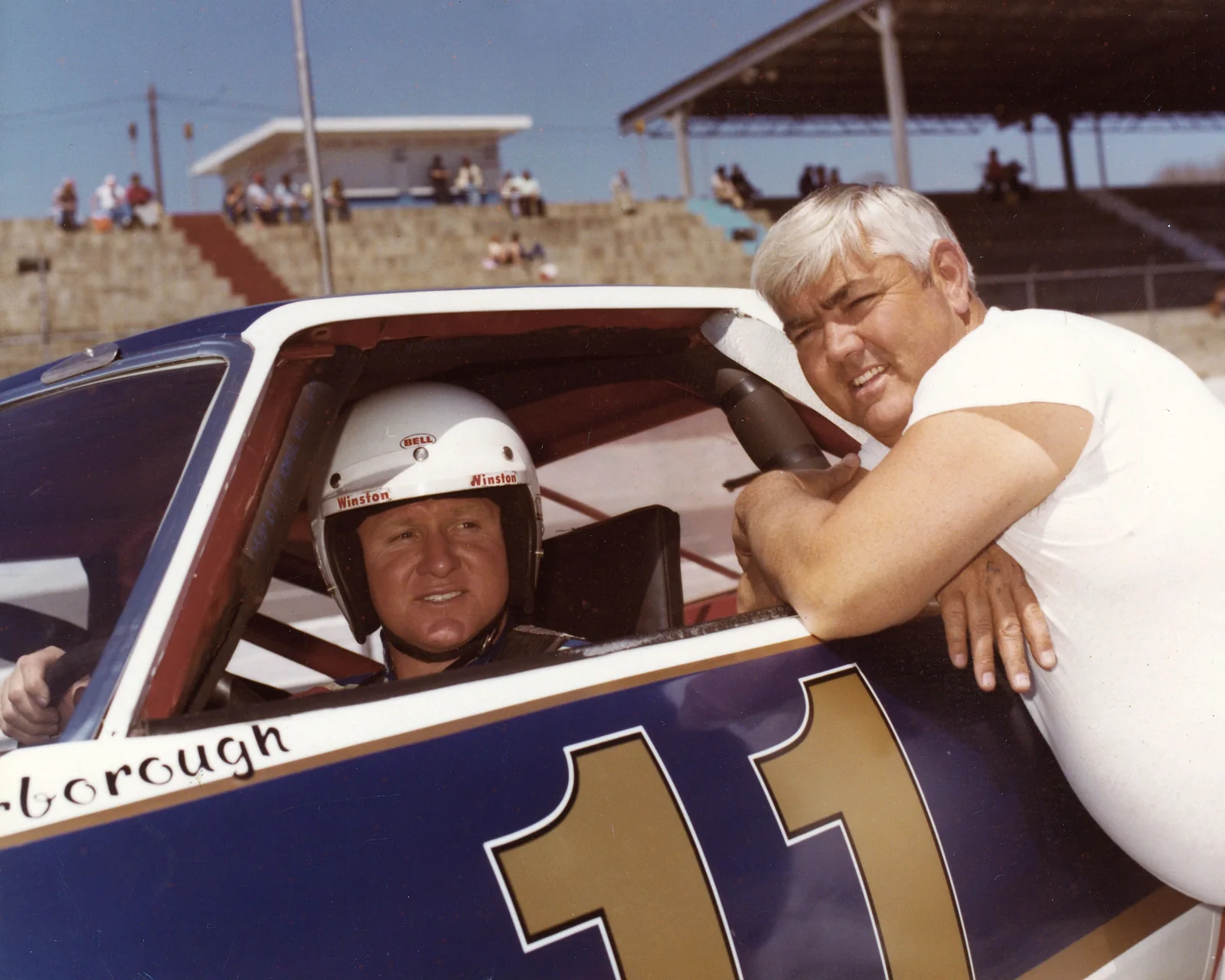
Winning with both men is evidence of organizational strength beyond one exceptional driver. An owner had to provide preparation, mechanical resources and a competitive working environment through changing seasons. Johnson also understood what drivers were trying to communicate because he had performed the job himself. Waltrip's recollections of their radio exchanges show an owner who could challenge a driver personally, rather than managing solely through a balance sheet.
Other winners in Johnson's cars included LeeRoy Yarbrough, Terry Labonte, Geoff Bodine and Bill Elliott. LeeRoy Yarbrough and Cale Yarborough are different drivers, a distinction that is easy to lose in a quick historical summary. The depth of the winning list is another reason to describe Johnson as a builder of racing careers, as well as a fast driver who later signed checks.
A business connection that reached beyond one team
Johnson also helped connect R.J. Reynolds with NASCAR as the tobacco company sought marketing opportunities around the 1971 television-advertising ban. He recognized that the company's available backing extended beyond what one team could use. The relationship became a series-wide sponsorship opportunity, linking his local business contacts to the broader championship.
The historical significance is the scale of that thinking. A team owner naturally needs sponsorship for his own cars, but a stronger series can support teams, prize funds and sustained competition across the calendar. Johnson's contribution here was commercial judgment rather than another adjustment to an engine or body panel. It belongs beside the mechanical stories because a race car cannot remain competitive without an organization able to keep developing and entering it.
His team won its final race with Elliott in the 1994 Southern 500, and Johnson sold the operation after 1995. The ownership career therefore carried his influence well beyond his last driving starts in 1966. The overall record combines engineering, judgment of people and the ability to maintain a racing business through several competitive periods.
What is fact and what is folklore in Junior Johnson's legacy?
Johnson's career attracted storytellers because it contained unusually strong material: a rural working background, illegal liquor, dramatic racing and later commercial success. Tom Wolfe's 1965 Esquire profile introduced that character to readers far beyond the speedway. The “Last American Hero” label became part of Johnson's public identity, and a later dramatized film helped carry the story into popular culture.
A memorable label is not a substitute for chronology. Johnson's driving victory in the Daytona 500 came in 1960. His six championships were earned as an owner. He was inducted into the NASCAR Hall of Fame's inaugural class in 2010 and died on December 20, 2019, aged 88. These are distinct, verifiable milestones; none requires embellishing a car chase to explain its significance.
Read the legend alongside the record
The familiar claim that authorities never caught him while hauling liquor is narrower than saying he never faced prosecution. He was convicted in 1956 after agents watched the family still. Accounts of his road-running reputation and the documented conviction can therefore coexist. A careful biography states where the arrest happened instead of turning a boast about driving into a claim of complete immunity from the law.
The same care applies to film, magazine writing and later brand storytelling. A dramatization can convey a setting or a public image while simplifying people and events. A liquor brand can accurately describe a partnership while naturally emphasizing its own heritage. Neither should silently replace a race classification or the historical distinction between Johnson's property and a friend's collection of cars.
His later legal connection with Piedmont Distillers adds another layer. It shows how an identity once tied to untaxed liquor became part of a legitimate consumer business. The still he built for the Hall serves a different purpose: preserving a working artifact so visitors can understand the early community behind the racing. Both developments make sense as later chapters, without implying the modern product and the original illicit trade operated under the same conditions.
The most useful way to carry this history into a current race is to look for the underlying problems: how a team finds performance, interprets a driver's feedback, manages equipment and keeps a competitive operation funded. The cars on the modern NASCAR schedule are far removed from a moonshine-hauling Ford, but those questions still help explain racing. Johnson's enduring importance is that he answered them in several roles, across several decades, with a record substantial enough to stand on its own.
About the author
NASCAR Schedule Editorial Team
The NASCAR Schedule editorial team turns verified schedules, timing and scoring, official announcements and race-weekend context into direct answers for fans.
View all articles by this author →Join the discussion
Comments
Sign in with Google to comment. Keep it race-focused; new comments are reviewed before publication.
Loading comments…