Why Was Kyle Larson Not Penalized at Talladega? The Yellow-Line Rule Explained
NASCAR judged Larson’s tire position legal at the October 25 Cup finish. Understand the corrected one-tire explanation, the other no-calls, and the evidence behind the debate.
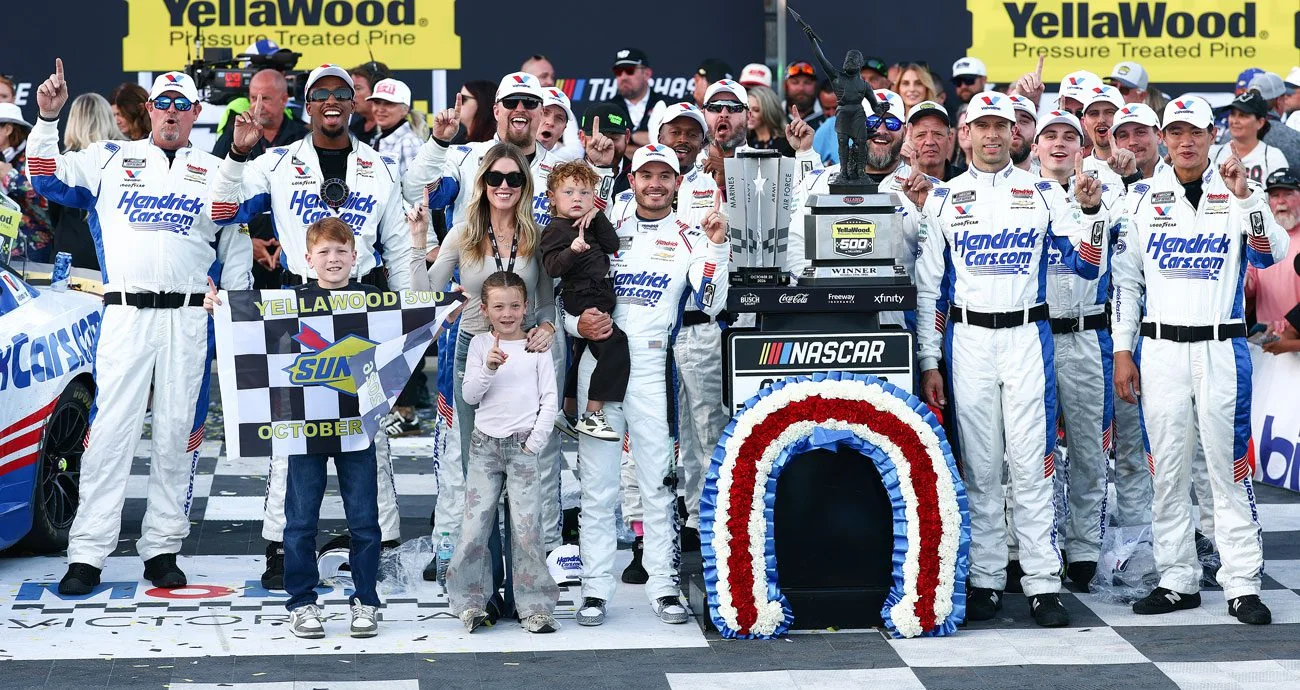
Kyle Larson was not penalized at Talladega because NASCAR judged that his tires remained on the yellow paint rather than moving completely below the inside boundary. Officials reviewed the October 25, 2026 NASCAR Cup Series finish and left his victory intact. The explanation was about tire position; it did not create an exemption for a popular driver or for the final lap.
That answer clears up Larson's result, but several related questions deserve their own explanation. Does one tire below the line count? Must a driver complete a pass? What happens when another car forces someone onto the apron? And why did Austin Hill, Ross Chastain and Carson Hocevar also avoid penalties? As of October 29, the useful way to read the controversy is to separate those decisions and follow the corrected reporting, rather than treat every low-lane move as the same incident.
Why NASCAR left Larson’s Talladega victory intact
NASCAR's explanation starts with a finding about where Larson's tires were. Mike Forde, NASCAR's vice president of racing communications, said officials reviewed the move and judged that the tire had not gone completely below the line. Larson therefore remained the winner of the YellaWood 500, ahead of Hendrick Motorsports teammate William Byron. The Cup Series results are the place to check the final classification; a disputed television frame does not replace that classification.
Touching the paint and clearing the paint are different
Under the interpretation Forde described, a tire overlapping the relevant yellow stripe is on the line. It must clear the stripe completely to be below it. That is a meaningful distinction for someone watching a low-lane run: a car can look unusually far inside without satisfying the threshold NASCAR says it applies. The double-painted boundary separates the racing surface from the apron, and the inside edge of that boundary is the reference.
A replay discussion therefore needs to identify the tire and the correct stripe before drawing a conclusion. The fender's edge is not the tire's edge. Nor does a driver's left-front tire tell the viewer everything about the left-rear tire at a different moment. Perspective, surrounding cars and the available angle can hide part of the contact area. Those are reasons to examine more footage, rather than reasons to invent a new allowance for a driver.
Forde illustrated the standard with a small amount of tire remaining on the paint. That example should not become a claim that NASCAR measured Larson's clearance to an exact fraction of an inch. The published explanation gives the judgment and its threshold. It does not supply a surveyed measurement that fans can reproduce from an ordinary photograph.
The one-tire correction did not change the result
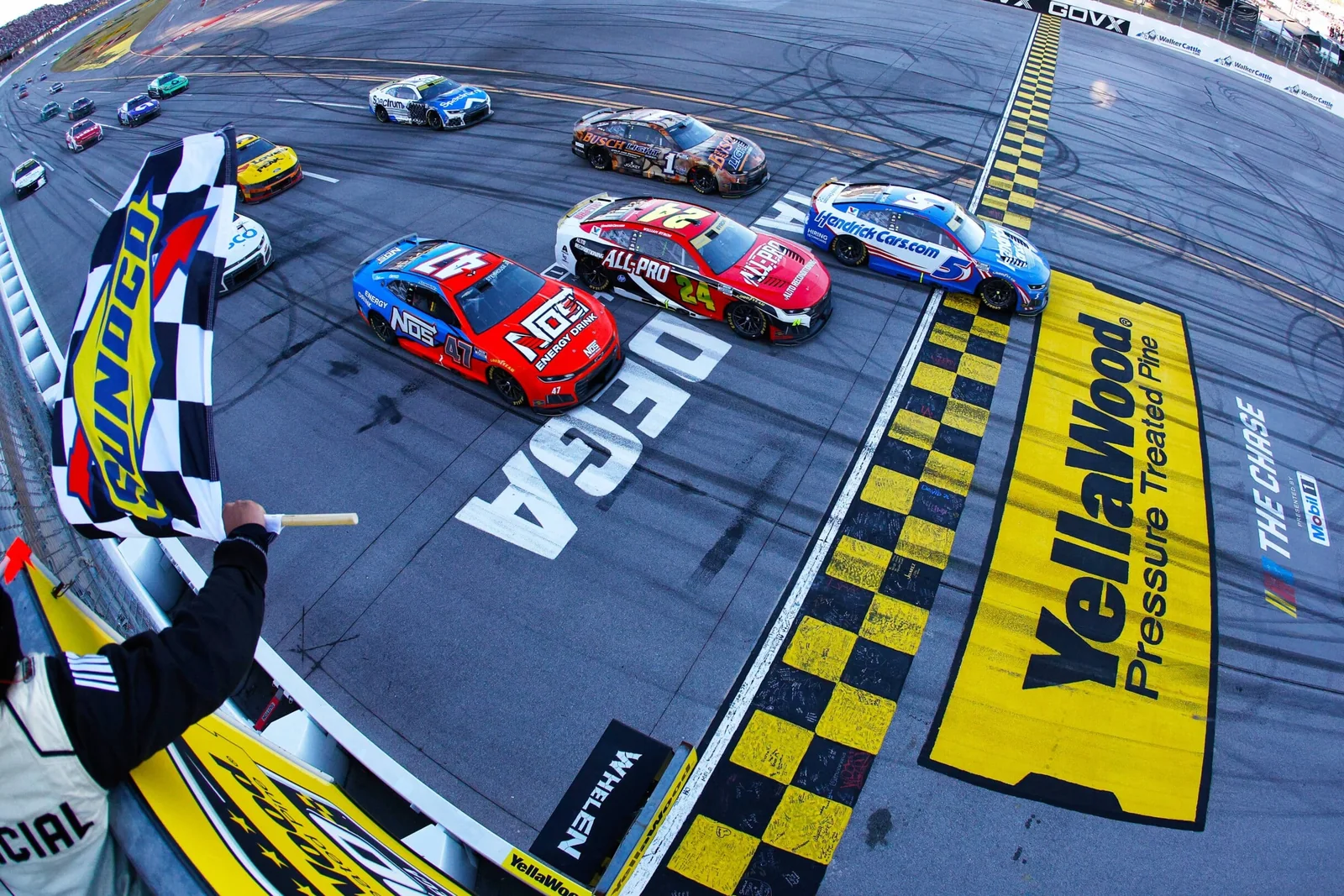
Reporter Jeff Gluck initially relayed an explanation suggesting both left-side tires had to be fully below the line. He subsequently corrected that account: one tire below could violate the rule, while NASCAR still judged that Larson had no tire below it. The correction matters. Fans should not repeat the earlier two-tire version as the current explanation, even when sharing an otherwise accurate account of the no-call.
It helps to separate the boundary question from the complete penalty question. Saying one tire can cross the boundary does not mean that every isolated moment below it automatically produces the same penalty, regardless of position gain or another car's actions. Those circumstances still need examination. The correction narrows the geometric explanation without erasing the rest of the rule.
The official outcome consequently stayed the same while the public wording improved. That can still leave a communication complaint: an explanation reaching fans in successive versions is harder to follow during a consequential finish. It does not, by itself, establish that officials changed Larson's result or that they invented an exception after seeing who won.
What a yellow-line penalty actually requires
The rule addresses passing below the double-painted boundary to improve position and also allows a penalty for forcing another vehicle below it to block a pass. Those are related provisions, but they examine different cars and different actions. A driver choosing the apron as a passing lane presents a different case from a driver being crowded there by a competitor.
- Establish whether a tire actually cleared the relevant yellow boundary.
- Examine whether the below-line move improved the car's position.
- Examine whether another car forced that driver down, and whether that other driver should face a blocking-related call.
That sequence is an explanation of the questions, rather than a claim that every crowded finish can be solved from a single frame. A camera may show a car on the apron clearly while leaving the preceding movement harder to see. It is particularly important not to reverse the forced-below provision: being forced down is part of why a passing driver can avoid a penalty, not an extra requirement that makes the passing driver guilty.
Gaining position does not require completing a clean pass
NASCAR's July 14 explanation of Bubba Wallace's EchoPark Speedway penalty is useful here. Officials said his below-line move improved his position, and attempting to return the gain did not erase the violation. Wallace's account of trying to avoid benefiting from the move was therefore different from NASCAR's assessment of what had actually happened.
The same explanation rejected a full-car-clearance test. A driver does not need to put his rear bumper ahead of the other car's front bumper before an improvement can count. Nor does every part of the advantage have to appear in a still frame taken while the car is below the paint. The movement and its eventual benefit need to be considered together.
For a viewer, this changes which part of a replay matters. Look at the relative order before the move, the route taken and the order afterward. A driver can use extra inside space to preserve momentum while another car has to follow the tighter traffic pattern above the boundary. Whether that happened in a particular case remains an officiating judgment; it should not be replaced with an assumption that overlapping cars cannot have improved their positions.
Likewise, a driver saying he did not intend to gain anything answers a different question from whether he gained something. The forced-below inquiry is about the surrounding circumstances and another car's movement. It should not become a blanket defense in which any unexpected outcome cancels a gain that officials have identified. Keeping those ideas separate makes the current explanation easier to follow.
The drafting guide explains why momentum and lane choice can change several positions in a few seconds. The yellow-line decision adds a boundary to that racing opportunity. It is also a specific superspeedway issue: a pit-exit blend-line call, a restart-zone decision or a road-course shortcut involves its own procedure. A replay showing paint is not enough to make all of those rules interchangeable.
Why Hill, Chastain and Hocevar received different explanations
The absence of yellow-line penalties did not mean NASCAR thought every car followed the same path legally. In the October 27 Hauler Talk discussion, Forde separated Larson's tire-position finding from Hill's finishing-position circumstances and the forced-below decisions involving Chastain and Hocevar. Reading those explanations individually is more useful than concluding that officials suspended the rule for everyone at the finish.
Austin Hill and the last car on the lead lap
Forde said NASCAR judged that Hill's No. 33 went down before being pushed during his move on Larson. Officials discussed the call, but Hill had already fallen to the last position among cars on the lead lap by the finish. A penalty placing him there would consequently have produced the same finishing position. The final results list Hill 14th, with 189 laps completed; the next finisher completed 188.
That is an explanation about the effect of a penalty, not a finding that Hill's movement was identical to Larson's. It also is not a general promise that losing places voluntarily cancels a violation. The specific account says Hill was already where this penalty would have placed him. Any broader rule allowing a driver to trade an infringement for a chosen result would need an explanation NASCAR has not supplied here.
Forde also discussed the hypothetical in which Hill had won, saying that would have required a consequential decision. The hypothetical helps explain why fans noticed the incident, but it should stay hypothetical. Hill did not win and then have the victory removed. Comparing that imagined outcome with Larson's actual win skips the different tire-position findings on which the two cases rested.
Being forced below and forcing someone below are separate calls
For Chastain and Hocevar, NASCAR judged that Todd Gilliland's No. 34 crowded them below the line. Officials therefore treated them as having been forced down. Gilliland was also reviewed, but Forde described the evidence of a move to block their pass as inconclusive. No penalty followed for him either.
The distinction lies in the blocking provision. It allows a penalty for forcing a rival below the boundary to stop a pass; it does not make a penalty on one car an automatic mathematical consequence of clearing another. Officials can be satisfied that a driver reacted to traffic without reaching the same level of certainty about the other driver's blocking action. Whether that degree of discretion is satisfactory is a fair policy question.
For a race fan, these are two separate pieces of evidence to look for. First, did the lower car choose the extra space or respond to a car moving toward it? Second, what did the higher car do as the pass developed? The frame that best answers the first question may not answer the second. A late snapshot is especially limited if it omits the movement that put both cars there.
That leaves room to challenge consistency without misdescribing the decision. A complaint that NASCAR should have made the Gilliland call more decisively addresses the actual judgment. Saying Chastain and Hocevar were cleared because every last-lap apron pass is legal does not. Their explanation was forced movement, while Larson's explanation was that the tire never went fully below.
Why the rule still applies on the final lap
There is no general final-lap exemption in NASCAR's published explanation. Its July 2026 account of Wallace's penalty concerned the final lap, and its review of the October Talladega finish examined potential violations rather than dismissing them because the checkered flag was close. A thrilling winning move still has to meet the applicable boundary.
Older finishes explain some of the frustration, but they also need their original context. In the October 2020 Talladega race, NASCAR distinguished evasive moves and drivers forced below the line from drivers penalized for crowding rivals down. That history shows why the circumstances matter. It does not prove that a photograph of one car, from a different season and angle, establishes what another car did six years later.
Removing the boundary would change the racing problem
NASCAR's stated reason for introducing the rule in 2001 was to stop the apron becoming an extra passing lane after incidents involving low moves and loss of control. In 2020, competition official Scott Miller defended retaining a boundary because cars spreading much wider would eventually need to return to the available racing surface. That is the policy argument officials have made, rather than a claim that the rule prevents every superspeedway crash.
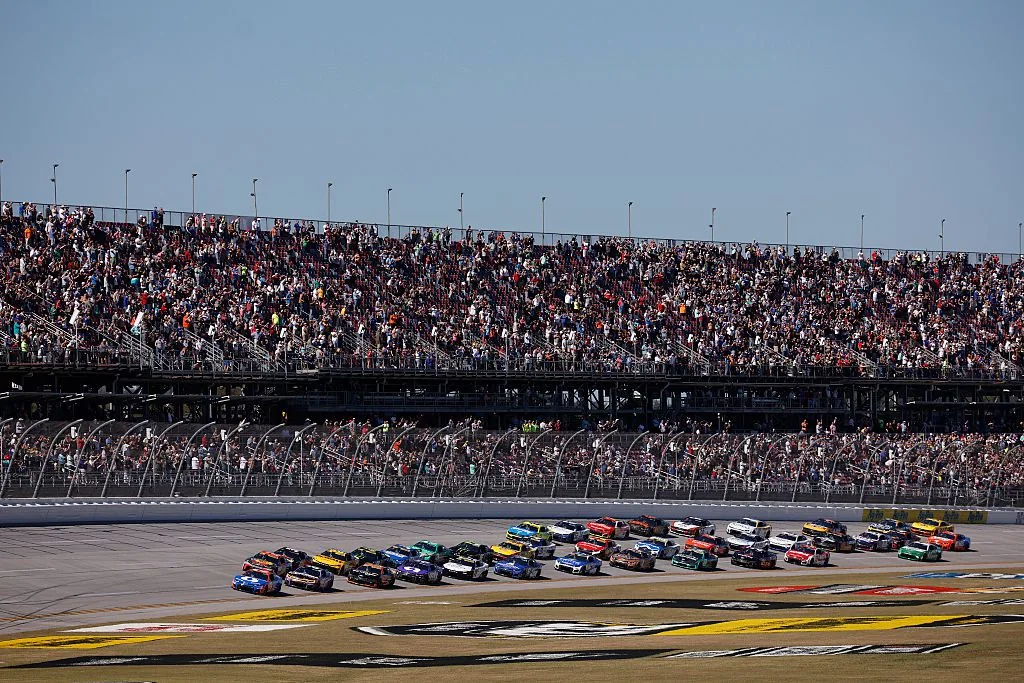
As racing analysis, removing that boundary would move the decision somewhere else. Drivers and spotters would need to judge how much apron they could use, when they could rejoin and whether another car should leave room. More asphalt being available in one part of a lap does not guarantee the same number of usable lanes at the next point. A change would therefore need a clear replacement standard, not just the instruction to stop looking at the paint.
Fans can reasonably prefer a different standard, clearer images or a smaller role for judgment. What this finish cannot establish is a reliable accident-rate comparison between racing with and without the rule. It also cannot authorize drivers to ignore it while it remains in use. For the other procedures that govern a finish, the NASCAR rules guide covers flags, overtime and penalties beyond this particular boundary dispute.
How to evaluate a disputed replay without mixing the questions
A useful replay review follows an interval, not just the most dramatic screenshot. Begin before the car moves down, follow it through the low section and continue until the relative positions become clear. Then compare that sequence with NASCAR's explanation for that particular car. This is a viewing method, not a claim that a fan has access to every angle available to race control.
Follow the tire, the position gain and the surrounding cars
First identify the car number and the moment. Hill's move against Larson out of Turn 2 and Larson's later charge toward the finish are different episodes within the same lap. A clip switching between them can make the discussion feel continuous while changing the driver whose actions are being assessed. Write down which car the proposed penalty would affect before deciding why it should be penalized.
Next give each piece of evidence the job it can actually perform. A close view may help locate a tire against the paint. A longer sequence may better explain whether a rival squeezed the available space or whether the move produced a gain. The final classification establishes where the cars were scored. None of those items automatically answers every other question.
Finally, account for what the view hides. Another car can cover the relevant tire, while a head-on image can compress the apparent gap between a body panel and the stripe. If the necessary part of the tire is invisible, describe the limitation. Replacing a missing view with an outline drawn around a fender adds certainty that the image itself may not support.
Better explanations can answer legitimate consistency complaints
The communication issue was real enough to prompt a public exchange. Hamlin criticized the officiating or its explanation, and Forde defended the officiating while acknowledging a communication problem. Fans in the correction threads likewise asked why the public account had moved from two tires to one. Those reactions identify a clarity problem; they do not measure the proportion of all fans who agreed.
Our editorial view is that a useful public explanation should attach the corrected standard to the incident it decided. Show the relevant sequence where available, identify which tire or movement matters, and say when uncertainty led to a no-call. That would make it easier to compare cases without asking readers to reconstruct a chain of posts and corrections themselves.
Keep the remaining debates separate. Manufacturer cooperation, championship incentives and minimum-speed enforcement have their own evidence and rules. They cannot establish a tire crossing by association. Larson's win remains in the record, the standings show its points context, and the race schedule shows what comes next. As of October 29, this finish supplies an officiating explanation to assess, not an announced repeal of the yellow-line rule.
About the author
NASCAR Schedule Editorial Team
The NASCAR Schedule editorial team turns verified schedules, timing and scoring, official announcements and race-weekend context into direct answers for fans.
View all articles by this author →Join the discussion
Comments
Sign in with Google to comment. Keep it race-focused; new comments are reviewed before publication.
Loading comments…